Yes — but only with a ball-end nylon set, and the one to buy is D'Addario's EJ34 Folk Nylon, because it is the only set of its kind whose maker publishes what the whole set pulls. Nothing breaks when you do this. The guitar gets quieter, the neck carries roughly half the load it was set up for, and the three fat nylon trebles will not drop into a steel-string's nut slots without filing.
If the reason you are asking is that steel strings hurt, this is the wrong fix and there is a better one two sections down. If the reason is that you want nylon tone out of the guitar you already own, read on: it works, with conditions, and the conditions are measurable.
Three different questions hide behind this one
People arrive at this question from three directions, and they need three different answers.
- "Steel strings hurt my fingertips." Nylon will help, and so will a cheaper, simpler change that keeps the guitar sounding like itself.
- "I want that classical sound." You can get partway there. A steel-string top is braced for about twice the load nylon applies, so it will never drive like a classical guitar.
- "I have a nylon set in a drawer." Check the ends before you do anything else. A tie-end set has no ball on it and cannot be fitted to a bridge-pin bridge at all.
The one requirement that is not negotiable: ball ends
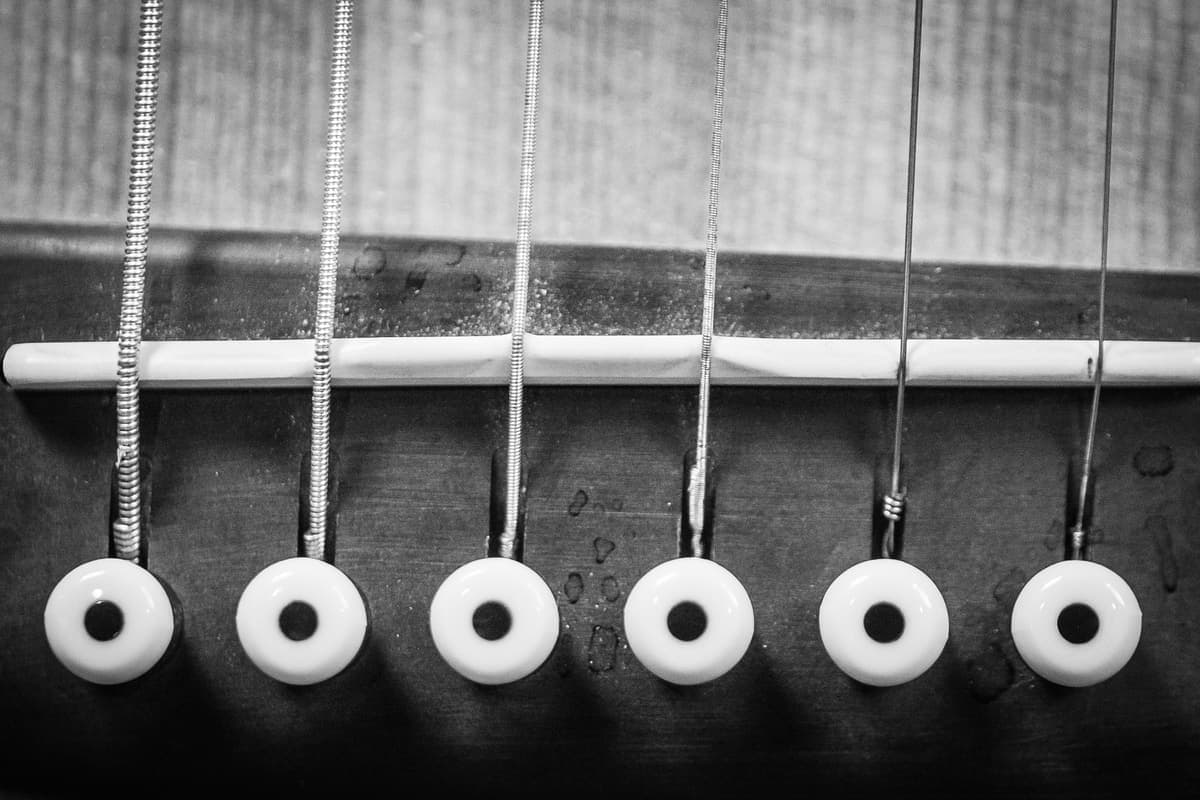
A steel-string acoustic anchors its strings with a brass ball dropped into a hole in the bridge and held by a pin. A classical guitar has no pins — the string is tied through a block. A standard nylon set is made for the second of those and there is nothing on the end of it to hold.
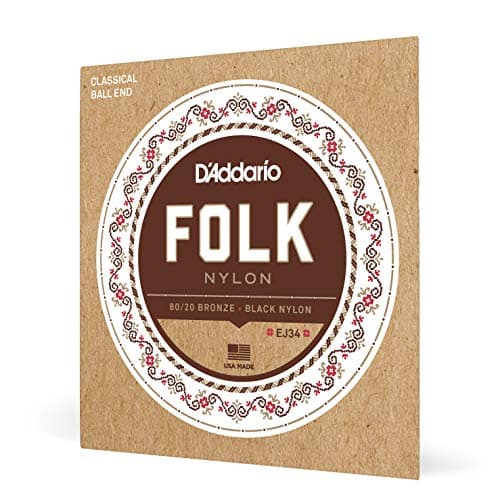
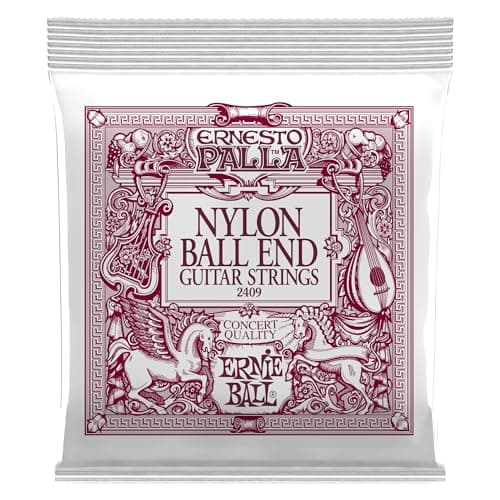
Ball-end nylon sets exist for exactly this. D'Addario's wording for the EJ34 is that the ball ends make them "compatible with other, non-classical acoustic guitars", and that Folk Nylons "bring the sweet sound of nylon to acoustic guitars with ball-end bridges". Ernie Ball sells the same idea as the Ernesto Palla ball end set and says ball ends mean "faster, easier installation over traditional tie-end strings".
Worth noticing exactly where each maker will say it. D'Addario's Folk Nylon category page describes the family as "Nylon strings for classical or steel string acoustics" — the only place in either maker's material where the phrase appears. The EJ34 product page itself never uses it; it describes the bridge instead. Ernie Ball files its ball-end set under classical guitar and makes no claim about any other instrument at all. One line on one category page is the high-water mark of manufacturer endorsement for this idea, and it is worth knowing that before you start filing a nut.
Which Folk Nylon set, because there are four
D'Addario publishes four sets in the family and they differ on two axes only: what the basses are wound with, and what color the trebles are. Nothing else about them changes, and the choice is genuinely small.
D'Addario's Folk Nylon family, all ball-end| Set | Bass wrap | Trebles |
|---|
| EJ34 | 80/20 bronze | Black nylon |
| EJ33 | 80/20 bronze | Clear nylon |
| EJ32 | Silver-plated copper | Black nylon |
| EJ32C | Silver-plated copper | Clear nylon |
Bronze is the brighter, more acoustic-sounding wrap and silver-plated copper is the traditional classical one, which is the same split covered on phosphor bronze vs 80/20 for steel sets. Clear and black nylon is a look rather than a specification — D'Addario publishes no difference in gauge or construction between the two. We feature the EJ34 because the bronze wrap suits a steel-string body and because it is the set D'Addario publishes a full tension chart for.
The number that decides everything else
D'Addario publishes tension per string for both sets involved, so this comparison is arithmetic rather than opinion. The EJ34 nylon set measures 16.8, 12.4, 11.9, 15.1, 16.5 and 15.2 lb. The EJ16 light phosphor bronze set — the default on a steel-string acoustic — measures 23.4, 23.3, 30.1, 29.9, 28.9 and 24.9 lb.
87.9 lb
What a ball-end nylon set pulls, against 160.5 lb for the light steel set it replaces
Both figures are D'Addario's own published per-string tensions, added up. The neck, the truss rod and the top of your guitar were all set up for the larger number.
Removing seventy-two pounds of pull from a neck is not dangerous. It is, however, a change the neck will respond to: less forward pull means the truss rod is now over-tightened for the load, the neck tends to straighten or back-bow, and the action drops until the strings start buzzing on the frets. The fix is a truss-rod adjustment in the loosening direction, which is the same procedure covered on fret buzz.
The second consequence is volume. An acoustic top is a driven membrane, and what drives it is string energy. Halve the tension and the guitar gets quieter — not broken, not damaged, just noticeably less loud than the instrument you are used to.
The part almost nobody mentions: the nut
Compare the published gauges rather than the feel. A light steel set has plain trebles of .012, .016 and .024 inches. The EJ34's trebles are .028, .032 and .040 inches. The Ernie Ball set is the same three numbers at the top.
Your top E string is about to be fatter than the wound G string that was there before. Nut slots are cut to the set a guitar ships with, so on most steel-strings the nylon trebles will sit high in slots that are too narrow, or refuse to seat at all. Widening those slots is a one-way job: once filed for nylon, the nut will not hold steel trebles properly again.
That is the real cost of this experiment, and it is a parts cost rather than a risk. A replacement nut is inexpensive; a nut filed wrong is a luthier visit. If you are not prepared to have the nut dealt with, you will get a set that plays sharp and rattles in the slots.
Published figures, like for like | EJ34 ball-end nylon | EJ16 light steel | EJ40 silk & steel |
|---|
| Treble gauges | .028 .032 .040 | .012 .016 .024 | .011 .014 .023 |
| Bass gauges | .031w .037w .045w | .032 .042 .053 | .028 .038 .047 |
| Total published tension | 87.9 lb | 160.5 lb | Not published |
| End type | Ball | Ball | Ball |
| Fits a bridge-pin bridge | Yes | Yes | Yes |
| Fits standard nut slots | No — trebles are far wider | Yes | Yes |
| Keeps the guitar's own voice | No | Yes | Mostly |
The reverse question is the dangerous one
Steel strings on a nylon-string guitar is the same question backwards, and it is the one with a published warning attached. Córdoba states it plainly: "We strongly advise against using steel strings on any nylon string guitar. Doing so will cause irreparable damage to the guitar's bridge, soundboard, neck and tuning machines, and will void the original warranty."
A classical guitar is built for loads in the region of the 87.9 lb figure above, and many have no truss rod at all. Put 160 lb on one and the top bellies, the bridge lifts and the neck moves. That is why the two directions of this question are not symmetrical: nylon on steel is a disappointment, steel on nylon is a repair bill.
What we did not doWe have not played any of this gear. Every guide in this category says it tested twenty tuners; we would rather say plainly that we tested none. What we did instead is on this page in full: published specifications with their sources, the makers' own manuals read rather than paraphrased, and a note wherever a company publishes nothing at all.
If the real problem is that it hurts
This is the most common reason people ask, and nylon is a heavy-handed solution to it. Two cheaper changes get most of the benefit and keep the guitar sounding like a steel-string.
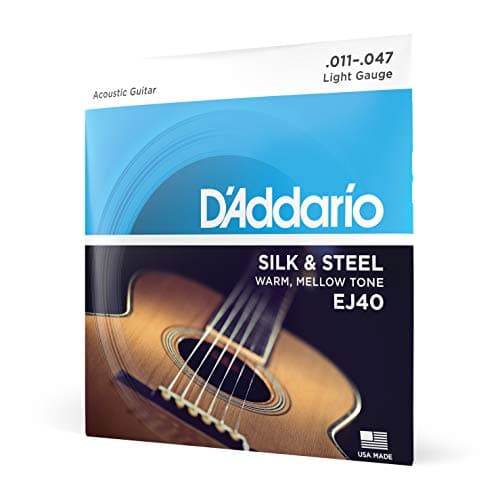
Silk and steel. A silk-wound set like the EJ40 lowers tension without changing the guitar's basic voice, and it fits the nut you already have. The catch is that almost nobody in the category publishes a tension figure for them — silk and steel strings is about exactly that gap.
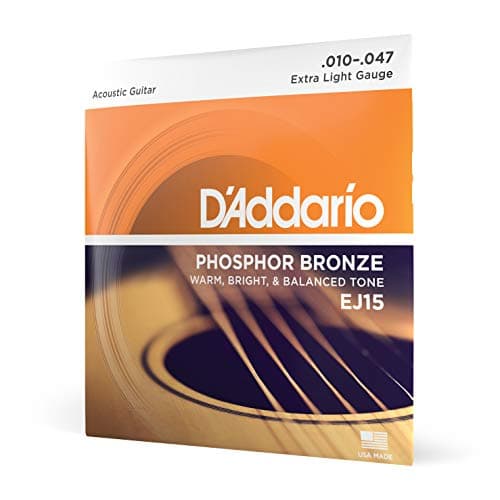
Extra-light steel. The EJ15 set drops to .010–.047 and takes real effort out of every chord for the price of a normal set. The ranking of what actually reduces fretting force is on the easiest strings to play, and if the guitar is fighting you, action that is too high is more often the cause than the strings are.
And if what you want is a nylon-string guitar, the honest answer is that a nylon-string guitar costs less than a nut replacement plus a setup plus a season of disappointment. Our nylon strings for a first classical guitar page covers that side of it.
What the first two weeks look like
Nylon behaves nothing like steel when it is new, and the difference catches people out badly enough that some give up in the first evening. This section is our own description rather than a maker claim, and it is the part no product page tells you.
A new nylon set will not hold pitch. Not for hours, and in practice not for several days — the material stretches far more than steel does, so you tune, play a chord, and it is flat again. That is normal and it is temporary. The standard way through it is to tune the guitar up a few times a day, stretching each string gently as described on how to restring a classical guitar, and to expect two or three days before the set settles.
While that is happening the neck is settling too. Seventy-two pounds of pull has come off it, and necks do not respond instantly. Give it a couple of days at the new tension before judging the action or touching a truss rod, because what the guitar does on day one is not what it will be doing on day four. If the action has dropped and strings are buzzing on the frets after that, fret buzz has the measuring method and the published relief figures to check against.
One thing that will not resolve with time is intonation. A nut cut for .012 that is now carrying .028 holds the string higher than it should at the first fret, which pulls notes sharp low on the neck — guitar intonation explains how to confirm that is what you are hearing. If it is, the nut needs cutting properly rather than waiting out.
If you are going ahead anyway
- Buy a ball-end set. Check the packet says so; the cheapest nylon sets in any shop are tie-end.
- Expect to have the nut slots opened, or to fit a second nut you can swap back.
- Plan a truss-rod adjustment a day or two later, once the neck has settled at the lower load.
- Give nylon a week before you judge the tuning. Nylon stretches far more than steel and will not hold pitch at first — that is normal and not a fault.
- Keep the old steel set. Going back is straightforward if the nut was not filed.
What we would actually buy
For nylon on a ball-end bridge, the EJ34: it is the only set here whose maker publishes a tension figure, which is the whole argument of this page. For the cheapest way to try the idea, the Ernie Ball Ernesto Palla ball end set, accepting that "medium" is all the tension information you get. For the much commoner problem of a steel-string that hurts, the EJ40 silk and steel set, or the EJ15 extra lights.