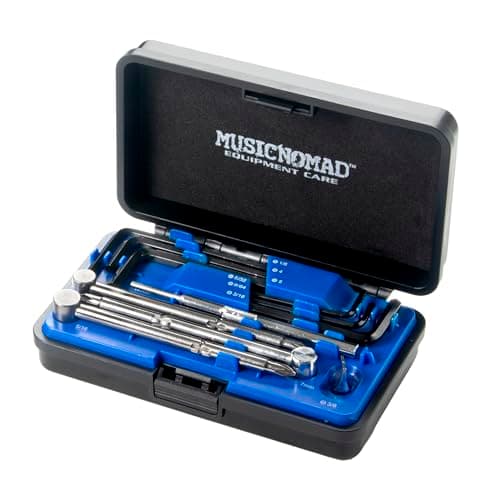
A setup is not a repair. It is a set of adjustments — neck relief, string height at the nut and saddle, intonation, sometimes pickup height — that bring a guitar to a comfortable, in-tune state. A technician does it in under an hour.
A large share of beginner guitars have never had one, because factory setups are done fast and to a tolerance, and the instrument has since traveled halfway around the world through several climates.
Check 1 — is it hard to press the strings down?
Play an open chord, then the same shape at the fifth fret, then a barre chord at the fifth. If the effort rises sharply as you go up the neck, the action is probably high.
A useful comparison: play a guitar in a shop. If a similar instrument there feels dramatically easier, that difference is setup, not price.
Check 2 — the neck relief check
Hold the low E string down at the first fret and at the fourteenth at the same time (a capo helps for the first). Look at the gap between the string and the top of the seventh or eighth fret.
- A very small gap — roughly the thickness of a sheet of paper — is correct.
- A large, obvious gap means too much forward bow. The action will be high everywhere.
- No gap, or the string resting on the fret means the neck is flat or back-bowed. Expect buzzing in the lower positions.
Either extreme is a truss-rod matter, and a truss rod is not a beginner adjustment. This check tells you whether to book a setup, not what to turn.
Check 3 — buzzing
Play every note on every string, one fret at a time, listening for buzz. What you find tells you different things:
- Buzzing everywhere — action too low, or neck back-bowed.
- Buzzing only in the first few frets — nut slots too low, or not enough relief.
- Buzzing at one or two specific frets on one string — usually a high fret. That is fret work, not a setup, and it is a different conversation with a technician.
Check 4 — intonation
Tune the guitar carefully. Then, on each string, compare the harmonic at the twelfth fret against the fretted note at the twelfth fret. They should read the same on a tuner.
- Fretted note sharp — the saddle needs to move back, away from the neck.
- Fretted note flat — the saddle needs to move forward.
On an electric with individual saddles this is adjustable with a screwdriver. On an acoustic with a single compensated saddle it is a shaping job for a technician. Either way, a guitar that is in tune open and sour at the twelfth fret is a setup problem, not a tuning problem.
That check is the short version. Guitar intonation is the long one: the procedure Fender publishes, the alternative Peterson publishes and prefers, what to do before you measure anything, and how fine an adjustment you are actually making.
Check 5 — the first-fret test
Press each string down at the third fret and look at the gap between the string and the first fret. It should be very small — barely visible.
A large gap means the nut slots are cut too high, which is the single most common comfort problem on inexpensive guitars. It makes the first three frets feel stiff and pushes notes sharp when you press hard, because you are stretching the string further to reach the fret.
Nut slots are filed to depth. It is skilled, it is not reversible, and it is exactly the job to pay someone for.
5
Checks that take ten minutes and decide whether to book a setup
None of them requires a tool you do not already own except a tuner, and four of them require nothing at all.
What the symptom usually means| Symptom | Likely cause | Beginner job? |
|---|
| Hard to press anywhere | High action / too much relief | No |
| Hard to press in the first three frets | Nut slots too high | No |
| Buzz everywhere | Action too low / back bow | No |
| Buzz at one fret on one string | High fret | No — fret work |
| In tune open, sour at the 12th | Intonation | On an electric, with care |
| Sharp fret ends | Fingerboard shrinkage from dry air | No |
| One string will not hold pitch | Bad winding at the post | Yes — restring it |
What a setup does not fix
It does not fix a warped or twisted neck, a lifting bridge, a cracked top, or badly seated frets. Those are repairs. It also does not fix technique — if only barre chords are hard, that may simply be barre chords being hard.
Every check above is a judgment made by feel, and each one becomes a number the moment you own a gauge. An action gauge costs less than a set of strings and turns this checklist into something you can hand to a technician.
What we did not doWe have not played any of this gear. Every guide in this category says it tested twenty tuners; we would rather say plainly that we tested none. What we did instead is on this page in full: published specifications with their sources, the makers' own manuals read rather than paraphrased, and a note wherever a company publishes nothing at all.
Is it worth it?
On a cheap guitar that is uncomfortable, a setup is the highest-value money you can spend on the instrument — usually less than a set of coated strings and a capo, and it changes how the guitar feels permanently.
Ask what they changed. That conversation is how you learn to do the safe parts yourself later, and the setup kits roundup covers the tools if you decide to.