Nylon strings for a first classical guitar ends by calling this "the fiddliest version of the job" and sending you to watch someone do it. That was honest, and it left a gap: the tie-on knot is the part specific to this instrument, and it is the part nobody writes down carefully.
So this page is the written version, built from what guitar makers actually publish — Taylor, Alhambra and Córdoba — plus two respected classical teaching sites. Where they disagree, and they do, the page says so rather than picking a winner.
Before you start: the two things that cause damage
Never fit steel strings. Córdoba publishes the clearest warning of any maker we found: it "strongly advises against using steel strings on any nylon string guitar", because doing so "will cause irreparable damage to the guitar's bridge, soundboard, neck and tuning machines, and will void the original warranty".
Never cut a string under tension. Alhambra publishes it as a rule: "Never cut strings under tension—always loosen them first to avoid damage or injury."
85.8 lb
Total pull of a normal-tension classical set, added up from D'Addario's published per-string figures
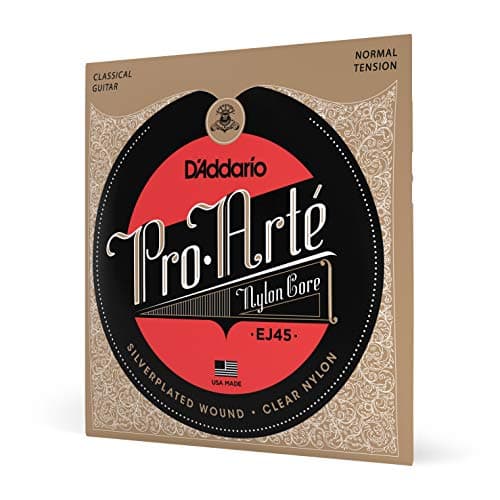
D'Addario publishes 16.2, 12.0, 11.9, 15.6, 15.9 and 14.2 pounds for the six strings of its Pro-Arte EJ45. The sum is ours, not theirs — but it shows why the saddle stays put only while strings hold it down.
What to have on the table first
A nylon set, matched to your guitar. Normal tension is the default and what most classical guitars ship with — nylon strings for beginners explains why nylon sets are sold by tension class rather than gauge.
Snips, and something soft for the top. A cloth or a sticky note behind the bridge, per Taylor and Alhambra, plus wire cutters for the ends once everything is at pitch.
A tuner you can leave clipped on. You will retune this instrument many times over the next few days, so a clip-on that stays put earns its place — the acoustic tuner roundup covers what the makers publish for accuracy.
Time. Not the twenty minutes a steel-string change takes: a first tie block is slow, and the strings keep moving afterwards.
One string at a time, and why
Two makers and one teacher publish the same instruction for different reasons, and the practical one is the most persuasive.
Alhambra: "Change one string at a time. This keeps tension on the neck and helps you remember how each string is tied." It also publishes an order that balances the pull — sixth, third, fifth, second, fourth, first.
Bradford Werner, of This is Classical Guitar, adds the reason you will care about at the moment it happens: if you take all the strings off, you cannot copy how they were tied, and the saddle is held in place by the strings, so it can fall out.
Classical Guitar Corner is the dissenting voice, and honest about it: some luthiers insist on one at a time, others say removing them all is not an undue stress. Its own compromise is to do the three trebles, then the three basses.
Step 1: protect the soundboard
The top of a classical guitar sits directly behind the bridge, and a loose string end whips straight at it. Taylor suggests putting a Post-it note on the top behind the bridge before you start; Alhambra says to protect the top with a cloth or thick paper. Both are one second of work against a permanent mark.
Step 2: the tie block, which is the whole difficulty
There are no bridge pins. The string passes through a hole in the tie block and is secured by wrapping its own tail under itself, so tension locks the knot.
How many wraps. Taylor publishes: "The strings should twist around themselves twice (three times for treble strings)". Classical Guitar Corner publishes the same asymmetry from the other end — trebles get two to three wraps in a figure-eight so they lie flat, while for the wound basses "one wrap is usually sufficient".
Where the tail must end up. This is the part that protects your guitar. Taylor: "the final loop must pass below the corner of the back of the bridge so that the strings remain secure and in tune". Classical Guitar Corner puts the consequence plainly — keep the tail off the top and the back corner so that if the knot slips, it cannot ding the soundboard.
Leave the right amount of slack. Taylor: leave enough loose at the bridge "to go just past the next hole after you pull it tight", because the next string wraps over that end and holds it.
Step 3: the slotted headstock
The other end is a roller in a slot, not a post, and the string is locked by bending it back on itself rather than by a machine head clamp.
Lock it first. Taylor: pass the string through the hole so the end points toward the body, hold a little tension, and pull the loop tight against the roller — "The bend should be in the top of the tuner hole to lock the string in position." Classical Guitar Corner adds a belt-and-braces option: pass the string through the same hole a second time before wrapping.
How many wraps. Taylor publishes a ceiling: "For best tuning, use a maximum of 4-6 wraps, and then snip the excess string end."
Which way to wind — and here the makers disagree. Taylor says to wind toward the outside of the rollers, over the tail of the string. Alhambra splits it: "For bass strings, wind toward the outside of the headstock; for trebles, wind toward the inside." Classical Guitar Corner goes further still and specifies per string, inside for the first E and outside for the B and G.
We are not going to pretend one of those is correct. What all three agree on is the thing that matters: the wraps should be neat, should not rub the edges of the slot, and the tail should point away from the wraps.
Step 4: bringing it up to pitch, and waiting
Nylon stretches far more than steel, and every source publishes some version of "this takes days".
Alhambra: "Nylon strings can take anywhere from a few hours to several days to stretch and stabilize. Frequent tuning during the first days is normal."
Classical Guitar Corner suggests opening the case every hour or two over the first couple of days and tuning back to pitch, or slightly sharp of it.
On hand-stretching, the makers split. Taylor is for it: after changing strings, "use your thumbs and forefingers to gently stretch each string across its entire length", then retune and repeat two or three times. Alhambra agrees. La Bella publishes the opposite instruction — do not tug or stretch strings, because you risk breaking one, and a few hours of playing breaks them in — though note that answer is given about its bass strings rather than classical sets. If you do stretch, do it gently, and expect the tie block to take up slack as well.
The tools, and the one compatibility trap
A classical guitar has no bridge pins, so the most-sold restringing tool on the market is carrying a feature you will never use — and, more importantly, its maker does not say whether the winder end fits your tuners at all.
D'Addario's Pro-Winder is described as fitting "virtually all guitars, banjos, ukuleles, and mandolins", with a bridge-pin puller "for use with acoustic instruments". The words classical, nylon and slotted do not appear on the page.
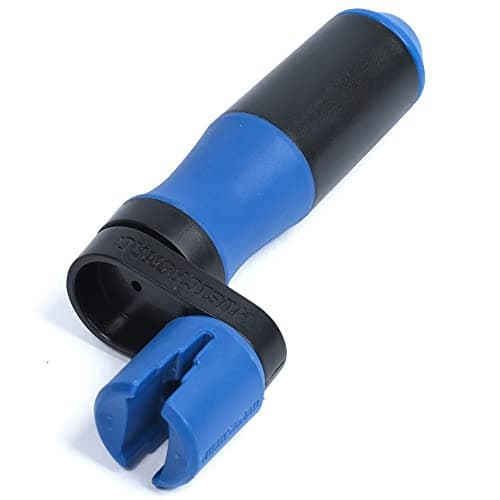
MusicNomad's GRIP Winder answers the question directly in its own FAQ: "Does it fit classical guitar pegs? Yes, it fits most all standard type classical tuning machines", and it publishes the socket size, 9 mm. That published answer is the reason it leads this page.
The other useful tool is something to hold the neck steady. The string winder roundup covers winders in general; the two supports below differ in approach rather than quality.
The picks
MusicNomad GRIP Winder — the winder that fits classical tuners
The only winder here whose maker publishes a classical answer, along with a 9 mm socket, a carbon steel shaft, a rubber lining and dual bearings so it spins smoothly.
Against it: MusicNomad says "classical tuning machines" rather than naming slotted headstocks, so unusual tuners are still worth measuring. It has no cutter, so you need snips as well. And it costs more than the generic three-in-one tools.
D'Addario Pro-Arte EJ45 — best first nylon set
Normal tension, clear nylon trebles sorted by diameter and silver-plated copper basses, from the maker that publishes a per-string tension figure for every string in the set. For a first classical restring, a normal-tension set is the safe default.
Against it: D'Addario publishes the tensions without the scale length they assume, and publishes no gauges at all for this set.
Savarez 540R — best carbon treble alternative
Alliance fluorocarbon trebles rather than clear nylon, which Savarez describes as thinner with a clear sound that holds up in high positions, over nylon-wound basses.
Against it: Savarez publishes its tension only as a category — "normal tension" — with no figures, so you cannot compare it numerically with the D'Addario set. The brochure it links is an image with no readable text.
D'Addario Headstand — best neck support for a case
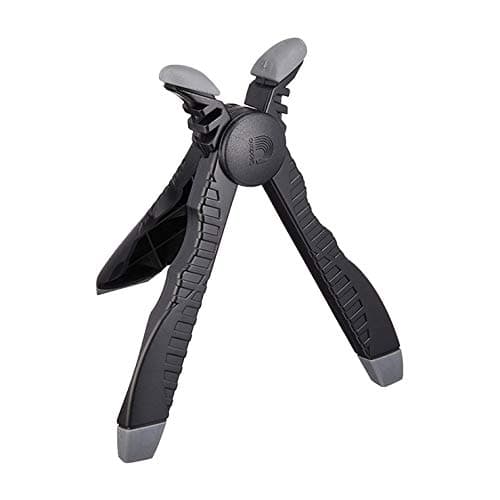
Folds to 5.25 by 1.18 inches, stands at 5 by 4.25, with over-molded contact points published as finish-safe. Both dimensions published, which is what tells you it fits your case pocket.
Against it: it supports the headstock rather than cradling the neck, the material is not published beyond the contact points, and D'Addario excludes banjos and mandolins.
MusicNomad Cradle Cube — best bench neck support
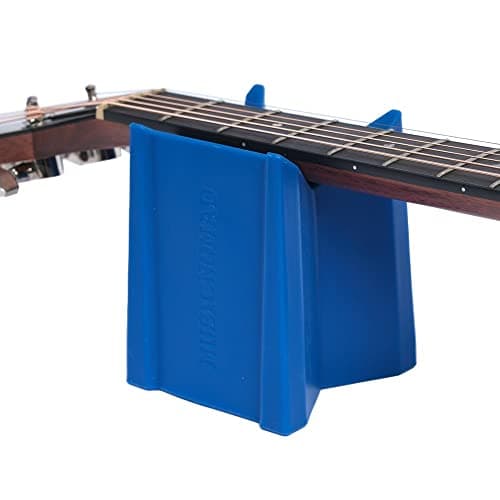
A soft gel block with five published heights and angles, stated safe on all finishes, which supports the neck from either side while you work.
Against it: no dimensions published, classical guitars are not on MusicNomad's own list of instruments for it, and a rolled towel does the same job for nothing.
How often to do all this
Alhambra: every one to three months for regular players, twice a year for beginners, and always when they sound dull or feel rough.
Bradford Werner: beginners can replace strings twice a year; advanced players change before each concert, or as often as they can afford.
D'Addario, writing about strings in general, puts the range honestly: some people change strings daily and others once a career, and a good bet is once a month or two. How often to change strings works through the variables.
What this job is not
It is not a steel-string change. How to change guitar strings covers bridge pins, ball ends and the tools that suit them. Almost none of that transfers.
It is not a setup. If the guitar buzzed before the restring it will buzz after it — that is relief, action or a fret, and the fret buzz page covers measuring it.
It is not a fix for a slipping knot. If a string keeps pulling through the tie block, add a wrap and make sure the tail is trapped under the following string rather than tightening everything harder.
What we would actually buy
For a first classical restring: a normal-tension set — the EJ45 is the reference — and the MusicNomad GRIP Winder, because its maker is the only one that publishes a classical fit. Add a neck support if you work at a table: the D'Addario Headstand if it needs to live in the case, the Cradle Cube if it lives on the bench. Snips you probably already own, and a cloth for the soundboard costs nothing.
What we did not doWe have not played any of this gear. Every guide in this category says it tested twenty tuners; we would rather say plainly that we tested none. What we did instead is on this page in full: published specifications with their sources, the makers' own manuals read rather than paraphrased, and a note wherever a company publishes nothing at all.