"My guitar is hard to play" is the most common complaint in a beginner's first three months, and lighter strings are the most common thing sold to fix it. Sometimes that is the right answer. Frequently it is not, and the reason matters enough to put before the picks.
Check this before you buy anything
The force it takes to fret a note is the string tension multiplied by how far you have to push the string down. Strings control the first number. Action controls the second, and it varies far more between guitars than string gauge does.
A guitar with action set high needs more force on every note, on every string, at every gauge. Fitting lighter strings on it makes a measurable but small improvement to a problem that a setup would mostly remove. That is why people fit extra-light strings, feel a little better, and still find barre chords impossible.
Five checks, ten minutes, no tools: does my guitar need a setup. If you want the number rather than the feeling, an action gauge costs less than a set of strings and turns "this feels high" into something you can compare against a specification.
If the action is fine and it is still hard, keep reading. This page is then the right one.
The criteria, in the order they decide it
1. Published gauge — the number everyone prints
Gauge is the thickness of the thinnest string in thousandths of an inch, and every maker prints the full set. Thinner strings need less tension to reach pitch, and less tension is less force under your fingers. On acoustic, a light set is usually .012 to .053 and an extra-light is .010 to .047. On electric, nines are .009 to .042 and tens are .010 to .046.
2. Published tension — the number almost nobody prints
Tension in pounds is what gauge is a proxy for, and it is the figure that would let you compare sets properly. D'Addario publishes per-string tension across its phosphor bronze range — the light EJ16 totals 160.5 lb across six strings — and is the only major brand in our coverage that publishes it at all.
Elixir, Ernie Ball and Savarez publish gauges only. So does D'Addario for its own silk and steel set, as that page found. Ranking on published tension is therefore a very short list, which is exactly why it decides the top spot here.
160.5 lb
Total published tension of a light D'Addario acoustic set, across six strings
It is useful because it is comparable. Almost no other brand gives you anything to compare it with, which is the real state of this category.
3. Construction, which changes feel at the same gauge
Two sets at identical gauges do not have to feel identical. A silk and steel set wraps a silk layer under the winding, which lowers tension at a given gauge and softens the feel — a real mechanism, sold entirely without published figures. A coating adds a slick film that makes the strings easier to slide along, which reduces friction rather than force.
4. What you give up
Lighter and softer both cost you something, and a page that pretends otherwise is not helping. Lighter strings drive an acoustic top less hard, so the guitar is quieter and thinner-sounding. They also buzz more readily on a guitar with low action, and they go out of tune more easily under a heavy hand.
The picks
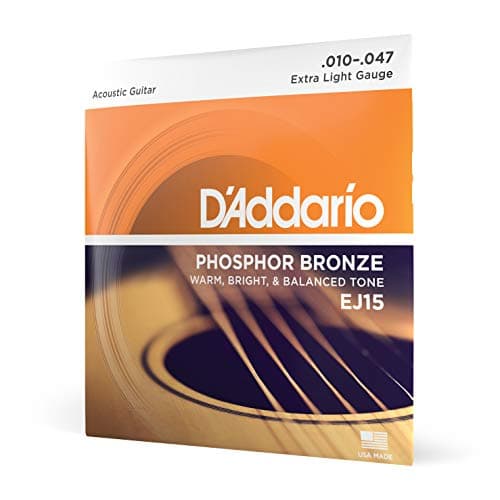
D'Addario EJ15 extra light, 10–47 — lightest with published tension
The honest first answer for an acoustic that is hard to press. At .010 to .047 it is the thinnest first string of anything here, and D'Addario publishes per-string tension across the range it belongs to — so the claim that it takes less force is checkable rather than asserted.
It is also the set we recommend on the silk and steel page for the same buyer, for the same reason: nothing in the silk-and-steel category is actually lighter at the top, and none of it publishes a number.
Against it: a dreadnought driven by extra-light strings sounds noticeably thinner and quieter than the same guitar on lights. Lighter strings buzz more easily if your action is already low. And it does not make barre chords easy — nothing does, in month two.
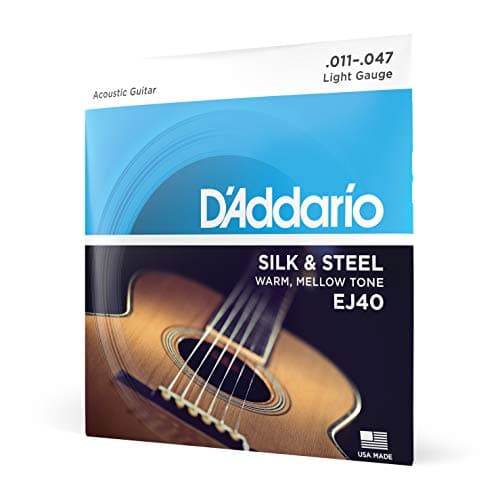
D'Addario EJ40 Silk & Steel, 11–47 — softest feel under the fingers
The silk layer under the winding lowers tension at a given gauge, and the wound strings feel noticeably softer than a bronze set of similar thickness. For fingertips that are genuinely sore rather than merely untrained, it is the most comfortable set here.
D'Addario also states this set suits smaller-body acoustics, which is the only body-size guidance any maker gives in the category.
Against it, and it is a real caveat: no maker publishes a tension figure for any silk and steel set, including D'Addario for this one, in a category sold entirely on tension. It is also heavier on the first string than the EJ15 above. And silk and steel is quieter and warmer, which on an already quiet guitar can be a step too far.
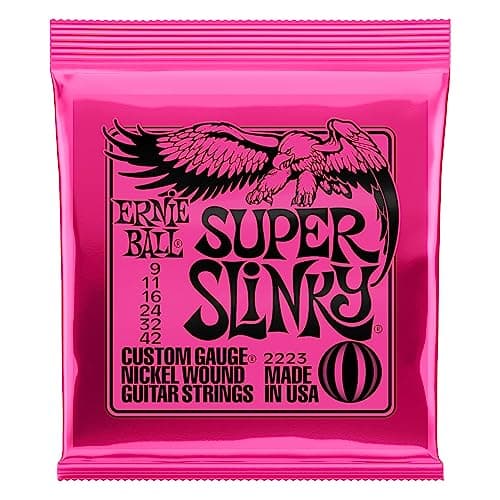
Ernie Ball Super Slinky 9–42 — easiest electric set
The electric answer. Nines rather than tens is the single change that makes bending — which is where electric playing starts — go from a wrestling match to something a beginner can actually do.
It is the honest beginner recommendation on an electric and it is the set we rank in the electric string roundup for the same reason.
Against it: Ernie Ball publishes gauges and no tension, so the comparison is by thickness only. Nines go out of tune more easily under a heavy picking hand. And on a guitar tuned below standard they go slack and buzz.
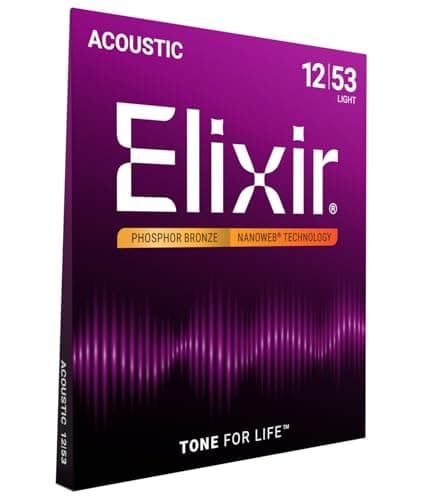
Elixir Phosphor Bronze NANOWEB light — smoothest to slide on
A different kind of easy. The coating does not reduce the force needed to fret a note at all — it reduces friction, so your hand slides along the strings rather than catching, and the finger squeak largely disappears.
For a player whose complaint is that changing position feels sticky rather than that pressing feels hard, this is the set that addresses the actual problem.
Against it: at .012 to .053 it is a full light set, so it takes more force than the EJ15, not less — it is on this page for feel, not for effort. It costs several times an uncoated set. And Elixir publishes no tension figure.
Side by side
Published gauges and tension| Set | Gauges | Type | Tension published |
|---|
| D'Addario EJ15 | .010 .014 .023 .030 .039 .047 | Acoustic, extra light | Yes, per string |
| D'Addario EJ40 | .011 .014 .023 .028 .038 .047 | Acoustic, silk and steel | No |
| Ernie Ball 2223 | .009 .011 .016 .024 .032 .042 | Electric, super light | No |
| Elixir 16052 NANOWEB | .012 .016 .024 .032 .042 .053 | Acoustic, coated light | No |
One row in four publishes the figure that this whole decision is supposed to rest on.
The things that are free
Wait. Fingertip pain in the first month is skin adapting, and it stops. Almost nobody who plays regularly past six weeks still complains about it. Changing gear to solve a problem that resolves itself is the most common beginner purchase mistake there is.
Press behind the fret, not on top of it. Fretting in the middle of a fret space takes far more force than fretting just behind the fret wire. This is technique, it is free, and it makes more difference than a gauge step.
Check the nut slots if only the first three frets are hard. That pattern is diagnostic — it points at nut height rather than at strings or relief, and it is technician work. Guitar action too high walks through which symptom points where.
What we would actually buy
Run the ten-minute setup check first. If the guitar measures fine and it is an acoustic, fit the EJ15 and give it two weeks. If your fingertips are sore rather than your hand tired, try the EJ40 instead and accept the loss of volume. On an electric, fit nines and stop thinking about it. If your complaint turns out to be friction rather than force, the coated set is the one that fixes it — coated vs uncoated covers what a coating costs you.
What we did not doWe have not played any of this gear. Every guide in this category says it tested twenty tuners; we would rather say plainly that we tested none. What we did instead is on this page in full: published specifications with their sources, the makers' own manuals read rather than paraphrased, and a note wherever a company publishes nothing at all.