A string set is labeled with two numbers — .012–.053, say — and a word: light, medium, extra light. The numbers are the diameters of the thinnest and thickest strings in thousandths of an inch. The word is the manufacturer's name for that combination, and it means different things at different brands.
Read the numbers, not the word. D'Addario calls .012–.053 "light". Ernie Ball calls .011–.052 "light". Both are correct within their own range and they are not the same strings.
The table
Common acoustic gauges| Name | Gauges | Typical use | Tension published? |
|---|
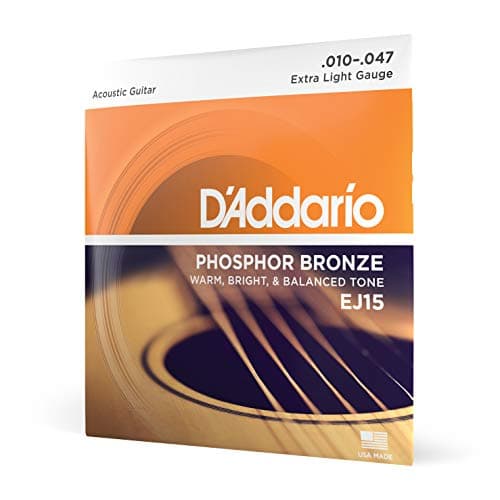
| Extra light | .010–.047 | Sore fingertips, small-bodied guitars | Yes (D'Addario EJ15) |
| Custom light | .011–.052 | Between the two standards | Varies by brand |
| Light | .012–.053 | The default on most acoustics | Yes (D'Addario EJ16) |
| Light/medium | .012–.056 | Light trebles, heavier bass | Varies |
| Medium | .013–.056 | Heavy strumming, bigger sound | Varies |
Common electric gauges| Name | Gauges | Typical use | Tension published? |
|---|
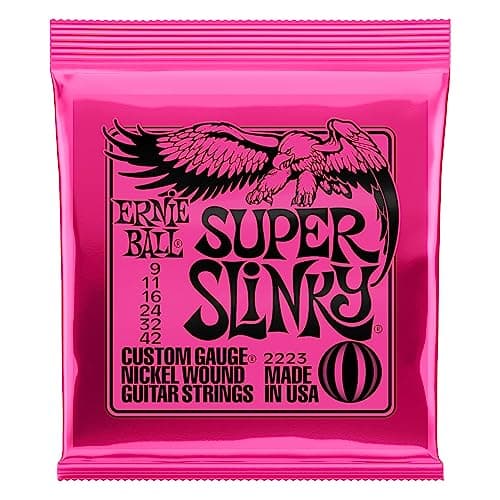
| Super light | .009–.042 | Beginners, bending, standard tuning | Yes (D'Addario EXL120) |
| Regular | .010–.046 | The most common factory gauge | Yes (D'Addario) |
| Heavy bottom | .010–.052 | Drop tunings with light trebles | Varies |
| Medium | .011–.048 | Drop tunings, harder strumming | Varies |
What actually changes when you go up a step
Fretting force. A thicker string needs more tension to reach the same pitch, and more tension means more force to push it down to the fret. This is the change you feel first and the one that matters most in the first months.
Bending. Disproportionately harder. Fretting scales roughly with tension; bending scales with tension and with how far you have to displace the string. Going from nines to tens on an electric is a noticeable fretting change and a large bending change.
Volume and low end. A thicker string moves more air on an acoustic and drives a pickup harder on an electric. Heavier sets sound fuller. This is the reason to go up, and it is a real one.
Neck relief. More total tension pulls the neck into slightly more forward bow. One step usually needs no adjustment; two steps often does, and the symptom is either buzzing (less relief) or high action (more relief). See does my guitar need a setup.
Intonation. A significant gauge change shifts where each saddle needs to sit. If chords start sounding sour up the neck after a big change, this is why.
160.5 lb
Total published tension of a light acoustic set (D'Addario EJ16)
Published string by string: 23.4, 23.3, 30.1, 29.9, 28.9 and 24.9 lb from the first string down. Almost no other brand publishes this.
The tension data problem
Gauge tells you diameter. Diameter alone does not tell you tension, because tension also depends on the core material, the winding construction and the scale length of the guitar.
D'Addario publishes tension per string for its sets, which is why this page keeps citing them: they are the only brand in this roundup that gives you a comparable number. Elixir, Ernie Ball and Savarez publish gauges alone.
The practical effect is that cross-brand comparison at the same gauge is guesswork. If you switch brands at identical gauges and the guitar feels different, you are not imagining it, and there is no published figure that would have told you in advance.
Which to buy
- First acoustic: light (.012–.053). Drop to extra light if your fingertips are still sore after two weeks.
- First electric: super light (.009–.042). Move to tens when bending stops feeling like work.
- Small-bodied acoustic: extra light or custom light. A smaller top is driven fine by lighter strings and the guitar will feel far more comfortable.
- Drop tunings: heavier, or a heavy-bottom set. Standard gauges go slack and buzz once you drop the tuning.
If the real complaint is that it is hard to play
Gauge is one of two variables and usually the smaller one. How far you have to push the string down — action — varies far more between guitars than gauge does. The easiest strings to play puts the free setup check ahead of the purchase, then ranks the sets that genuinely take less force.
Two gauge questions sit just outside this table. Electric strings on an acoustic is a tension question — a 9-42 electric set pulls about half what a light acoustic set does — and nylon on a steel-string is the same arithmetic again, with a nut problem attached.
The construction that claims to sidestep gauge
Silk and steel sets wrap a silk layer under the winding, which lowers tension at a given gauge, and they are marketed almost entirely to people whose fingertips hurt. The catch is that no maker we checked publishes a tension figure for one, and D'Addario's silk and steel set is actually heavier on the first string than its own extra-light phosphor bronze set. Silk and steel strings puts the published gauges next to each other.
What we did not doWe have not played any of this gear. Every guide in this category says it tested twenty tuners; we would rather say plainly that we tested none. What we did instead is on this page in full: published specifications with their sources, the makers' own manuals read rather than paraphrased, and a note wherever a company publishes nothing at all.
If you are weighing a specific step up, light vs medium covers the most common one on acoustic, with the tension arithmetic laid out.