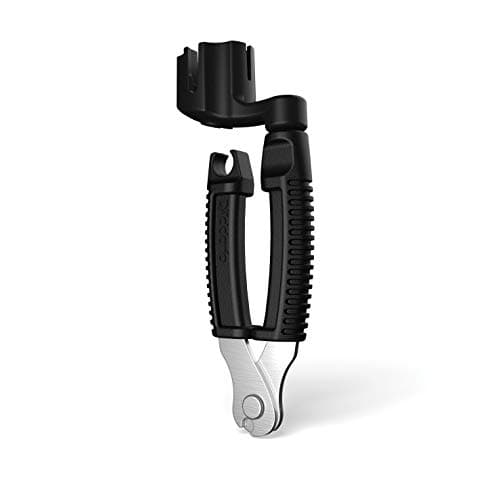
Changing strings is a twenty-minute job the first time and a ten-minute job after that. Two parts of it cause almost all the damage beginners do to guitars: getting bridge pins out of an acoustic, and winding the string at the tuning post.
Both are covered below in more detail than the rest, because those are the parts that matter.
What you need
- A new set of strings, the right type for your guitar
- A string winder — ideally one with a bridge-pin puller and wire cutters built in
- A cloth
- A tuner
- Optionally, fretboard oil if the board is dry and unfinished
You can do it with your fingers and a pair of household wire cutters. It takes three times as long and the pin puller is the part genuinely worth having: D'Addario's Pro-Winder combines a winder, hardened steel cutters and a bridge-pin puller in one tool. See string winders.
One at a time, or all at once?
Either is fine on a normal guitar. The neck is under roughly 70–80 kg of tension and removing it for ten minutes does no harm — technicians take all six off routinely to clean fretboards.
Two exceptions. A guitar with a floating tremolo (a Floyd Rose or a floating Strat bridge) is balanced between string tension and spring tension, so removing all six at once unbalances it and makes setup fiddly — change those one at a time. And if you are nervous, one at a time keeps the tension roughly constant and there is no downside beyond the fretboard staying dirty.
Step 1 — slacken and remove
Turn each tuning peg until the string is completely slack. Then cut it near the middle with wire cutters, or unwind it fully from the post.
Do not cut a string under tension. A string at pitch holds a lot of stored energy and the cut end whips. It is a genuine eye-injury risk and it is entirely avoidable by slackening first.
Step 2 — the bridge pins (acoustic only)
Most steel-string acoustics hold the string ball-ends in the bridge with six tapered pins. They wedge in tightly, especially when new.
The right way: use the notch on a proper string winder. It slips under the pin head and lifts straight up, with the tool bearing on the bridge over a broad area.
The way that damages guitars: levering with pliers, a screwdriver, a fork or a coin. Every one of those concentrates force on a small area of the bridge and chips or dents it, and the damage is permanent and visible.
If a pin is genuinely stuck, push the string slightly into the guitar from the top first — that unseats the ball end from under the bridge plate and the pin usually releases immediately.
Step 3 — clean the parts you can only reach now
With the strings off, the fretboard is accessible for the only time in two months. Wipe it down. If it is unfinished rosewood or ebony and looks gray and dry, this is when to apply a fretboard oil — a very small amount, worked in, then wiped off.
Use a product whose maker publishes what is in it. MusicNomad's F-ONE publishes that it contains no lemon oil, petroleum, wax or water, which on a contested question like fretboard care is the specification that matters. Do not oil a finished (glossy) maple board — it does not want it. How to clean your guitar has the detail.
Step 4 — fit the new string
Acoustic: drop the ball end into the bridge hole, insert the pin with its groove facing the soundhole so the string sits in it, and pull the string gently upward while pressing the pin down. The ball should seat under the bridge plate. If the pin pops up when you tension the string, the ball is not seated.
Electric: thread through the body or the bridge depending on the design and pull through to the headstock.
Step 5 — the winding, which decides whether it stays in tune
This is the step that separates a guitar that holds tuning from one that does not.
- Pull the string through the post hole and leave slack — about two to three inches past the post for wound strings, a little more for plain ones. Too little slack and there are not enough turns; too much and you get a messy pile.
- Bend the string end sharply where it exits the post. This stops it slipping while you wind.
- Wind so the string wraps downward on the post, toward the headstock face. This increases the break angle over the nut, which improves tuning stability and reduces the chance of the string sitting badly in the nut slot.
- Aim for two to three neat turns, each below the last, with none crossing over another. Crossed windings slip and are the commonest cause of a single string that will not stay in tune.
- Cut the excess close to the post once tensioned. Leaving two inches of sharp wire on a headstock is how people cut a finger.
Step 6 — stretch and tune, repeatedly
Tune to pitch. Then gently pull each string upward away from the fretboard along its length — an inch of lift, no more, moving along the string. It will go flat immediately. Retune. Repeat two or three times per string.
This brings the string to its settled length in minutes instead of days. Without it, a new set drifts flat for the better part of a week. Always tune up to the note, never down — the reasoning is in how to use a clip-on tuner.
What we did not doWe have not played any of this gear. Every guide in this category says it tested twenty tuners; we would rather say plainly that we tested none. What we did instead is on this page in full: published specifications with their sources, the makers' own manuals read rather than paraphrased, and a note wherever a company publishes nothing at all.
Common problems
One string keeps going flat. The winding at the post is slipping, usually because there were too few turns or the windings crossed. Redo that string.
A bridge pin keeps popping up. The ball end is not seated under the bridge plate. Slacken, push the string down into the body, reseat, and re-tension while holding the pin.
A pinging noise while tuning. The string is binding in the nut slot and releasing in jumps. A tiny amount of graphite from a pencil in the slot usually fixes it; if it persists, the slot is too tight and that is a technician job.