Skip to content
Capo & Cable
Guide

In tune open, sour at the fifth fret: that is intonation

Fender publishes the test, Peterson publishes a better one and says so, and Taylor publishes the reason an acoustic is a technician's job rather than yours. What nobody publishes is how accurate your tuner has to be.

By Scooter M./Published September 27, 2026

A close-up of electric guitar strings where they cross the bridge

DisclosureSome links on this page are affiliate links. If you buy through one we may earn a commission at no extra cost to you. It never changes a ranking, and we accept no payment for placement. The full version.

The shortlist

Ranked, with the published numbers

Ranked on the specifications each maker actually publishes, on what they refuse to publish, and on what the thing costs today. Tap any row for the full write-up, including who should skip it.

#ProductBest forScorePrice
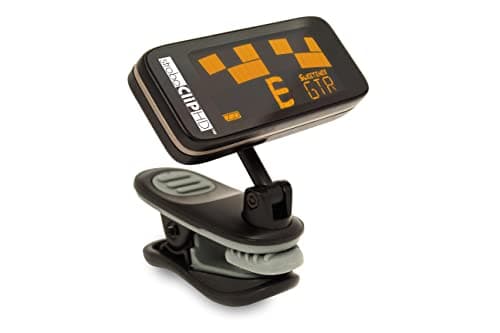
01Peterson Peterson StroboClip HDPetersonPeterson StroboClip HDThe only tuner with published intonation instructions8.9$56.99 · View on Amazon
02D'Addario D'Addario EJ16 Phosphor Bronze Light, 12–53D'AddarioD'Addario EJ16 Phosphor Bronze Light, 12–53Fit these before you measure anything9.0$9.99 · View on Amazon
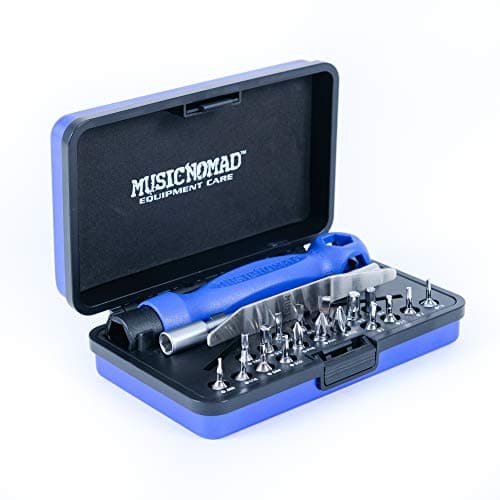
03MusicNomad MusicNomad Premium Guitar Tech Screwdriver and Wrench Set, 26 pcMusicNomadMusicNomad Premium Guitar Tech Screwdriver and Wrench Set, 26 pcBest tool set for electric saddles8.4$53.99 · View on Amazon
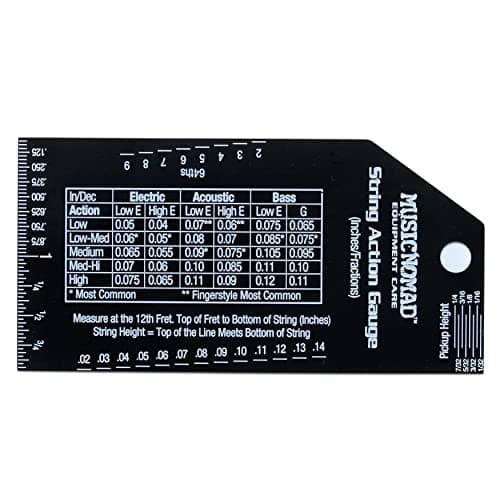
04MusicNomad MusicNomad String Action Gauge (MN602)MusicNomadMusicNomad String Action Gauge (MN602)Best gauge for the step that comes first9.0$17.99 · View on Amazon
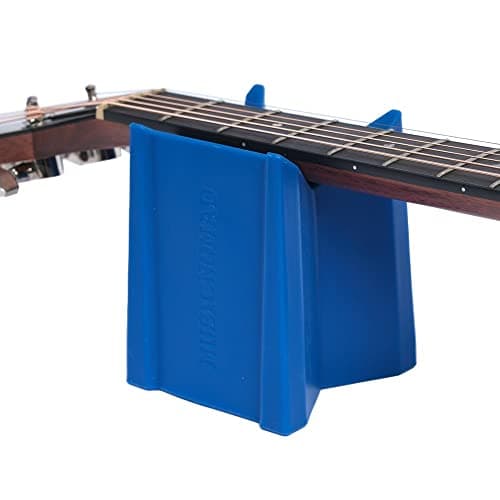
05MusicNomad MusicNomad Cradle Cube Neck Support (MN206)MusicNomadMusicNomad Cradle Cube Neck Support (MN206)Best bench support8.5$19.99 · View on Amazon
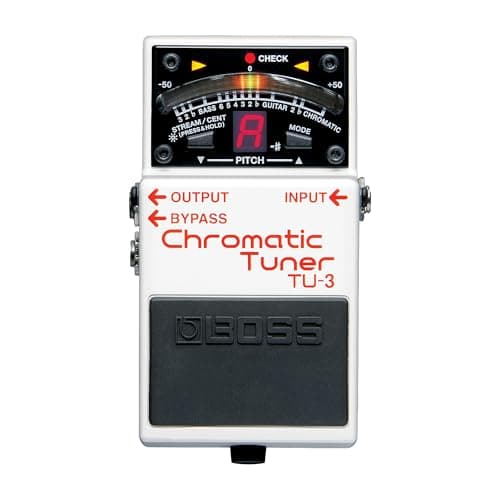
06Boss Boss TU-3 Chromatic Tuner pedalBossBoss TU-3 Chromatic Tuner pedalHonest about its own resolution8.7$103.99 · View on Amazon

Scores are ours and editorial. They are never published as review or rating markup, because we have not played these instruments — here is how we pick.

Here is the specific complaint this page is for. You tune all six strings carefully. The open chords sound right. Then you play a D at the second fret, or a barre chord at the fifth, and something is faintly, maddeningly wrong — not wildly out, just sour enough that you keep glancing at the tuner and finding nothing to fix.

That is intonation, and it is a different fault from a guitar that will not hold its tuning. If your pitch drifts while you play, the cause is at the nut, the tuner post or in strings that have not settled, and a guitar that will not stay in tune works through those. Intonation is the opposite problem: the guitar holds pitch perfectly well, and the pitch it holds is wrong as soon as you leave the open strings.

What the word actually means

Fender publishes the clearest one-sentence definition we found:

"When we intonate a guitar we shorten or lengthen the active vibrating length of a string so that it will be in tune with itself, given the scale length of the instrument, as well as differences in string gauges and micro-variations from string to string which occur in the manufacturing process."

Two things follow from that. The first is that intonation is relative — Fender writes that the aim is for the instrument to be "in relative tune to itself", and a guitar can be perfectly intonated and still be a tempered instrument that never sounds mathematically pure. Fender says so outright in its own procedure: "Remember, guitars are tempered instruments!"

The second is that string gauge is part of the equation. Change to a heavier set and the correct saddle positions change with it. Fender publishes the consequence as a rule: "Always check and adjust the intonation as needed after every change of strings."

Three things to do before you measure anything

Fit new strings. Taylor is explicit about this, and it is the step most people skip: "We recommend that players change their strings before consulting a service technician to adjust their intonation, since guitar strings naturally lose some elasticity with time and wear." Peterson goes further and lists "a set of new strings" among the items you need before you start. Old strings give you a reading of an old string, and you will chase it.

Get the action and relief right first. Fender puts intonation last in its own setup order, and says why in one line: "Adjustments should be made after all of the above have been accomplished." String height changes how far you stretch a string to fret it, which changes the pitch of the fretted note, which is the very thing you are about to measure. If the action is high, fix that first — action that is too high and fret buzz cover the two directions that can go wrong, and action gauges covers measuring it.

Hold the guitar the way you play it. Peterson publishes this as a working instruction, and it is the detail that separates a reading you can trust from one you cannot: "Lay the guitar flat on a bench to adjust it, but always check the intonation with the instrument in the playing position, as the readings will be visibly (and later audibly) different." The same page adds "Remember to fret the string using the pressure that you would normally apply while playing", and Fender says the same thing from the other side — "make sure you are depressing the string evenly to the fret, not the fingerboard".

On an electric there is a fourth: Peterson publishes "Lower the pickups away from the strings to avoid 'doubling' and electromagnetic pull". A magnet close to a vibrating steel string pulls on it, and the tuner reads the result.

The test everybody publishes — and the one Peterson disputes

The standard check is the twelfth-fret comparison. Fender publishes it verbatim in the Stratocaster setup guide:

"Check each string at the 12th fret, harmonic to fretted note (make sure you are depressing the string evenly to the fret, not the fingerboard). If sharp, lengthen the string by adjusting the saddle back. If flat, shorten the string by moving the saddle forward."

The direction rule, which is the part people get backwards
What the tuner shows at the 12th fretWhat the string needsWhich way the saddle moves
Fretted note SHARP of the harmonicTo be made longerBack, away from the neck
Fretted note FLAT of the harmonicTo be made shorterForward, toward the neck
Fretted note matches the harmonicNothingLeave it alone

Here is the interesting part, and it comes from the one company that publishes a document devoted to this job. Peterson describes the twelfth-fret method, then says plainly: "While the above is a common system, it is not always the most satisfactory." Its preferred alternative uses the fifth and seventeenth frets instead: "Tune a string at the 5th fret. Check the string at the 17th. If sharp, move the saddle back, thus lengthening the string. If flat, shorten the string by moving the saddle forward."

That is still an octave apart, so the arithmetic is the same, but both readings are now fretted notes taken in the part of the neck where you actually play chords. The twelfth-fret harmonic is a lovely clean tone that you never use in a song. If you have a tuner that can resolve it, the fifth-and-seventeenth check is the more honest one, and Peterson is the only manufacturer we found that says so.

Electric or acoustic: this is where the page splits in two

On most electrics, this is a screwdriver job. Each string has its own saddle with its own adjustment screw, so the direction rule above is directly actionable. Work one string at a time, retune after every move, and expect to go round two or three times. Fender ends its procedure with exactly that: "Re-tune, play and make further adjustments as needed."

On most acoustics, you cannot adjust it at all.Taylor publishes why, and it is worth understanding rather than just accepting. An acoustic has one saddle serving all six strings: "Most saddles are placed at a slight angle to the bridge, which adds length to the lower strings to adjust for differences in string thickness. Likewise, many saddles are made with compensation points for some or all of the strings, which helps fine-tune those points even more." The compensation is built into the shape of the bone or synthetic blank at the factory. There is no screw.

Changing it means changing the saddle itself. Taylor: "A skilled guitar technician can cut more accurate notches into the saddle, effectively adjusting the intonation of each string by changing the string's distance from the nut." Peterson agrees and adds the warning in its own note: "Changing the saddle by filing or adding bone & glue is a job best done by an experienced luthier or instrument technician."

So on an acoustic the useful outcome of this page is a diagnosis, not a repair. You establish that intonation is genuinely the fault, you rule out old strings and high action, and then you hand a technician a specific complaint with measurements instead of "it sounds funny". Peterson is blunt about how much of the rest is you: "much of the intonation is in the hands of the player, since most acoustic guitars have non-adjustable string saddles."

One acoustic family is the exception, and it shows how fine the tolerances are. Martin's service documents for its SC models — the ones with the Sure Align neck — publish an actual intonation setscrew reached through the soundhole, with a published sensitivity figure.

2–3 cents

The intonation change from ONE full rotation of the setscrew on a Martin SC, per Martin's own service document

Martin's procedure also says to detune roughly two full steps first, that the screw must ONLY be adjusted without string tension, to torque the dovetail bolts back to 25 inch-pounds, and to recheck on a strobe tuner. Its header warns that failing to follow the directions may result in damage not covered by the warranty.

Two things to take from that number. One rotation of a screw moves the pitch by two or three cents — so the adjustments that matter here are genuinely small, and a tuner that rounds to the nearest cent is rounding away a third of your adjustment. Two: Martin publishes that procedure under a "For Authorized Martin Dealer and Service Center Use Only" header. Read it to understand the scale of the job, not as an invitation.

How accurate does the tuner need to be?

We went looking for a published answer and there is not one. No guitar maker and no tuner maker publishes a required minimum accuracy in cents for setting intonation. Fender's tools list for a full Stratocaster setup says only "Electronic tuner". That is the honest state of the published record, and anyone who tells you a specific cents threshold is inventing it.

What makers do publish is two useful things. Martin names a tuner type — its procedure step six reads "Tune to pitch and recheck intonation on strobe tuner" — and it is the only guitar maker in this research that specifies one. And the tuner manufacturers publish their own resolution, which lets you compare.

Published accuracy figures, from each manufacturer's own specification
TunerPublished accuracyPublished for intonation work?
Peterson StroboClip HD0.1 cent, detection and displayYes — Peterson publishes an intonation guide
Korg Pitchclip 2+±0.1 cent in strobe modeNo
Boss TU-3±1 centNo
Korg Pitchclip 2±1 centNo
Snark ST-8Not publishedNo

The Peterson distinction is the one worth reading carefully, because it is a real difference and the company explains it: "unlike other tuners which list the detection accuracy as the main specification, the StroboClip HD detection AND display accuracy is 0.1 cent due to its high definition display." A tuner can detect a fine difference and then show it to you rounded off, which is useless for a job where one screw rotation is worth two or three cents.

Peterson also publishes two setup details for this task that no guitar maker mentions: set the tuner to Equal temperament from the Sweetener menu rather than an instrument-specific sweetening, and "Check intonation frequently, especially when changing strings and especially prior to recording."

If a saddle is miles out: Fender's rough-in method

Fender publishes a second procedure, headed "INTONATION (ROUGHING IT OUT)", for getting saddles into the right neighborhood before fine-tuning by ear and tuner. Measure from the nut to the center of the twelfth fret, double it, and set the first-string saddle so the string length matches that figure. Then step each subsequent saddle back by roughly the gauge of that string — for an .011 second string, .011 further back — with the fourth-string saddle ending up parallel with the second.

It is a starting position, not a finish. But it is the fastest way to recover a bridge somebody has already had a go at, and it needs a ruler rather than a tuner.

What setting intonation will not fix

It will not fix a guitar that drifts out of tune while you play — that is nut binding, string settling or a tuner post, and it has its own page. It will not fix buzzing. It will not fix a warped or twisted neck, and it will not make a barre chord easier. It also will not make chords in the first three frets perfect, because open-position chords on a tempered instrument have their own compromises baked in.

And if the fault comes back within a week or two of being set, the strings are the first suspect again, followed by the nut. A guitar whose intonation will not stay put has a different problem from one that was simply never set. Does my guitar need a setup is the five-minute triage that tells you whether intonation is really the thing to chase.

What we would actually buy

If you own an acoustic: a fresh set of strings and nothing else. Fit them, let them settle, and check again. If it is still sour up the neck, you have a technician-shaped problem and buying tools will not change that.

If you own an electric and want to do this properly: the tuner is the purchase that matters, because every other tool here is a screwdriver. A tuner that publishes 0.1 cent on both detection and display is the difference between setting intonation and guessing at it.


The write-ups

Each one in full, including who should skip it

01The only tuner with published intonation instructions
8.9/10
Peterson Peterson StroboClip HD

Peterson

Peterson StroboClip HD

One tuner you will still be using in ten years

A strobe tuner in a clip-on body, with sweetened tuning presets for particular instruments. Genuinely more accurate than anything else here, and genuinely more tuner than a first guitar needs.

Good
  • The most accurate reading of anything in this roundup
  • Instrument-specific sweetened presets built in
  • Metal-bodied clip rather than molded plastic
Less good
  • Several times the price of the tuner a beginner needs
  • Strobe readout is unfamiliar at first
  • Overkill until you are doing your own setups
Skip this if

This is your first month of playing. A strobe display takes learning, and the Korg gets you in tune faster today.

Published specification

Accuracy±0.1 cent
DisplayBacklit strobe LCD
PresetsSweetened tunings for named instruments
Live price$56.99
$56.99 · View on Amazon

#ad Price as of October 17, 2026, from Amazon. Prices change. How this site is funded.

Our scoring

Ease for a beginner6.4
Build9.4
Published-spec clarity9.0
Value at this price6.8
02Fit these before you measure anything
9.0/10
D'Addario D'Addario EJ16 Phosphor Bronze Light, 12–53

D'Addario

D'Addario EJ16 Phosphor Bronze Light, 12–53

The first set you put on a steel-string acoustic

The default light-gauge acoustic set, and the only one here whose maker publishes per-string tension in pounds — so you can compare it against anything else on a like-for-like basis.

Good
  • Per-string tension published, which almost nobody else does
  • Cheap enough to change often while you are learning
  • Stocked in every music shop in the country
Less good
  • Uncoated, so they dull faster than a coated set
  • 12s are a real step up in tension from a factory-strung 11 set
  • Nothing special about the tone — that is the point
Skip this if

Your fingertips are still raw after a week. Drop to the extra-light EJ15 and come back to these when the calluses arrive.

Published specification

Gauges.012 .016 .024 .032 .042 .053
MaterialPhosphor bronze over hex high-carbon steel
Total tension160.5 lb across the set (published per string)
CoatingUncoated
Live price$9.99
$9.99 · View on Amazon

#ad Price as of October 17, 2026, from Amazon. Prices change. How this site is funded.

Our scoring

Ease for a beginner8.8
Build8.6
Published-spec clarity9.8
Value at this price9.4
03Best tool set for electric saddles
8.4/10
MusicNomad MusicNomad Premium Guitar Tech Screwdriver and Wrench Set, 26 pc

MusicNomad

MusicNomad Premium Guitar Tech Screwdriver and Wrench Set, 26 pc

Everything on the guitar except the truss rod itself

The broader kit: the screwdriver bits that fit tuner screws, pickguard screws and truss-rod covers without chewing them, plus the hex wrenches for saddle height.

Good
  • Correct-fitting bits stop you rounding out small screws
  • Spanner wrench covers the output-jack nut that always works loose
  • One case rather than a drawer of loose keys
Less good
  • Overlaps the truss-rod set if you buy both
  • No measuring tools at all
  • More tool than the first year of ownership needs
Skip this if

You want a single tool. This is a case of bits, and a case of bits is a thing you have to keep track of.

Published specification

Contents18 screwdriver bits, 7 hex wrenches, 1 spanner
Bit typesPhillips, flat head, Allen
SpannerFor jack and pot nuts
Live price$53.99
$53.99 · View on Amazon

#ad Price as of October 17, 2026, from Amazon. Prices change. How this site is funded.

Our scoring

Ease for a beginner7.4
Build9.0
Published-spec clarity8.6
Value at this price8.0
04Best gauge for the step that comes first
9.0/10
MusicNomad MusicNomad String Action Gauge (MN602)

MusicNomad

MusicNomad String Action Gauge (MN602)

The first measurement you ever take on your own guitar

One piece of etched stainless steel that turns "this feels high" into a number, doubles as a fret rocker, and costs less than a set of strings. It is the tool the setup kits leave out.

Good
  • Three scales on one tool, so it matches whatever units the maker's spec uses
  • Recommended heights printed on the gauge, so you do not need the internet
  • Works as a fret rocker, which finds the high fret that a truss rod will not fix
Less good
  • Does not measure neck relief or nut height
  • Steel edges are sharp enough to mark a finish if you are careless
  • A number is only useful if you know the maker's target, which is not on the tool for every guitar
Skip this if

You also want to measure neck relief and nut height. This gauge does action and fret rock only; the sets below add the rest.

Published specification

MeasuresString action; doubles as a fret rocker
ScalesMetric, imperial and 64ths
MaterialStainless steel, etched white on black
IncludedPick-up ruler and measuring instructions
Reference tableRecommended heights by instrument, printed on the tool
Live price$17.99
$17.99 · View on Amazon

#ad Price as of October 17, 2026, from Amazon. Prices change. How this site is funded.

Our scoring

Ease for a beginner9.2
Build9.2
Published-spec clarity9.0
Value at this price9.4
05Best bench support
8.5/10
MusicNomad MusicNomad Cradle Cube Neck Support (MN206)

MusicNomad

MusicNomad Cradle Cube Neck Support (MN206)

Holding the neck still on a table

Five heights and angles in one soft gel block, so the neck is supported at whatever angle keeps the headstock steady while you fight a tie block.

Good
  • Five published heights and angles from one block
  • Gel rather than hard plastic, and stated safe on all finishes
  • Works for setup and cleaning jobs too, not only restringing
Less good
  • No dimensions published, so bench fit is a guess
  • Classical guitars are not on the maker's own list of instruments
  • More than a rolled towel does for free
Skip this if

You restring on your lap. This is a bench tool, and a towel under the neck costs nothing.

Published specification

What it is5-in-1 neck support rest in a soft gel material, supporting either side of the neck
Positions5 varying heights and angles
Finish safetyStated safe on all instrument finishes
Instruments namedAcoustic, electric, ukulele, violin, banjo, mandolin — classical guitar is not named
DimensionsNot published
Live price$19.99
$19.99 · View on Amazon

#ad Price as of October 17, 2026, from Amazon. Prices change. How this site is funded.

Our scoring

Ease for a beginner8.8
Build8.6
Published-spec clarity7.6
Value at this price8.2
06Honest about its own resolution
8.7/10
Boss Boss TU-3 Chromatic Tuner pedal

Boss

Boss TU-3 Chromatic Tuner pedal

An electric player who already has a board

The tuner that lives on a pedalboard and mutes your signal while you use it. Boss publishes ±1 cent, and the box is the same one that has survived on stages for decades.

Good
  • Silent tuning on stage — the audience hears nothing
  • Powers other pedals from its DC output
  • Published ±1 cent and a famously indestructible enclosure
Less good
  • Needs a power supply and two cables to do anything
  • Useless for an acoustic with no pickup
  • Costs more than the guitar strap, the picks and the tuner combined
Skip this if

You have no amp, no board and no cables. Then this is a heavy metal box that needs power to do what a clip does for a fifth of the price.

Published specification

Accuracy±1 cent
MuteOutput muted when the tuner is engaged
Power outDC output jack for daisy-chaining pedals
DisplayHigh-brightness mode for stage lighting
Live price$103.99
$103.99 · View on Amazon

#ad Price as of October 17, 2026, from Amazon. Prices change. How this site is funded.

Our scoring

Ease for a beginner6.0
Build9.6
Published-spec clarity8.8
Value at this price7.4
Questions

Frequently asked

Can I set the intonation on my acoustic guitar myself?
On almost all acoustics, no — there is one saddle for all six strings and its compensation is cut into the blank at the factory. Taylor publishes that changing it means a technician cutting more accurate notches into the saddle, and Peterson publishes that filing a saddle or adding bone and glue "is a job best done by an experienced luthier or instrument technician". What you can do yourself is the diagnosis, and fitting new strings first.
Which way do I move the saddle?
Fender publishes the rule: if the fretted note at the twelfth fret is sharp compared with the harmonic, lengthen the string by moving the saddle back, away from the neck. If it is flat, shorten the string by moving the saddle forward. Retune after every adjustment, because moving the saddle changes the pitch you just set.
Do I need new strings before checking intonation?
Taylor recommends it explicitly, because strings "naturally lose some elasticity with time and wear", and Peterson lists a new set among the things you need before you start. Fender frames it the other way round — "Always check and adjust the intonation as needed after every change of strings" — because a different gauge needs different saddle positions.
How accurate does my tuner have to be to set intonation?
Nobody publishes a required figure, and we looked. Fender's tools list says only "Electronic tuner". The useful reference points are that Martin specifies rechecking on a strobe tuner, and that one full rotation of the intonation screw on a Martin SC is worth 2 to 3 cents — so a tuner with ±1 cent resolution is coarse relative to the adjustment you are making.
Should I check intonation at the 12th fret or the 5th and 17th?
Fender publishes the twelfth-fret harmonic-versus-fretted method. Peterson describes that method and then says "it is not always the most satisfactory", preferring to tune at the fifth fret and check at the seventeenth — both fretted notes, an octave apart, in the region where you actually play. Either works; the second needs a finer tuner.
Why does my guitar sound worse the further up the neck I go?
That is the classic intonation pattern, because the error compounds with fretted distance from the nut. If instead the guitar sounds fine everywhere but slowly goes flat or sharp as you play, that is tuning stability rather than intonation, and a guitar that will not stay in tune is the page for it.
Sources

Where these numbers came from

Every specification on this page came from one of these pages. Where a row reads "not published", it means we checked the page listed and the figure was not there.