Silk and steel strings are sold to exactly one person: the beginner whose fingertips hurt. Every listing says some version of "easier on the fingers", and it is the most sympathetic marketing claim in the whole string aisle, because that pain is real and it is the single most common reason people stop playing in the first month.
So this page starts where the claim does. Easier on the fingers means lower tension. Tension is a number, in pounds, and D'Addario publishes it per string across its phosphor bronze range — the light EJ16 set totals 160.5 lb, a figure we lean on all through the gauge guide.
We checked four silk and steel sets from four makers, including D'Addario's own. Not one of them publishes a tension figure. The category whose entire reason to exist is tension is the category that will not print it.
0 of 4
Silk and steel sets here whose maker publishes a tension figure
D'Addario publishes per-string tension across its phosphor bronze range and not for its silk and steel set. La Bella gets closest with the word 'medium', which is relative to nothing.
What silk and steel actually is
Not a coating, and not a different metal. A silk and steel string has a layer of silk or a similar filament wrapped around the steel core, underneath the metal winding. The winding then sits on the silk rather than directly on the core.
Two things follow. The silk takes up part of the string's cross-section, so at the same overall gauge there is less steel doing the work, and less steel at pitch means less tension. And the silk damps the string, which is where the warmer, quieter, softer-attack sound comes from.
That is a real mechanism and it is not in dispute. The problem is that "less tension" without a number is not a specification, it is a direction, and you cannot compare a direction against the extra-light phosphor bronze set sitting next to it on the shelf.
The criteria, in the order they decide it
1. What the gauges actually are
This is the check anybody can do in the shop, and it produces the most surprising finding on this page.
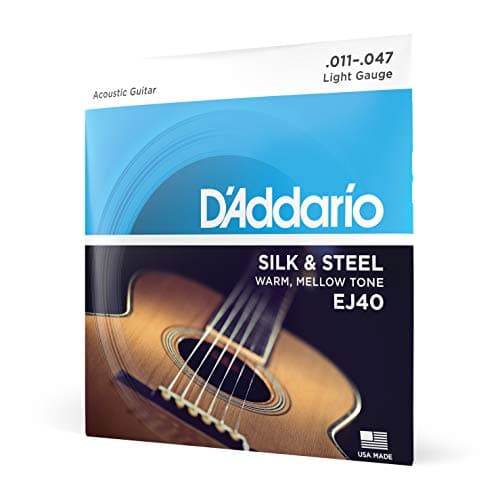
D'Addario's EJ40 silk and steel set runs .011 .014 .023 .028 .038 .047. D'Addario's own EJ15 extra-light phosphor bronze set runs .010 .014 .023 .030 .039 .047. Compare them string by string: the silk and steel set has a heavier first string, an identical second and third, marginally lighter fourth and fifth, and an identical sixth.
In other words, the gauges are not where the easier feel comes from. Whatever tension advantage silk and steel has over an extra-light bronze set is coming entirely from the silk layer, at broadly the same gauges — and that is precisely the part nobody quantifies.
2. Whether the set is light at all
Silk and steel is a construction, not a tension class, and the two get conflated constantly. La Bella's 710M is a silk and steel set at .012 to .056. That is heavier at both ends than a standard light phosphor bronze set, and dramatically heavier than the extra-light one.
If somebody hands you a silk and steel set because your fingers hurt and it happens to be that one, it will make the problem worse. Read the gauges. Every listing prints them, even when it prints nothing else.
3. What the maker publishes about construction
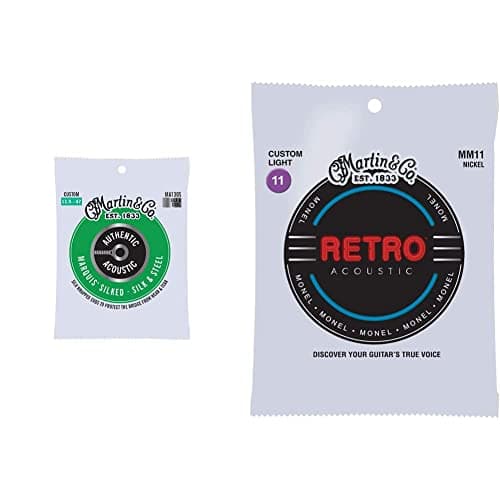
Three of the four say almost nothing beyond the name. Pyramid is the exception: its listing describes a round wire core with silk wrapping, which at least tells you where the silk sits. D'Addario states silver-plated windings and that the set is especially suitable for smaller-body acoustics — the only body-size guidance in the group. Martin publishes the gauges and the words "silk and steel".
4. What it costs you in sound
This is the honest trade and it deserves stating before the picks rather than after. Silk and steel is quieter and warmer than bronze. Less steel vibrating and a damping layer under the winding means less volume, less top-end sparkle and a softer attack.
For fingerstyle in a quiet room, many players consider that an upgrade. For strumming chords on a small-bodied guitar that is already not very loud, it can push the instrument to a point where it does not project enough to be enjoyable. That is not a defect in the strings. It is what the construction does.
Published gauges, side by side
Every set here publishes gauges. None publishes tension.| Set | Gauges | Construction published | Tension published |
|---|
| D'Addario EJ40 | .011 .014 .023 .028 .038 .047 | Silver-plated wound over silk | No |
| Martin MA-130S | .0115 .014 .023 .028 .038 .047 | Silk and steel folk | No |
| Pyramid 305/100 | .011 .014 .021 .027 .035 .046 | Round wire core with silk wrapping | No |
| La Bella 710M | .012 .016 .025 .033 .046 .056 | Silk and steel, round wound | Only the word "medium" |
| D'Addario EJ15 (bronze, for reference) | .010 .014 .023 .030 .039 .047 | Phosphor bronze over hex steel | Yes, per string |
The last row is the one to read twice. The extra-light phosphor bronze set is lighter on the first string than three of the four silk and steel sets, and it is the only row in the table whose maker will tell you what the tension is.
The picks
D'Addario EJ40 — best first silk and steel set
It wins on availability and on being the only one that says what guitar it is for. D'Addario publishes that the set is especially suitable for smaller-body acoustics, which is genuinely useful guidance in a category where the sound trade-off depends heavily on how loud your guitar was to begin with.
The silver-plated windings are also noticeably smoother under a sliding hand than a plain bronze winding, which reduces finger squeak — a secondary benefit that gets less attention than the tension claim and is easier to verify for yourself.
Against it: no published tension, a heavier first string than D'Addario's own extra-light bronze set, and the trade in volume and top end that applies to the whole category. The silk at the ball end also frays with repeated restringing, which is cosmetic until it is not.
Pyramid 305/100 — lightest wound strings
If the goal is genuinely less to push against, this is the set that delivers it where it counts. Every wound string is thinner than the D'Addario and Martin equivalents — .021 against .023, .027 against .028, .035 against .038, .046 against .047 — and the wound strings are where a beginner's fretting hand does most of its complaining.
It is also the only listing that describes the construction rather than just naming it: a round wire core with silk wrapping. That is one sentence more than the rest of the category manages.
Against it: still no tension figure, harder to find on a shelf than the two big names, and lighter wound strings mean less volume again on an instrument the construction has already quieted.
Martin MA-130S — same gauges, different name
Worth including precisely because of what the comparison shows. Five of its six gauges are identical to the D'Addario set. The only difference is the first string, at .0115 against .011.
That means the choice between these two is not a choice about performance, it is a choice about which one your shop stocks. Anyone telling you one of them transforms a guitar and the other does not is describing something the published specifications do not support.
Against it: Martin publishes less than D'Addario does — no core material, no body-size guidance, and no tension. On a page ranked on what makers put in writing, that is the whole reason it is third rather than first.
La Bella 710M — heaviest set here
Included as the counter-example, and it is a legitimate product for a legitimate buyer. At .012 to .056 with round wound silk and steel construction, it puts warmth and body into a large guitar that sounds thin on light sets, and for fingerstyle players on a dreadnought that is a real proposition.
It is also the only set on this page that states a tension class at all, even though "medium" without a figure is relative to nothing.
Against it, and this matters more than the pros: if you found this page because your fingertips hurt, this set is the wrong answer. It is heavier than the light phosphor bronze set you are probably already using, and the .056 sixth string is the heaviest on anything we cover.
The honest alternative
Before you buy any of these, consider that the sore-fingertips problem has three cheaper answers and they are all more reliable.
Wait two weeks. Fingertip pain in the first month is your skin adapting, and it stops. Almost nobody who plays regularly past six weeks is still complaining about it. Changing gear to solve a problem that resolves itself is the most common beginner purchase mistake there is.
Fit extra-light phosphor bronze instead. A .010 first string is thinner than three of the four sets on this page, the maker publishes the tension so you can check the claim, and the guitar keeps its volume and top end. The acoustic string roundup has the sets, and light vs medium explains why going lighter is the safer direction for a beginner.
Check whether the guitar is the problem. This is the one people skip, and it is the one that most often turns out to be the cause. If the action is too high, every string on the instrument is harder to press than it should be, and no string set fixes that. Five checks in ten minutes tells you which situation you are in, and an action gauge turns the answer into a number.
Two practical warnings
Check your tuner still reads the wound third string. On these sets the third string is wound rather than plain. Clip-on tuners handle it without complaint, because they read vibration through the headstock and do not care what the string is made of — how to use a clip-on tuner covers the reading. It is magnetic pickups on an electro-acoustic that can respond differently to a wound third, and if yours is a soundhole magnetic pickup rather than an undersaddle piezo, expect a different balance.
They do not last as long. The silk layer is organic and it takes up sweat and skin oil the way the windings do, and it cannot be wiped clean the way a plain winding can. Expect a shorter usable life than an equivalent uncoated bronze set, and considerably shorter than a coated one — coated vs uncoated covers what a coating actually buys, and no coated silk and steel set appeared in our checks.
The verdict
Silk and steel is a real construction that does a real thing, sold by a category that will not put a number on the thing it does. If you want the warmer, quieter, softer sound for fingerstyle, buy the D'Addario and enjoy it — that is a sound preference and it is a good reason.
If you are buying it because your fingers hurt, buy an extra-light phosphor bronze set instead. It is lighter at the top, the maker publishes the tension, and you keep the volume. Then give it two weeks, because the fingertips were probably always going to sort themselves out.
What we did not doWe have not played any of this gear. Every guide in this category says it tested twenty tuners; we would rather say plainly that we tested none. What we did instead is on this page in full: published specifications with their sources, the makers' own manuals read rather than paraphrased, and a note wherever a company publishes nothing at all.