The three types, and which one you need
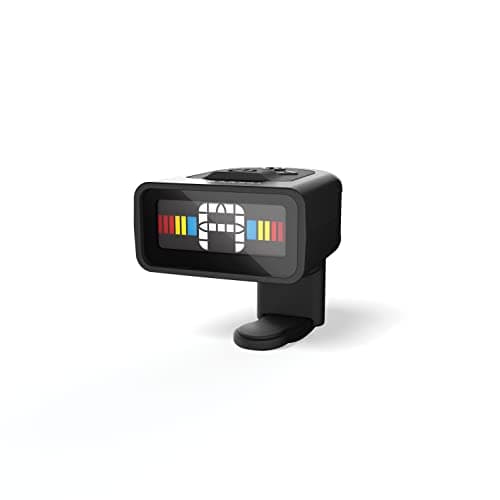
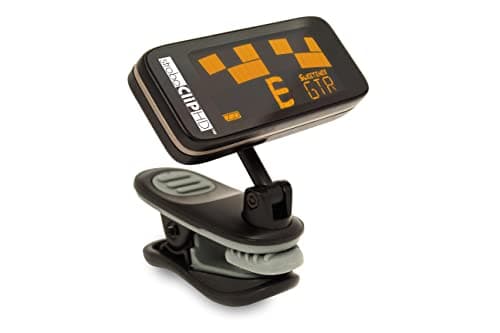
Clip-on tuners read vibration through a clamp on the headstock. They are cheap, they work in noise, they work on any instrument, and they are what almost every beginner should buy. The entire top of this page is clip-ons for that reason.
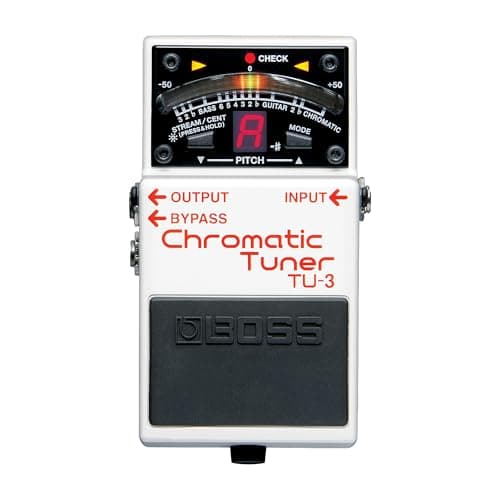
Pedal tuners sit in the signal chain between an electric guitar and an amp, and mute the output while you tune. They are excellent and they are irrelevant unless you already own an amp, a cable and somewhere to put a pedal. A solid-body also gives a clip-on less vibration to read than an acoustic does, which is the subject of the electric tuner roundup. See clip-on vs pedal vs app for the full comparison, and the tuner pedal roundup for the picks once you have a board to put one on.
Phone apps use the microphone, which means they work in a silent room and fail in a real one. They are free, so there is no reason not to have one as a backup — but a microphone tuner is a fundamentally worse tool than a vibration sensor, and the difference shows up the first time you tune anywhere other than your bedroom.
Accuracy: the specification half this category refuses to publish
A cent is one hundredth of a semitone. Human ears begin noticing mistuning somewhere around five to ten cents on a sustained note, so a tuner accurate to ±1 cent is comfortably finer than your hearing, and a tuner accurate to ±0.1 cent is finer than your guitar's own intonation.
The useful finding is not which number is smallest. It is that Korg and Peterson publish a figure, and Snark and D'Addario do not publish one anywhere we could find. That is not proof the unpublished ones are inaccurate — it is a statement about what each company is willing to be held to. On a spec sheet, silence is information.
Battery: the spec that decides whether it works when you pick it up
Almost everything here runs on a CR2032 coin cell. Korg publishes approximately 24 hours of use for the Pitchclip 2 and 18 hours for the Pitchclip 2+. That is playing time, not shelf time, and it is short enough that a spare cell belongs in the case from day one.
Rechargeable versions exist, including a rechargeable Snark. They remove the coin-cell problem and add a charging cable to remember. For a tuner that lives clipped to a headstock in a case, a coin cell and a spare is the simpler answer.
The clamp is what actually fails
Across every brand in this category, the part that breaks is the clip. Spring-loaded plastic hinges fatigue, and the tuner ends up sliding off a headstock mid-song. D'Addario's ratchet clamp is the most convincing mechanical answer here; Peterson's metal-bodied clip is the most durable. Neither publishes a cycle rating, because nobody in this category does.
A tuner only tells you the guitar has drifted. Working out why it drifted — new strings, a slipping winding, a nut that grips, or the room itself — is the subject of why a guitar will not stay in tune.
What we did not do
We have not tuned a guitar with any of these. Everything above comes from published specification sheets, product manuals and the pattern of what each maker is prepared to state in writing. That is a real method with real limits, and how we research sets out both.