"Action" is the height of the strings above the frets. High action means every note takes more finger pressure, barre chords feel impossible, and notes go sharp when you press — because you are stretching the string further to reach the fret.
It is the commonest reason a beginner concludes their hands are not strong enough. Usually the hands are fine.
How to measure it
Measure at the twelfth fret, from the top of the fret to the bottom of the string, with the guitar tuned to pitch and held in playing position. Measure the low E and the high E.
A string action gauge is the right tool and costs very little. A steel rule with millimeter markings that start at the very edge works. A tape measure does not — the hook and the dead space at the end make it useless at this scale.
Typical action, measured at the 12th fret| Guitar | Low E | High E |
|---|
| Steel-string acoustic | roughly 2.0–2.5 mm | roughly 1.6–2.0 mm |
| Electric | roughly 1.6–2.0 mm | roughly 1.2–1.6 mm |
| Classical / nylon | roughly 3.5–4.0 mm | roughly 3.0–3.5 mm |
Those are the ranges commonly used as reference points across the instrument-repair trade. They are not a manufacturer specification for your particular guitar — where your maker publishes one, that figure wins. If yours measures well above these, high action is real rather than imagined.
Three causes, in order of likelihood
1. Too much neck relief
The neck is bowing forward under string tension, lifting the middle of the fingerboard away from the strings. Check it with the relief test: hold the low E at the first fret and the fourteenth simultaneously and look at the gap at the seventh or eighth fret. A very small gap is correct; an obvious one is too much.
The fix is the truss rod, and it is not a beginner job. Small movements, a quarter turn at a time, with hours between to let the neck settle. Done wrong it damages necks permanently. If this is your cause, book a setup.
2. Saddle too high
If relief is correct and the action is still high, the saddle is sitting too tall.
On an electric with individual saddles, this is adjustable with a small hex key and is genuinely a beginner job: lower a little, check for buzz, repeat. Recheck intonation afterwards, because changing string height changes the effective string length.
On an acoustic, the saddle is a single piece of bone or synthetic material that has to be removed and sanded down from the bottom. It is doable and it is not reversible — sand too much and you buy a new saddle. If you have never done it, pay someone.
3. Nut slots too high
This one only affects the first few frets, and it is the most common comfort problem on inexpensive guitars.
Test: hold each string down at the third fret and look at the gap between the string and the first fret. It should be barely visible. A clear gap means the slot is too high.
Do not file nut slots. Too deep is unrecoverable without replacing the nut, the correct depth differs per string, and the files are specific to string gauge. This is the definitive pay-someone job.
3
Possible causes of high action
Relief, saddle height and nut slots. Only saddle height on an electric is a safe beginner adjustment.
The thing you can change today
Lighter strings. Less tension means less forward bow, which lowers action slightly, and lighter strings need less force regardless. It is not a substitute for a proper setup and it is a completely reversible experiment that costs the price of a set of strings.
Going from lights to extra lights on an acoustic, or tens to nines on an electric, makes a real difference to a guitar that hurts. The gauge guide has the options, and if it is your fingertips rather than the guitar that is the complaint, sore fingertips works through that in order.
Where the truss rod line is, stated plainly
This site does not publish a truss-rod how-to. That is deliberate. There is a genuine risk of permanently damaging a neck, the correct procedure varies by instrument, and a written guide cannot see your guitar.
If your problem is relief, the honest advice is to take it to a technician, watch what they do, and ask questions. That is how you learn it safely. Anyone selling you a five-minute truss-rod tutorial is being less careful with your guitar than we are willing to be.
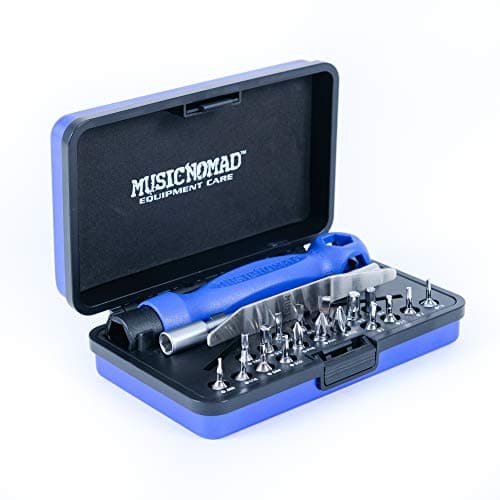
One thing worth owning before any of that: a measuring gauge. Relief is argued over in a range about four thousandths of an inch wide, and nobody judges that by eye. Measuring first is what separates a diagnosis from a guess.
What we did not doWe have not played any of this gear. Every guide in this category says it tested twenty tuners; we would rather say plainly that we tested none. What we did instead is on this page in full: published specifications with their sources, the makers' own manuals read rather than paraphrased, and a note wherever a company publishes nothing at all.