Nylon strings work differently enough from steel that most of the advice on the rest of this hub does not transfer. Three things change.
They are sold by tension, not gauge. A set is labeled normal, hard or extra-hard tension rather than by a diameter in thousandths. Diameters do vary between sets, but the tension class is the thing you choose.
They stretch for days. A new nylon set drifts flat for the better part of a week before settling. This is normal, it cannot be entirely avoided, and it catches out everyone arriving from steel strings.
They tie on. Most classical guitars have no bridge pins. The string is threaded through a hole in the bridge and tied back on itself, which is a genuinely fiddly first restring.
The warning that comes first
Never fit steel strings to a classical guitar. A classical guitar's neck and top are built for nylon tension — typically well under half what a steel set applies — and it usually has no truss rod at all. Steel strings can bow the neck and lift the bridge off the top.
The reverse is a smaller problem but still wrong: nylon on a steel-string acoustic sounds dead, and the ball-end fitting is not designed for it.
If you are unsure which you own: a classical guitar has a wide, flat fingerboard, a slotted headstock with rollers, and no bridge pins. A steel-string acoustic has a narrower, curved fingerboard, solid headstock and usually six bridge pins.
Tension classes
What the tension class changes| Class | Feel | Sound | Suits |
|---|
| Low / light | Easiest to fret, floppiest | Softer, less projection | Beginners with sore fingers |
| Normal / medium | The default | Balanced | Almost everyone starting out |
| Hard / high | Firmer under the finger | More volume and projection | Established players, some guitars |
Start at normal tension. It is what most classical guitars are set up for, and it is what the standard sets are built around. Going higher adds projection at the cost of effort; going lower is an option if the guitar hurts to play, though nylon is already far gentler on fingertips than steel.
The strings are two different products in one packet
The three treble strings (G, B, E) are solid nylon monofilament. The three basses are multifilament nylon cores wrapped in silver-plated copper — D'Addario publishes exactly that construction for the Pro-Arte set.
The trebles are where set quality differs most. D'Addario publishes that its Pro-Arte trebles are sorted by laser for consistent diameter, which matters because an inconsistent treble string plays out of tune with itself along the neck no matter how well you tune the open string. That is a real specification, and it is the kind of thing worth paying for once you can hear it.
Days, not minutes
How long a new nylon set takes to settle
Expect to retune several times a day for the first two or three days. It is the material, not the set.
Living with the stretch
You can speed it up the same way as with steel: after tying and tensioning, gently pull each string away from the fretboard along its length, then retune. Repeat several times.
It will still drift. Nylon creeps under sustained load in a way steel does not, and the first two or three days genuinely require retuning several times a session. After that it settles and holds well.
Plan restrings accordingly: do not change nylon strings the night before you need the guitar to be reliable.
Strings are one of four items where classical guitars part company with the standard beginner accessory list — the capo, the strap and the truss-rod tools are the others. What a first classical guitar needs is the corrected list, and the one item on it with no steel-string equivalent, raising the guitar for the seated classical position, is covered in guitar footstools and supports.
What we did not doWe have not played any of this gear. Every guide in this category says it tested twenty tuners; we would rather say plainly that we tested none. What we did instead is on this page in full: published specifications with their sources, the makers' own manuals read rather than paraphrased, and a note wherever a company publishes nothing at all.
Which set
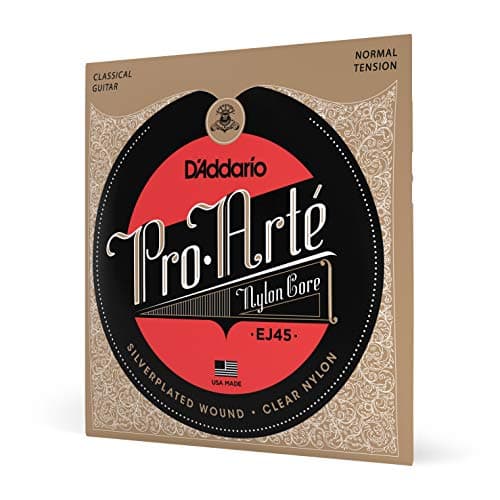
D'Addario Pro-Arte normal tension (EJ45) is the reference set — every other nylon set is described against it, it is available everywhere, and D'Addario publishes its construction and treble-sorting method.
Savarez is the usual first upgrade, with more projection and clarity. Savarez publishes very little in English, which we note as a limitation rather than glossing over it.
Restringing a classical is the fiddliest version of the job — the tie block takes practice. How to restring a classical guitar is the written version, with the wrap counts Taylor and Alhambra publish and the reason the saddle can fall out if you remove every string at once.