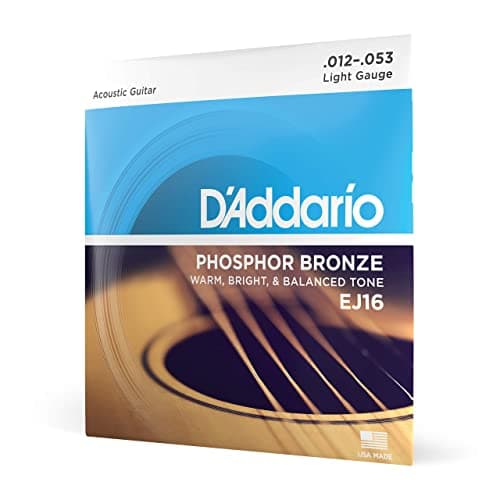
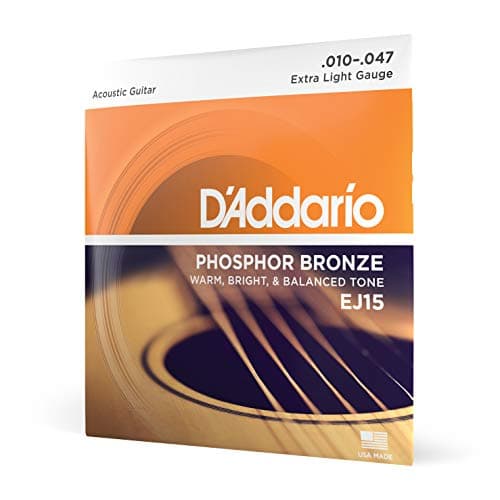
Both swaps fit and neither breaks anything — but do not make either one permanent. Electric strings on an acoustic pull about half the tension the top was braced for, so the guitar goes quiet and thin. Acoustic strings on an electric sound unbalanced, because the bronze wrap on the wound strings is not magnetic and the pickup barely hears it. If you have an acoustic, buy an acoustic set: D'Addario's EJ16 for a normal guitar, the extra-light EJ15 if it hurts to play.
The two directions are different problems with different evidence behind them, so this page takes them one at a time.
Electric strings on an acoustic: a tension problem
Nothing physically stops you. Both sets are ball-end, both drop into bridge pins, and electric sets are lighter, so the guitar is under less load rather than more. The problem is that less load is the whole problem.
D'Addario publishes per-string tension on both sides of this comparison, which turns the usual hand-waving into arithmetic. The EXL120 electric set (.009–.042) measures 13.1, 11.0, 14.7, 15.7, 15.5 and 14.4 lb. The EJ16 light acoustic set (.012–.053) measures 23.4, 23.3, 30.1, 29.9, 28.9 and 24.9 lb.
84.4 lb
What a 9-42 electric set pulls, against 160.5 lb for the light acoustic set it replaces
Both are D'Addario's own published per-string figures added up. An acoustic top is a driven membrane and string tension is what drives it — this is why the guitar goes quiet rather than why it breaks.
That is almost exactly the same drop as fitting nylon, which is covered on nylon strings on a steel-string guitar, and it has the same two consequences. The guitar loses volume and low end, and the neck — set up for the heavier pull — tends to straighten, which drops the action until something buzzes.
The second difference is the alloy. An acoustic set is wound with bronze, which is chosen because of how it sounds in open air. An electric set is wound with nickel-plated steel, which is chosen because of how it behaves in a magnetic field. Played acoustically, nickel wrap sounds thinner and more metallic than bronze — that is not a defect, it is the material doing the job it was picked for somewhere else.
There is one case where this swap is a sensible, deliberate thing to do: a practice guitar you want to be quiet. Extra-light electric strings on an acoustic make it noticeably easier to fret and noticeably less audible to everyone else in the house. Just do not expect it to record, busk or play in a room with other people.
Acoustic strings on an electric: a magnetism problem
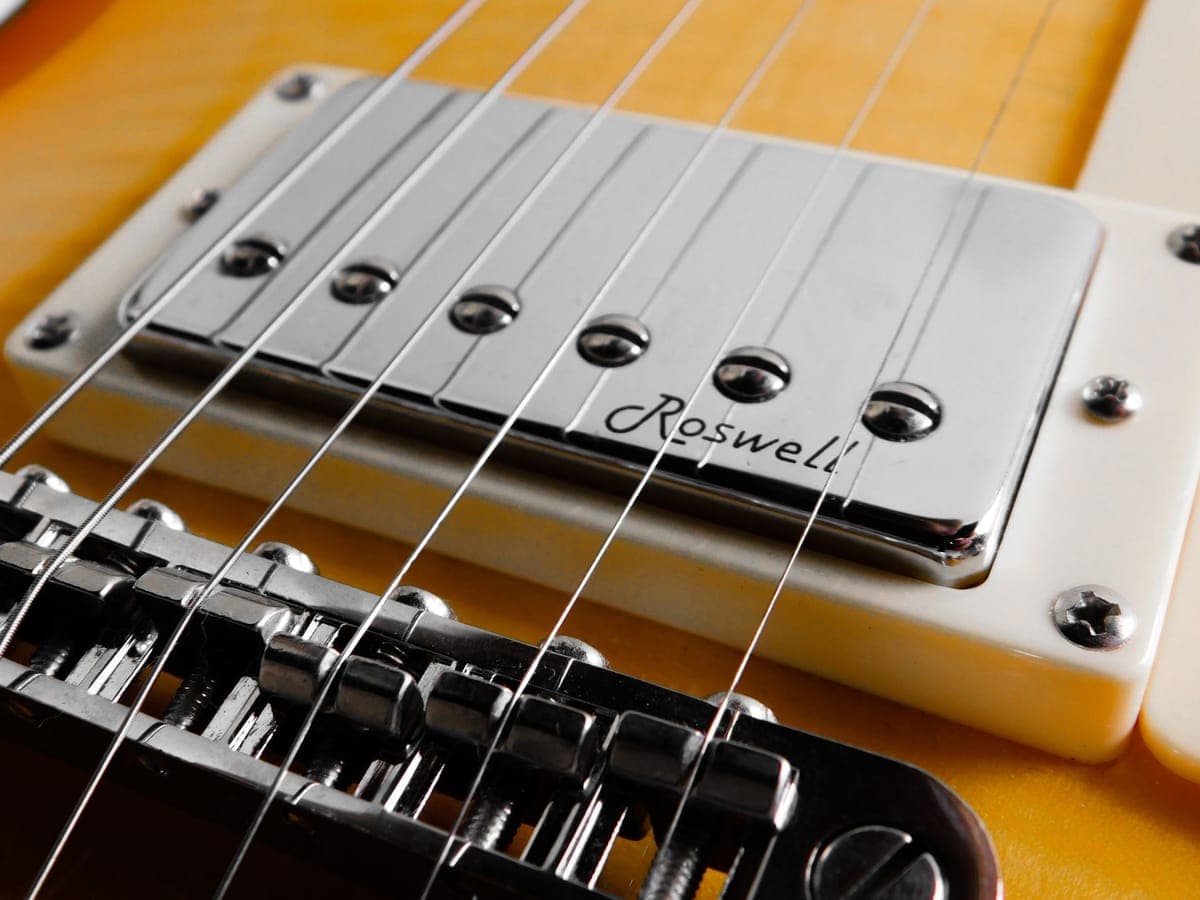
This one fails for a reason you can read off a pickup maker's own page. Seymour Duncan publishes that "bronze is not attracted to the magnetic field in a guitar pickup" and that what the pickup actually responds to is the steel core: "the core is the same material used on the B & E strings, and are attracted to the magnetic field in a pickup."
So the plain strings — the ones with no wrap at all — behave normally, because they are plain steel either way. The three wound strings come through on the signal of a thin steel core wearing a jacket the pickup cannot see. The result is not silence. It is imbalance: three loud strings and three weak ones, which is a far more irritating fault than nothing at all.
A piezo or under-saddle pickup is a different matter entirely, because it senses vibration rather than magnetism and does not care what the wrap is made of. If your electric has a piezo bridge saddle, that part of the signal is unaffected.
What each swap actually changes | Electric set on an acoustic | Acoustic set on an electric |
|---|
| Does it physically fit | Yes, ball ends either way | Yes, ball ends either way |
| Any risk of damage | No — tension goes down | No — tension goes up slightly |
| Published tension involved | 84.4 lb vs 160.5 lb | 160.5 lb vs 84.4 lb |
| What you hear | Quiet, thin, less low end | Three strong strings, three weak ones |
| Why | Too little energy driving the top | Bronze wrap is not magnetic |
| Setup consequence | Neck straightens; action drops; buzz | Neck pulls forward; action rises |
| Worth doing | Only for deliberately quiet practice | No |
The nut, which is the part that actually complains
Tension explains the volume. The thing that produces rattles and tuning trouble is narrower than that, and it is the same component that makes the nylon version of this question a job rather than an experiment: the nut.
Nut slots are cut for the set a guitar shipped with. Fit a 9-42 electric set to an acoustic cut for .012–.053 and every string is now sitting in a slot wider and deeper than it is — the top E in particular, which drops from .012 to .009. A string that is loose in its slot can buzz against the walls, move sideways under a heavy strum, and sit lower than the slot floor intends, which lowers the action at the first fret and invites open-string buzz.
This is our own mechanical reasoning rather than a published maker claim, and it is the honest reason we call the swap temporary rather than wrong. It is also entirely reversible, which the nylon version is not: an oversized slot does nothing permanent, and putting the correct set back fixes it the same afternoon. Nothing is filed, nothing is modified, and the only cost of having tried it is a set of strings.
Going the other way — a .053 acoustic low E into an electric nut cut for .046 — is the version that does not fit. Forcing a thicker string into a narrow slot chips nut material, and that damage does not reverse. If you are determined to try acoustic strings on an electric, use a light set and stop at the first string that will not seat.
The gauges overlap. The alloys do not.
Here is the thing that makes this swap tempting, and it is a real observation rather than a myth: at the light end of each range, the two kinds of string are almost the same thicknesses. An extra-light acoustic set and a regular electric set are within a thousandth or two of each other on most strings.
Published gauges, acoustic and electric side by side| Set | Type | Gauges | Wrap |
|---|
| D'Addario EXL120 | Electric | .009 .011 .016 .024 .032 .042 | Nickel-plated steel |
| Ernie Ball 2221 Regular Slinky | Electric | .010 .013 .017 .026 .036 .046 | Nickel-plated steel |
| D'Addario EJ15 | Acoustic | .010 .014 .023 .030 .039 .047 | Phosphor bronze |
| D'Addario EJ16 | Acoustic | .012 .016 .024 .032 .042 .053 | Phosphor bronze |
Look at the EJ15 against the 2221: .010 and .010 on the top, .047 and .046 on the bottom. Two sets that would feel broadly similar under the fingers, and that are not interchangeable at all — because the difference between them is the wrap, and the wrap is chosen for the instrument rather than for your hand.
That is the useful way to hold this in your head. Gauge is about your fingers. Alloy is about the instrument. Swapping sets across instruments gets you the first one right and the second one wrong, which is why both halves of this page end with the same advice: fix comfort with gauge inside the correct family, which is what the string gauge guide is for.
The case where the alloy genuinely matters
There is a real version of this question, and it belongs to acoustic players rather than electric ones: an acoustic guitar fitted with a magnetic soundhole pickup. Those pickups are magnetic, so the same physics applies — the bronze wrap on your acoustic strings is doing nothing for the signal.
Martin's Retro sets are the string most often raised here, and Martin publishes the alloy: Monel, a nickel-copper blend, over a tin-plated steel hex core. Nickel is the material electric strings are wound with.
We are not going to take the next step for you, because no maker does. No acoustic string maker we checked publishes a claim that its sets work better with a magnetic pickup, including Martin on the Retro pages. The alloy is published; the pickup claim is not. If you are chasing this, the honest advice is to buy one set and listen, not to trust a chain of inference.
What we did not doWe have not played any of this gear. Every guide in this category says it tested twenty tuners; we would rather say plainly that we tested none. What we did instead is on this page in full: published specifications with their sources, the makers' own manuals read rather than paraphrased, and a note wherever a company publishes nothing at all.
The set that sits between the two
There is a middle category, and it is worth knowing about because it is the only legitimate product answer to "I want an acoustic string that a magnetic pickup can hear". Martin's Retro sets are wound with Monel, which Martin publishes as a nickel-copper alloy, over a tin-plated steel hex core. Martin publishes tension for the range too — its Extra Light .010–.047 set is listed at 131.6 lb.
Compare that with the figures above: 131.6 lb sits between the 84.4 lb of an electric set and the 160.5 lb of a light acoustic set, which is exactly where an extra-light acoustic set should sit. Nothing exotic is happening to the tension; what is different is the wrap.
And here is the limit of what we will say about it. Martin does not publish a magnetic-pickup claim for Retro sets, and neither does any other acoustic string maker we checked. The alloy is published. The inference — nickel is magnetically active, therefore these work better under a magnetic soundhole pickup — is ours, and we are flagging it as ours rather than dressing it up as a specification. If your acoustic has a magnetic pickup fitted, buy one set and listen; do not rebuild your string budget around a chain of reasoning nobody will stand behind in writing.
What to buy instead, by what you were trying to do
- "It hurts to play my acoustic." Extra-light acoustic strings, not electric strings. The EJ15 drops to .010–.047 and keeps the bronze. The easiest strings to play ranks the options on published tension.
- "I want the acoustic quieter for late practice." Electric strings will do it, and so will headphones and a pickup without ruining the guitar's voice.
- "I had a spare set in a drawer." Keep it for the guitar it was made for. A set costs less than the setup it will cost you.
- "My electric strings feel too stiff." Go down a gauge inside the electric range — 9s rather than 10s — which is what electric strings for beginners is about.
What we would actually buy
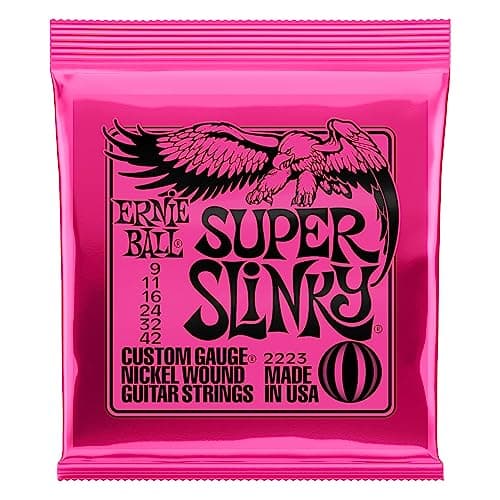
For an acoustic: the EJ16 if the guitar is comfortable, the EJ15 if it is not. For an electric: the Ernie Ball Super Slinky 2223, or the D'Addario EXL120 if you want the per-string tension published. Each of these costs less than one visit to a tech, which is the real price of getting this wrong for a month.