Skip to content
Capo & Cable
Roundup

On a 12-string, the number that matters is total tension

Twelve strings pull roughly twice as hard as six. Two makers publish exactly how hard, one publishes a warning about it, and one publishes nothing at all.

By Scooter M./Published September 21, 2026

A close-up of acoustic guitar strings

DisclosureSome links on this page are affiliate links. If you buy through one we may earn a commission at no extra cost to you. It never changes a ranking, and we accept no payment for placement. The full version.

The shortlist

Ranked, with the published numbers

Ranked on the specifications each maker actually publishes, on what they refuse to publish, and on what the thing costs today. Tap any row for the full write-up, including who should skip it.

#ProductBest forScorePrice
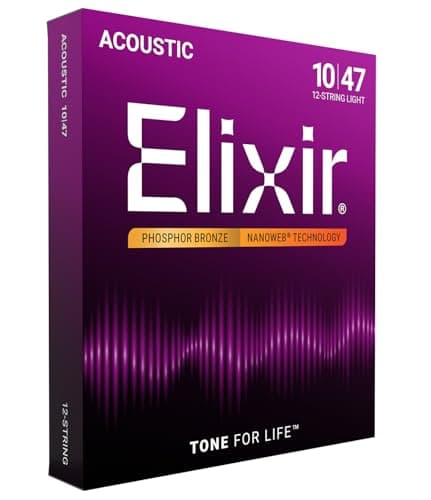
01Elixir Elixir 12-String Phosphor Bronze NANOWEB, Light 10-47 (16152)ElixirElixir 12-String Phosphor Bronze NANOWEB, Light 10-47 (16152)Best 12-string set9.0$34.99 · View on Amazon
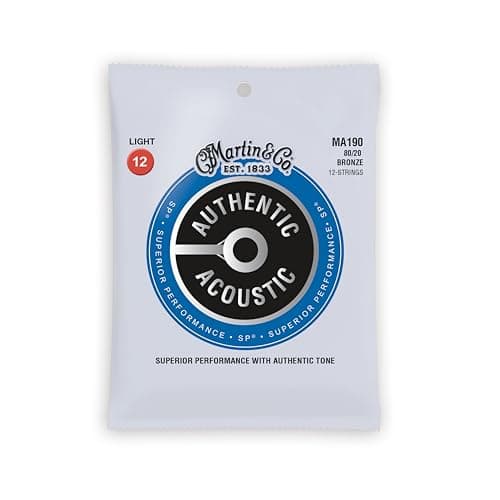
02Martin Martin Authentic Acoustic SP 12-String, Light 12-54 (MA190)MartinMartin Authentic Acoustic SP 12-String, Light 12-54 (MA190)Fullest sound, highest tension8.4$10.99 · View on Amazon
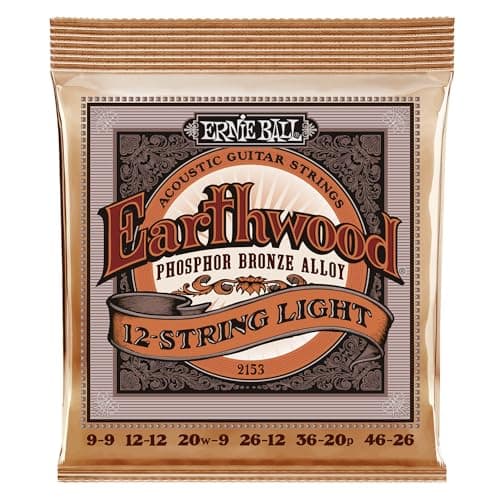
03Ernie Ball Ernie Ball Earthwood 12-String Phosphor Bronze, Light 9-46 (P02153)Ernie BallErnie Ball Earthwood 12-String Phosphor Bronze, Light 9-46 (P02153)Lightest and cheapest8.3$12.49 · View on Amazon

Scores are ours and editorial. They are never published as review or rating markup, because we have not played these instruments — here is how we pick.

A six-string light set pulls on the order of 160 to 180 pounds. The 12-string sets on this page publish figures from 251 pounds to 324 pounds. That is the entire story of the category: the same bridge, the same top, and nearly twice the load trying to fold it.

Which is why this page ranks on published tension first and tone second. Anyone can tell you a set sounds bright. Only two makers here tell you what it is doing to your guitar.

What the makers actually publish

Elixir publishes the most complete data in the category: per-string tension for every course plus a total of 251 lb for its light 12-string set, and — uniquely — the basis for those numbers, stating that tension is an approximation based on a 25.5 inch scale length in standard tuning.

Martin publishes totals for its whole range: 261.7 for the extra-light 12-string and 324.0 for the light. It does not state the scale length those totals assume, so they are not strictly comparable with Elixir's.

D'Addario publishes per-string tension for its 12-string sets on its own product pages — the EJ38 light set lists every string from .008 to .047 with its own figure — but it publishes no set total and no scale length.

Ernie Ball publishes no tension figure at all, for any Earthwood set, in a category sold on how hard it pulls.

324 lb vs 251 lb

Published total tension: Martin's light 12-string set against Elixir's

Seventy-three pounds separates two sets that are both sold as 'light'. Gauge names do not transfer between brands on a 12-string, which is why the published number matters more here than on a six-string.

The criteria, in the order they decide it

1. Total tension, against what your guitar can take

Martin publishes the clearest statement of the risk anywhere in strings: "Martin does not recommend heavy gauge strings for any Martin guitars" and "heavy strings can cause too much tension on the top, which may cause irreversible damage". That is written about six-string sets, and Martin's own light 12-string already carries 324 lb.

If your 12-string is old, lightly built, or simply unknown to you, the lighter set is the conservative choice and the one we would default to. Many vintage 12-strings were designed to be tuned below concert pitch, and the tension figures above assume standard tuning.

2. The octave strings, which are where sets break

Each course pairs a normal string with a much thinner octave string — Elixir's light set pairs a .023 wound G with a .009 plain, and D'Addario's EJ38 pairs a .023 with a .008. Those thin plain strings are the ones that snap at the ball end, and they are the reason a light 12-string set is not simply a quieter medium one.

D'Addario also publishes the detail most players get wrong: the top two courses are unisons, not octaves, because "modern string technology is not advanced enough to provide octave strings for either the B or E".

3. Alloy, which decides the voice more than the brand does

Phosphor bronze — Elixir and the Ernie Ball set here — is warmer and holds its tone longer against corrosion. Ernie Ball publishes the exact composition: 92% copper, 7.7% tin, 0.3% phosphorus, over a tin-plated hex steel core. 80/20 bronze — the Martin set — is brighter and more immediate, and fades faster. Phosphor bronze vs 80/20 covers that choice in full on six-strings; nothing about it changes here.

4. Coating, which matters more on twelve strings than six

Restringing a 12-string is the same job as a six-string done twice, with more ball ends to seat and more slack to wind. Anything that makes it less frequent is worth more here. Coated vs uncoated sets out the trade honestly: longer life and a slicker feel against a higher price.

5. What a gauge change asks of the setup

Elixir publishes the warning plainly: changing gauge, especially going heavier, may change tension enough to require adjustment to the setup of your guitar. On a 12-string that is not a formality — the neck is carrying twice the load already. Fret buzz covers the measurements that tell you whether the neck has moved.

Published figures, side by side

What each maker publishes for its light 12-string set
SetGaugesTotal tensionScale statedAlloy
Elixir 16152 NANOWEB10-47251 lbYes — 25.5 inPhosphor bronze, coated
Martin MA190 SP12-54324.0No80/20 bronze
Ernie Ball P02153 Earthwood9-46Not published—Phosphor bronze
D'Addario EJ38 (reference)10-47Per string onlyNoPhosphor bronze

The D'Addario row is there for comparison rather than as a pick: its published per-string table is the most detailed in the category, but the only listing we could verify on Amazon was a three-pack with almost no stock, so we have not featured it.

The picks

Elixir 12-String NANOWEB — best 12-string set

Light gauges at 251 lb published total, per-string figures for every course, and the only stated scale length in the category. The NANOWEB coating then addresses the practical complaint about 12-strings, which is how often you have to restring twenty-four of them.

Against it: several times the price of a plain bronze set, no winding type published, and the coated feel is not to everyone's taste.

Martin MA190 — fullest sound, highest tension

Heavier gauges, 80/20 brightness and Martin's published 324.0 total. On a modern, well-braced 12-string in good health this is the set that fills a room.

Against it: that number is the highest here by 73 lb, Martin does not state the scale length behind it, and the Amazon listing contradicts itself by describing a set of six strings. Buy it for a guitar you know is built for it.

Ernie Ball Earthwood 12-String — lightest and cheapest

Nine to forty-six, phosphor bronze, with the alloy published to the decimal place, at the lowest price on the page. For an older 12-string, or one whose history you do not know, the lightest published gauges are the sensible default.

Against it: Ernie Ball publishes no tension at all, so you are inferring the load from gauges alone. The .009 pairs are the most break-prone strings on any 12-string. And uncoated means you are back at the restring sooner.

Fitting a 12-string set without losing an evening

Change them in courses, not in order. Doing both strings of a pair together keeps the neck load even and stops you mixing up octave and main strings.

Do not take all twelve off at once unless you are cleaning the fretboard. Releasing that much tension in one go moves the neck more than a six-string does.

Watch the octave strings at the bridge. Thin plain strings kink easily at the ball end, and a kinked string breaks at the worst moment.

Retune everything twice. Twelve strings settling against each other takes longer than six — how to change guitar strings covers the stretching routine.

What we would actually buy

A modern 12-string you play often: the Elixir light set, for the published tension and the longer life between restrings. A well-built guitar where you want volume: the Martin MA190, accepting 324 lb. An old or unknown instrument: the Ernie Ball 9-46, because the lightest published gauges are the safest thing to put on a top you cannot inspect.

What we did not do

We have not played any of this gear. Every guide in this category says it tested twenty tuners; we would rather say plainly that we tested none. What we did instead is on this page in full: published specifications with their sources, the makers' own manuals read rather than paraphrased, and a note wherever a company publishes nothing at all.
The write-ups

Each one in full, including who should skip it

01Best 12-string set
9.0/10
Elixir Elixir 12-String Phosphor Bronze NANOWEB, Light 10-47 (16152)

Elixir

Elixir 12-String Phosphor Bronze NANOWEB, Light 10-47 (16152)

Knowing exactly what you are putting on the top

The only 12-string set here whose maker publishes both a per-string tension table and the scale length those figures assume, wrapped in the coating that makes a 24-string restring less frequent.

Good
  • Per-string and total tension published, with the scale length behind the numbers
  • The published tension ladder lets you compare light, medium and heavy before buying
  • Coating means fewer 24-string restrings, which is the job everyone dislikes
Less good
  • Several times the price of an uncoated set
  • No winding type published
  • Coated strings feel different under the fingers, which not everyone likes
Skip this if

You restring often and cheaply. Coated sets cost several times a plain bronze set, and the value only appears if they stay on longer.

Published specification

Gauges10-47 light: .010/.010, .014/.014, .023/.009, .030/.012, .039/.018, .047/.027
Total tension251 lb, stated as an approximation at a 25.5 in scale in standard tuning
CoatingUltra-thin NANOWEB over phosphor bronze wrap
Heavier options12-string medium 286 lb and heavy 439 lb, published in the same chart
Winding typeNot published
Live price$34.99
$34.99 · View on Amazon

#ad Price as of October 17, 2026, from Amazon. Prices change. How this site is funded.

Our scoring

Ease for a beginner8.8
Build9.0
Published-spec clarity9.6
Value at this price8.0
02Fullest sound, highest tension
8.4/10
Martin Martin Authentic Acoustic SP 12-String, Light 12-54 (MA190)

Martin

Martin Authentic Acoustic SP 12-String, Light 12-54 (MA190)

Volume and a fuller bottom end

The heaviest 12-string set we would put on a guitar, and the one whose maker publishes both the total tension and a blunt warning about what too much of it does to a top.

Good
  • Total tension published for every set in the range, so you can compare before buying
  • Tin-plated core and higher tensile strength published by the maker
  • The fullest sound here, if your guitar is built for it
Less good
  • 324 lb is the highest published tension on this page by a wide margin
  • Martin publishes no scale length behind its tension figures
  • The Amazon listing's own copy calls it a set of six strings, which it is not
Skip this if

Your 12-string is old, light-built or of unknown provenance. Martin publishes 324 lb of total tension for this set, and that is a lot of pull on a bridge you cannot inspect.

Published specification

Gauges.012/.012, .016/.016, .025/.010, .032/.014, .042/.020, .054/.030
Total tension324.0, as published in Martin's gauge table
Construction80/20 bronze wrap, tin-plated core wire, higher tensile strength
Maker's gauge warningMartin recommends extra light through medium only; heavy strings can cause too much tension on the top
Scale length behind the tension figureNot published
Live price$10.99
$10.99 · View on Amazon

#ad Price as of October 17, 2026, from Amazon. Prices change. How this site is funded.

Our scoring

Ease for a beginner7.6
Build9.0
Published-spec clarity8.4
Value at this price8.8
03Lightest and cheapest
8.3/10
Ernie Ball Ernie Ball Earthwood 12-String Phosphor Bronze, Light 9-46 (P02153)

Ernie Ball

Ernie Ball Earthwood 12-String Phosphor Bronze, Light 9-46 (P02153)

An older or lightly built 12-string

The lightest set here and the cheapest, which on a 12-string is a real argument: less pull on the top, less fight under the fingers, and a set you will actually replace when it dies.

Good
  • Lightest gauges here, which is the gentlest published option for an old 12-string
  • Alloy composition published down to the percentages
  • Cheapest set on the page, and 12-strings eat sets
Less good
  • No tension figure published at all, in a category where tension is the whole question
  • The .009 pairs are the most breakage-prone strings on any 12-string
  • Uncoated, so on a 24-string restring you will be back sooner
Skip this if

You want to know what tension you are fitting. Ernie Ball publishes no tension figure for any Earthwood set.

Published specification

Gauges.009 .009, .012 .012, .020w .009, .026 .012, .036 .020p, .046 .026
Construction92% copper, 7.7% tin, 0.3% phosphorus wrap over tin-plated hex steel core
TensionNot published
Other 12-string gaugesCustom Light 10-48 (P02152) and 80/20 versions in light, custom light and medium
Winding typeNot published as a spec
Live price$12.49
$12.49 · View on Amazon

#ad Price as of October 17, 2026, from Amazon. Prices change. How this site is funded.

Our scoring

Ease for a beginner9.0
Build8.2
Published-spec clarity6.8
Value at this price9.2
Questions

Frequently asked

What gauge strings should I put on a 12-string guitar?
Light or extra light unless you know the guitar is built for more. Published totals run from Elixir's 251 lb light set to Martin's 324.0 light set, and Martin warns that too much tension on a top can cause irreversible damage. On an older 12-string, start with the lightest set you can find.
How much tension does a 12-string set have?
Elixir publishes 251 lb total for its light 12-string set at a 25.5 inch scale, 286 lb for medium and 439 lb for heavy. Martin publishes 261.7 for its extra light and 324.0 for its light 12-string. Ernie Ball publishes no tension figures.
Should I tune a 12-string down a step?
No maker publishes a recommendation to tune down a whole step. D'Addario does publish instructions for tuning a 12-string down a half step, course by course. Many older 12-strings were built with lower tunings in mind, so if yours is vintage, ask a technician before loading it to standard pitch with a heavy set.
Why do the thin strings on my 12-string keep breaking?
The octave strings are much thinner than their partners — a light set pairs a .023 wound G with a .009 or .008 plain — and they take the same tuning stress with far less metal. Kinks at the ball end and sharp bridge or nut edges are the usual culprits. Why strings keep breaking reads the break location on any guitar.
Are coated strings worth it on a 12-string?
The case is stronger than on a six-string, simply because restringing twelve is twice the work. Coated sets cost more per set and the maker's claim is longer life rather than better tone.
Sources

Where these numbers came from

Every specification on this page came from one of these pages. Where a row reads "not published", it means we checked the page listed and the figure was not there.