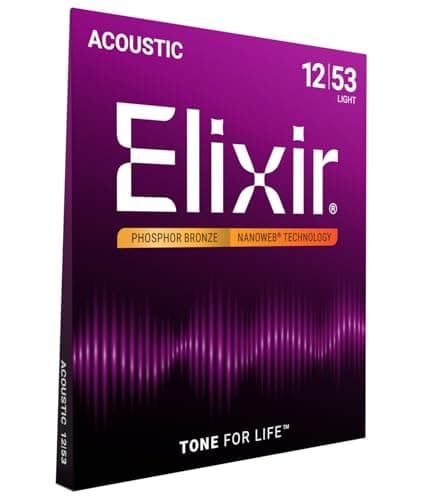
Light acoustic sets are .012–.053. Medium sets are .013–.056. One thousandth of an inch on the top string, three on the bottom — and a meaningful jump in how much force every chord costs you.
The case for medium is real: more tension driving the top means more volume and more low end, which is why heavy strummers and bluegrass players use them. The case against, for a beginner, is also real, and it is that a guitar which hurts gets played less.
What the numbers say
D'Addario publishes tension per string. For the light EJ16 set the six strings measure 23.4, 23.3, 30.1, 29.9, 28.9 and 24.9 lb, totaling 160.5 lb across the neck.
Moving to a medium set raises every one of those figures. Exactly how much depends on the set, and D'Addario publishes the figures for theirs — which is the reason this page can talk about tension at all rather than adjectives.
What tension does not tell you directly is fretting effort, because that depends on action height and scale length as well. But tension is the part you control by choosing a set, and it is the part that is published.
~10%
Roughly how much total neck tension rises going light to medium
Enough that a guitar set up for lights can develop more forward bow, higher action and shifted intonation on mediums.
Light vs medium, plainly | Light (.012–.053) | Medium (.013–.056) |
|---|
| Fretting effort | Lower | Noticeably higher |
| Volume and low end | Balanced | Fuller, louder |
| Bending | Possible | Hard work |
| Suits | Most guitars, most players, all beginners | Heavy strummers, flatpickers, bigger bodies |
| Effect on neck | What most guitars are set up for | More forward bow; may need a setup |
| Risk on a small-bodied guitar | None | Real — check the maker's recommendation |
The structural caution
Some acoustics — particularly small-bodied, parlor and vintage instruments — are built for light strings and their makers say so. Fitting mediums to a guitar not designed for them puts sustained extra load on the top and the bridge.
If your guitar came with a recommended gauge, follow it. If you cannot find one and the guitar is small-bodied or old, stay on lights. This is the one place in the strings category where the wrong choice can do slow structural damage rather than just feel unpleasant.
When medium is the right answer
- You strum hard and lights buzz or sound thin under your right hand.
- You play flatpicked bluegrass or anything where volume and projection are the point.
- You have a dreadnought or jumbo body that was built for them.
- Your fingertips are established and effort is not the limiting factor.
When to go the other way instead
If lights already feel like hard work, the useful move is down, not up. Extra light (.010–.047) drops the tension again, and it is the single most effective thing you can do for a guitar that hurts to play — more effective than any accessory on this site.
The other thing to check before changing gauge at all is the action. High action makes every gauge feel heavier than it is, and lowering it is often the real fix. Guitar action too high covers how to tell whether that is your actual problem.
There is a third option people reach for at this point and it is not a gauge at all: silk and steel construction, which lowers tension without changing the number on the packet. It is a real mechanism sold without a single published figure — silk and steel strings explains what you can and cannot verify about it.
What we did not doWe have not played any of this gear. Every guide in this category says it tested twenty tuners; we would rather say plainly that we tested none. What we did instead is on this page in full: published specifications with their sources, the makers' own manuals read rather than paraphrased, and a note wherever a company publishes nothing at all.
The honest recommendation
Stay on lights for the first year. If the guitar hurts, go lighter, not heavier. Revisit mediums when your hands are established and you can name a specific thing you want that lights are not giving you — usually volume under a heavy pick hand.
A gauge change is cheap and reversible, so this is a decision to experiment with rather than agonize over. The gauge guide has every common option in one table.