Several pages on this site end at the same sentence. The headphone amp page says a headphone amp works "only with an acoustic that has a pickup and an output jack". The practice headphones page says the same. Neither explains how an acoustic gets one, and for most beginners the answer sounds like it involves a workshop and a drill.
It does not have to. Every pickup on this page fits without modifying the instrument and comes back out again, which for a guitar you may not own forever is the single most important property it can have.
The two technologies, because everything follows from this
Magnetic — senses the steel
A magnetic pickup is the same idea as an electric guitar's: a coil around a magnet, sensing steel strings moving through a magnetic field. It drops into the soundhole and clamps to the edges.
It is louder, far more resistant to feedback, and it does not hear the room. What it also does not hear is your guitar: it senses the strings and not the top, so an amplified magnetic pickup sounds closer to a clean electric than to the instrument in your hands. Whether that is a problem depends entirely on what you want it for.
It does not work on nylon strings at all. Nylon does not move through a magnetic field. If your guitar is a classical, skip to the piezo section — see also the classical starter kit page.
Piezo — senses the vibration of the wood
A piezo sensor produces a voltage when it is physically compressed, so it reads the vibration of whatever it is attached to. Mount it to the bridge or the top and it hears the guitar rather than the steel.
That gets you much closer to the sound of the instrument, and it works on any acoustic instrument including nylon-string guitars and ukuleles. The costs are real: piezos are more feedback-prone at volume, and they have a characteristic hard attack — the "piezo quack" — that some players never learn to like.
0 of 5
Pickups here that require modifying the guitar
Every one clamps, mounts or sticks on and comes back off. Under-saddle pickups, which need the saddle removed and a hole drilled through the guitar, are deliberately not on this page.
The criteria, in the order they decide it
1. Does fitting it change the guitar permanently
This is first and it is not close. An under-saddle pickup — the type fitted to most factory electro-acoustics — requires lifting the saddle, drilling through the bridge and usually cutting a hole in the side for the endpin jack. That is a permanent alteration to an instrument, it is technician work, and it costs more in labor than every pickup on this page costs outright.
Everything ranked below is removable. If you sell the guitar, or decide in three months that you never plug in after all, you take the pickup out and the guitar is exactly as it was.
2. Does it need a battery
Passive pickups need no power at all. Active ones have a preamp inside and need a battery, which gives more output and usually some tone control, and adds a thing that dies mid-song.
Four of the five here are passive. For a beginner that is the right default: fewer failure points, nothing to remember, and a passive pickup into a decent amp is perfectly loud for a room.
3. Feedback behavior, which decides whether you can play loud
An acoustic guitar is a hollow box with a hole in it, which makes it an excellent resonator for the sound coming out of an amplifier pointed at it. Above a certain volume it will howl.
Magnetic pickups resist this far better than piezos because they do not sense air movement at all. This single difference is why almost every acoustic player who performs loudly ends up with a magnetic pickup, whatever they think of the tone.
Whichever pickup you fit, the cheapest thing that reduces the howl is to block the hole: soundhole covers compares the two makers that publish a fit diameter, and lists the free control settings to try first.
4. What the maker actually publishes
Very little, is the honest answer. Of the five here, not one publishes an output level or an impedance figure. Seymour Duncan describes the Woody HC as "moderate output", which is a word rather than a number. LR Baggs publishes "highly feedback resistant", which is a claim rather than a measurement.
What they do publish, and what we have ranked on, is the sensing method, the mounting method, whether power is required and the construction. Every spec card here marks the missing figures as unpublished rather than filling them in.
The picks
Seymour Duncan Woody SC — best first pickup
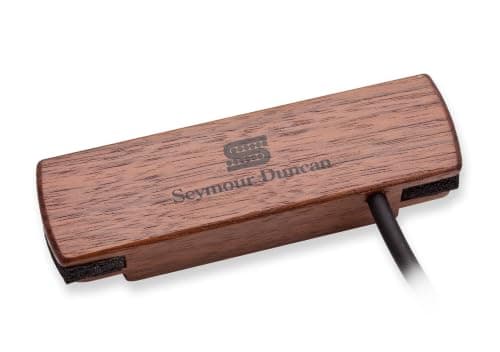
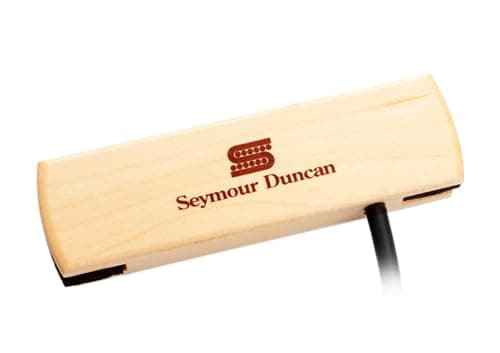
A passive magnetic single coil in a maple housing that mounts in the soundhole with no modification to the guitar and no battery. Seymour Duncan publishes the part number (SA-3SC) and states the no-modification mounting explicitly.
It wins because of what it lets you undo. This is the purchase that answers "do I actually want to plug this guitar in" for a modest sum, and if the answer turns out to be no, you remove it and nothing happened.
Against it: a single coil hums near stage lighting, computer screens and dimmer switches, and that is a real nuisance rather than a theoretical one. Being magnetic, it sounds more like an electric than like your guitar. The cable hangs out of the soundhole, which is exactly as tidy as it sounds. And no output figure is published, so you cannot plan a gain match on paper.
KNA SG-1 — most like your actual guitar
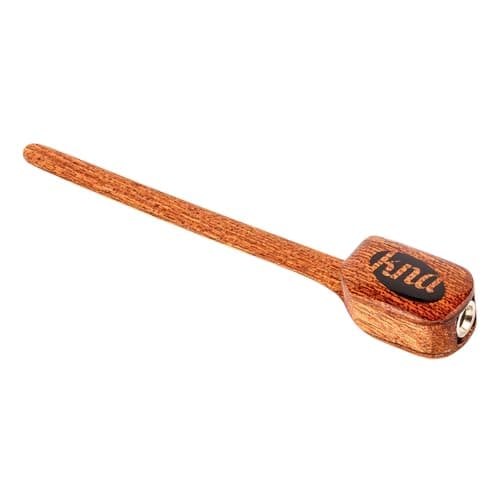
A passive piezo sensor in a small wooden housing that attaches to the bridge without modification. Because it reads the top of the guitar rather than the steel, it is the pick on this page that sounds most like the instrument you own.
It is also the one that works on a nylon-string guitar, which rules out every magnetic pickup here.
Against it: piezos feed back sooner than magnetics, and this model is passive with no notch filter to fight it, so it is not the choice for a loud stage. There is no volume control on the SG-1 — KNA puts one on the SG-2 instead — so you are adjusting at the amp. The piezo attack is divisive. And KNA publishes no output or impedance figure we could find.
Seymour Duncan Woody HC — best where there is hum
The same instant-mount magnetic design with the hum designed out. If you have ever heard a single coil next to a laptop or under stage lighting, the difference is not subtle and it is the whole reason this exists.
Seymour Duncan publishes that it is double potted — the construction that stops a pickup squealing microphonically at volume — and houses it in a maple cover.
Against it: hum-canceling designs are warmer and less bright than single coils, so this is a tonal trade rather than a straight upgrade. It costs meaningfully more than the SC for a problem you may not have at home with the screens off. It is still magnetic, so it still sounds more like an electric. And "moderate output" is a description rather than a specification.
KNA AP-2 — cheapest way to find out
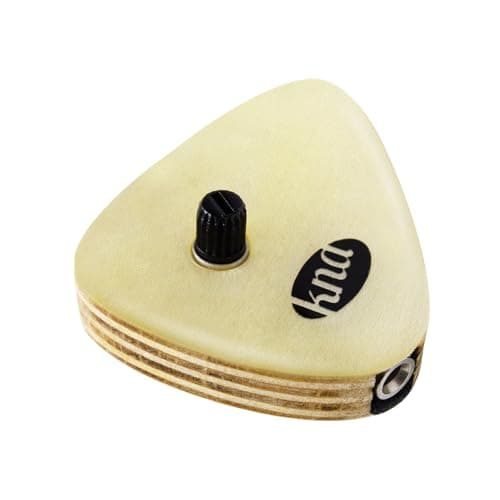
A surface-mount piezo with an onboard volume control, at the lowest price on this page, that works on a guitar, a ukulele or anything else with a top that moves. If the real question is "is amplifying my acoustic something I will actually do", this answers it for the least money.
The onboard volume control is a genuine advantage over the SG-1 above, which has none.
Against it: surface mounting is the most position-sensitive approach here, and where you stick it changes the sound substantially, so expect to move it around. It is the most feedback-prone option on the page. A universal sensor is a compromise on every instrument rather than optimized for one. And no output figure is published.
LR Baggs M1 — best if you play out
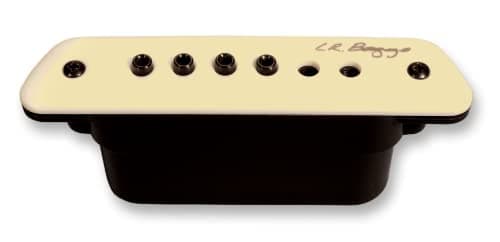
The pickup that addresses the central complaint about magnetics head on: LR Baggs publishes that the M1 blends string signal with body signal, so it hears some of the guitar rather than only the steel. It also publishes adjustable pole pieces for string balance and describes it as highly feedback resistant.
For someone who has decided they are playing through a PA, this is the one on the page built for that job.
Against it: roughly three times the Woody SC, which is a lot for a first pickup. Stock was thin when we checked. It is still magnetic, so still steel-string only. And the feedback resistance is published as a claim rather than as a measured figure, which on a page ranked this way is worth stating plainly.
Side by side
What each maker publishes| Pickup | Sensing | Power | Nylon strings | Modifies guitar | Output figure |
|---|
| Woody SC | Magnetic, single coil | Passive | No | No | Not published |
| KNA SG-1 | Piezo, bridge mount | Passive | Yes | No | Not published |
| Woody HC | Magnetic, hum canceling | Passive | No | No | Described, not published |
| KNA AP-2 | Piezo, surface mount | Passive | Yes | No | Not published |
| LR Baggs M1 | Magnetic, string + body | Passive | No | No | Not published |
Read the last column. This is a category where nobody publishes the figure that would let you compare two products numerically, so the decision has to be made on method instead.
What else you need to actually hear it
A pickup on its own makes no sound. The rest of the chain is already covered here and is worth pricing before you buy:
A cable. Ten feet is plenty for a room, and at that length cable quality has very little audible effect — the budget cable page sets out what the cheap ones give up, which turns out to be the warranty rather than the tone.
Something to plug into. A headphone amp is the cheapest and by far the quietest option, and with a pickup fitted it finally works on your acoustic. A practice amp is the answer if you want to be heard in a room — though a guitar amp voiced for electric guitar is not a flattering match for an acoustic pickup, and an acoustic-specific amp or a PA is the better long-term answer. The acoustic amp roundup works through that choice, including the cheaper answers that are not an amp at all. If the venue has a PA, what you need instead is a preamp or a DI — and a piezo pickup in particular wants a much higher input impedance than an ordinary input provides.
Headphones, if you went the quiet route. Closed back and wired — headphones for guitar practice covers why the plug size matters more than the sound.
What a pickup will not do
It will not make a quiet guitar louder acoustically. It only does anything when plugged in. A guitar that sounds thin unamplified sounds thin amplified, and the fix for that is strings and a setup rather than electronics.
It will not sound like the recording in your head. The amplified acoustic sound on records is usually a microphone, or a microphone blended with a pickup, processed afterwards. A single soundhole pickup into an amp is a different thing and knowing that in advance saves disappointment.
It will not fix tuning or intonation. Plugging in makes both more obvious, not less — see the acoustic tuner roundup.
What we would actually buy
Steel-string guitar, playing at home, unsure whether you will use it: the Woody SC, because it costs little and comes back out. Nylon strings, or you want it to sound like your guitar: the KNA SG-1. On the smallest budget, or you also own a ukulele: the AP-2. Playing through a PA in front of people: the LR Baggs M1, and budget for the cable and the amp at the same time rather than afterwards.
What we did not doWe have not played any of this gear. Every guide in this category says it tested twenty tuners; we would rather say plainly that we tested none. What we did instead is on this page in full: published specifications with their sources, the makers' own manuals read rather than paraphrased, and a note wherever a company publishes nothing at all.