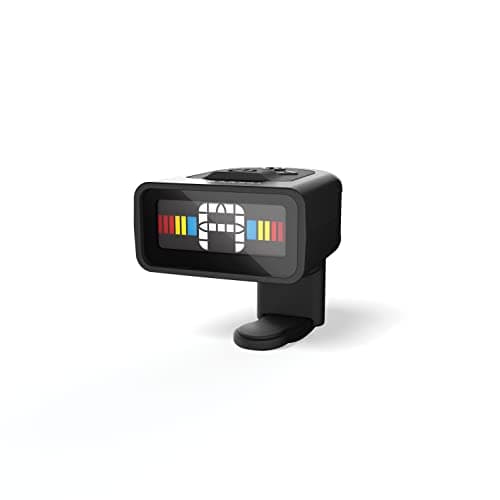
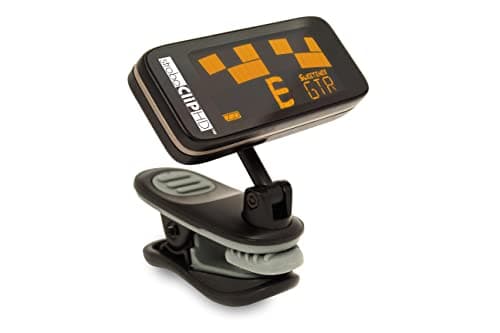
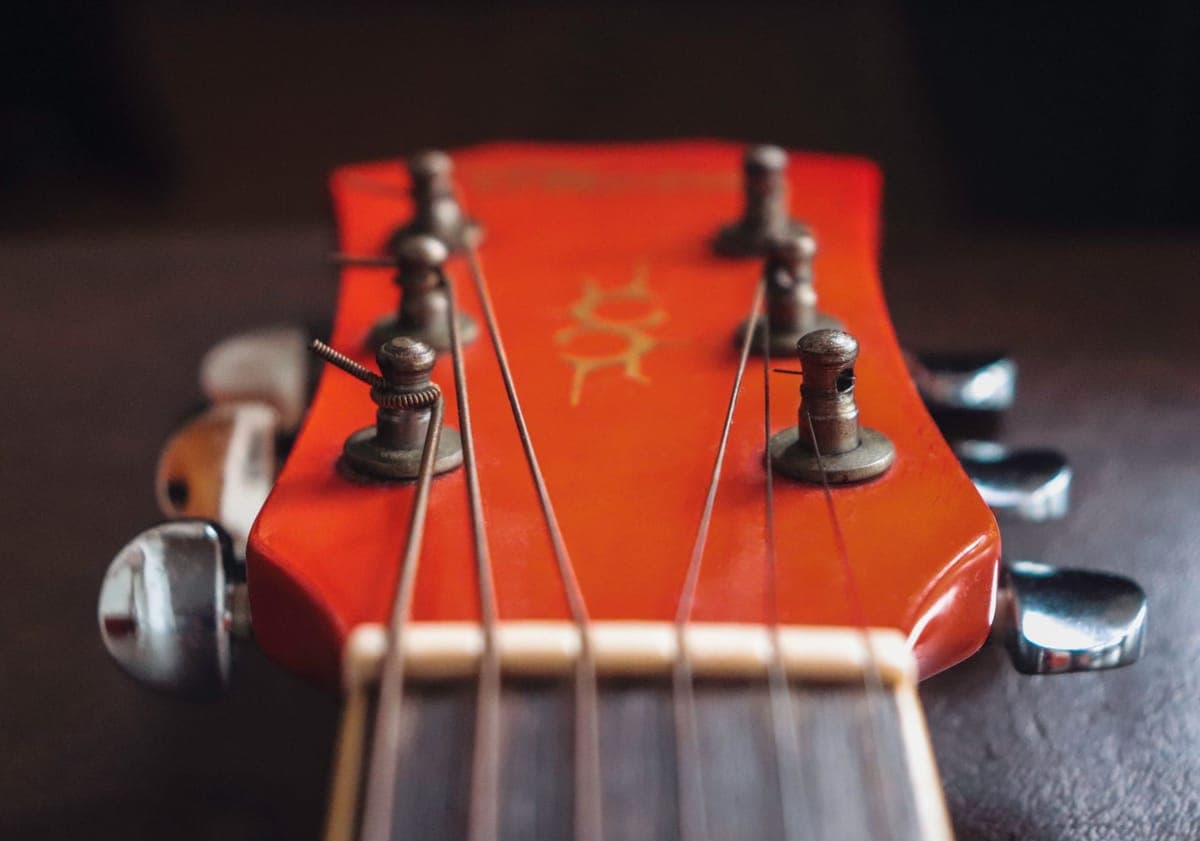
An acoustic guitar with no pickup produces no electrical signal, which rules out every pedal tuner ever made. That leaves two options: a microphone-based tuner, which fails the moment the room is not silent, and a clip-on, which reads the vibration traveling through the headstock and does not care about room noise at all.
So the real question is not which type but which clip-on, and that comes down to four things: whether the maker publishes an accuracy figure, how long the battery lasts, whether the clamp holds, and whether you can read the display without moving your head.
Accuracy: two of these four publish a number
Korg publishes ±1 cent for the Pitchclip 2. Peterson publishes ±0.1 cent for the StroboClip HD. Snark and D'Addario publish nothing we could find on any product page or manual.
That absence is not proof of inaccuracy. Both are widely used and widely liked, and a tuner does not have to publish a figure to work. It is, however, a statement about what each company is willing to be held to, and on a spec sheet silence is information. We report it as a row that reads "Not published" rather than quietly leaving the row out, because leaving it out is how a comparison table starts lying by omission.
For context on what the numbers mean: a cent is one hundredth of a semitone. Human hearing starts noticing mistuning somewhere around five to ten cents on a sustained note. ±1 cent is comfortably finer than your ear. ±0.1 cent is finer than most guitars' own intonation, which is why it is a setup tool rather than a tuning tool.
Published specifications, side by side| Model | Accuracy | Battery | Weight |
|---|
| Korg Pitchclip 2 | ±1 cent | CR2032, approx. 24 h | 17 g |
| Korg Pitchclip 2+ | ±0.1 cent | approx. 18 h | Not published |
| Snark ST-8 | Not published | CR2032 | Not published |
| D'Addario Micro (PW-CT-12) | Not published | Not published | Not published |
| Peterson StroboClip HD | ±0.1 cent | Not published | Not published |
Battery: the spec that decides whether it works when you pick it up
Almost everything here runs on a CR2032 coin cell. Korg publishes approximately 24 hours for the Pitchclip 2 — and that is playing time, not shelf time. Twenty-four hours sounds like a lot until you realize it is twenty-four hours of the tuner being on, and that a tuner left clipped to a headstock with the display lit does not know you have gone to bed.
Practical consequence: buy a strip of CR2032 cells at the same time as the tuner and keep one in the case. They cost very little and a dead tuner at the start of a practice session is genuinely annoying.
The clamp is what actually breaks
Across every brand in this category, the failure is the clip. A spring-loaded plastic hinge fatigues, and eventually the tuner slides off a headstock while you are playing.
D'Addario's answer is a ratchet clamp rather than a friction spring, which holds position mechanically instead of relying on spring pressure. Peterson's answer is a metal-bodied clip. Nobody in this category publishes a cycle rating, so this is a design argument rather than a measured one, and we will say so rather than dress it up.
Reading it from the playing position
This is the thing that separates a tuner you use from one you fight. The Snark's display rotates a full 360 degrees on its clip, so it can be pointed at your eyes regardless of where on the headstock it sits — and it is a full-color screen, which is easier to read at a glance than monochrome.
The D'Addario Micro goes the other way: it is designed to hide behind the headstock so an audience never sees it, with four selectable viewing angles. That is a great feature on stage and a slight nuisance in a bedroom, where a bigger screen wins.
What we did not doWe have not played any of this gear. Every guide in this category says it tested twenty tuners; we would rather say plainly that we tested none. What we did instead is on this page in full: published specifications with their sources, the makers' own manuals read rather than paraphrased, and a note wherever a company publishes nothing at all.
Which one to buy
If you want the numbers published before you spend anything, the Pitchclip 2. If you want the screen that is easiest to read while holding a guitar, the Snark. If you want the tuner nobody can see, the D'Addario Micro. If you have decided to buy once and are willing to learn a strobe display, the Peterson.
Any of the four will get an acoustic guitar in tune, and the difference between them matters far less than the difference between owning one and not. How to use a clip-on tuner covers the part that actually catches people out.