Buying a headphone amp is the single cheapest way a beginner buys practice hours, and it arrives with a problem nobody mentions in the listing: it does not come with headphones. Neither does a practice amp. The headphone socket is the whole reason you bought either of them and it is the one thing left empty in the box.
So people reach for whatever is in the drawer, which is usually a pair of wireless earbuds, and discover that playing guitar through them is strange in a way they cannot name. That is not a tone problem. It is a timing problem, and it has a fix that costs less than a set of strings.
The four things that decide this, in order
Everything below is chosen against these four, in this order. None of them is frequency response, which is where most headphone advice starts and which is the least useful thing to know when the signal is a guitar and the room is a bedroom.
1. The plug, and whether the adapter is in the box
This is the one that ruins evenings. Guitar gear does not agree with itself about socket size. The devices built for silent practice use the small one: Boss publishes a 3.5 mm stereo mini jack for the Katana-Mini's phones output, and Fender publishes a 1/8" stereo headphone output on the Mustang Micro — the same socket under two names. Step up to a full-size combo and it flips: Boss publishes a 6.3 mm stereo jack for the headphone output on the Katana 50 Gen 3.
A beginner rarely owns only one of those, and rarely owns the same one in two years. The answer is a headphone that terminates in a 3.5 mm plug and ships with a 6.3 mm adapter, because that combination fits every socket in the paragraph above. All four picks on this page do exactly that, and three of the four use an adapter that screws onto the plug rather than pushing over it.
That distinction is worth more than it sounds. A push-on adapter is a loose sleeve on the end of a cable that is being pulled sideways every time you shift in a chair. It works its way off inside the socket, and the first sign is one channel dropping out mid-song. A screw-on adapter is part of the plug until you unscrew it.
2. Impedance, because the amp driving it is tiny
Impedance is how hard the headphone is to drive, in ohms. A phone, a laptop or a matchbox-sized headphone amp running off a battery has a weak output stage, and a high-impedance headphone plugged into a weak output is quiet — not distorted, not broken, just disappointing at full volume.
The four here run from 35 Ω to 64 Ω, all published, and every one of them works from a headphone amp. But the spread is real and it runs in a useful direction: the ATH-M40x is the easiest load at 35 Ω, the ATH-M20x next at 47 Ω, then the MDR-7506 at 63 Ω and the HD 280 PRO at 64 Ω. If your practice rig is a battery-powered unit hanging off the guitar jack, buy toward the bottom of that range.
What to avoid entirely is the 250 Ω and 600 Ω studio-monitoring versions of these same product families. They exist, they are sold in the same aisle, and they are designed for a desk amplifier that you do not have.
32 dB
Sennheiser's published external sound insulation for the HD 280 PRO
It is the only isolation figure any of these four makers publishes. Audio-Technica and Sony publish none on the listings we checked, so the row on their spec cards says so.
3. Closed back, or the silent practice is not silent
An open-back headphone has a perforated outer cup. It sounds more open and it leaks sound in both directions by design — that is the design. For listening to music alone in a room it is a genuine advantage. For practicing guitar at eleven at night in a house with other people in it, it defeats the entire purchase.
Semi-open designs, including some of the most commonly recommended studio headphones in the world, have the same problem in smaller measure. This is the one place where the standard internet recommendation and the guitar-practice use case genuinely diverge, and it is worth ignoring the standard recommendation. Every pick here is closed back.
Only Sennheiser puts a number on how much that is worth: 32 dB of external sound insulation. Audio-Technica and Sony publish no attenuation figure at all on the listings we checked, so their spec cards carry a row saying exactly that rather than a figure we estimated.
4. Wired, and the cable shape you will actually live with
Bluetooth headphones add latency — a delay between the string moving and the sound arriving. For listening it is invisible. For playing it is not, because your hands are correcting against what you hear, and a delayed signal teaches your hands to correct against something that already happened. Every pick here is wired, and that is not a budget compromise.
Cable shape then splits the four cleanly. A coiled cable — the MDR-7506, the HD 280 PRO, one of the two leads supplied with the M40x — sits short at rest and stretches when you stand, which is the right behavior when the socket is across the room in an amp. A straight 3 m cable is better when the socket is on the guitar itself and the slack has nowhere to go but the floor. The M20x is straight-only, the M40x supplies both, and the M40x's cable is the only detachable one here.
The four, side by side
Published specifications | ATH-M20x | MDR-7506 | HD 280 PRO | ATH-M40x |
|---|
| Impedance | 47 Ω | 63 Ω | 64 Ω | 35 Ω |
| Back | Closed | Closed | Closed | Closed |
| Isolation published | No | No | 32 dB | No |
| Cable | 3 m straight | 1.2–3 m coiled | 1–3 m coiled | Coiled + straight |
| Cable detachable | No | No | Replaceable | Yes |
| 6.3 mm adapter | Included | Screw-on | Screw-on | Threaded |
| Weight, no cable | 200 g | 230 g | 273 g | 241 g |
Read that table across the impedance row and the cable row and the decision more or less makes itself. Everything else is preference.
Why each one won what it won
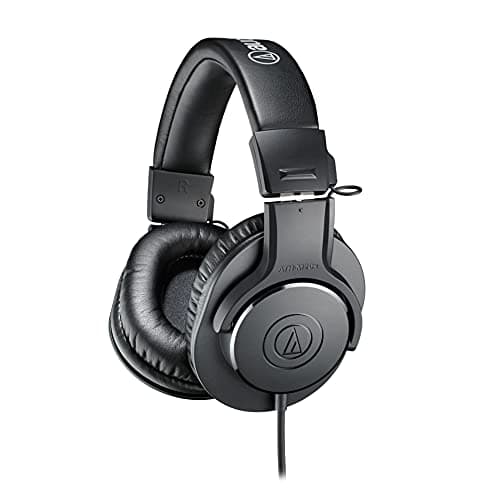
ATH-M20x — best first pair
It is the cheapest pair on the page that gets all four criteria right at once, and there is nothing else to say for it, which is the compliment. Closed back, 47 Ω, 3.5 mm plug with a 6.3 mm adapter, 200 g. If your practice rig is a headphone amp on the end of the guitar, this is the correct amount to spend.
The honest catch is the cable. Three meters is a lot of slack for someone sitting still, it is fixed to the cup, and on any headphone in this class the cable is the part that dies first. When it goes, the headphone goes with it.
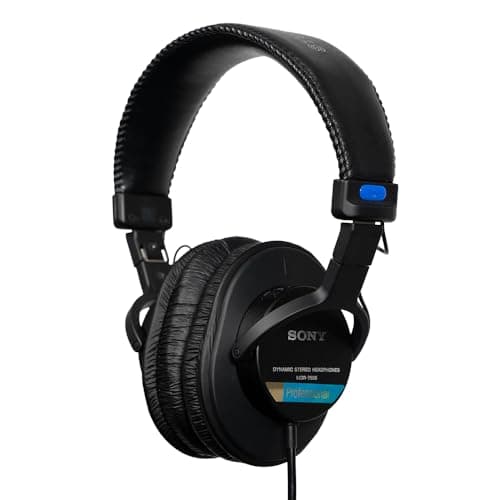
Sony MDR-7506 — best at an amp
The coiled lead is the argument. It is 1.2 m at rest and extends to 3 m, so it stays off the floor while you sit and still reaches when you stand up to reach the amp. The 6.3 mm adapter screws on. It folds flat enough to live in a gig bag pocket, which none of the others really do.
Two honest marks against it: the cable is not detachable, which is a worse trait on a coiled lead that gets tugged than on a straight one that lies still; and the flaking of the ear-pad coating with age is reported by long-term owners often enough that it should be treated as expected rather than as bad luck. Replacement pads are sold. At 63 Ω it is also the second-hardest of the four to drive loud from a battery unit.
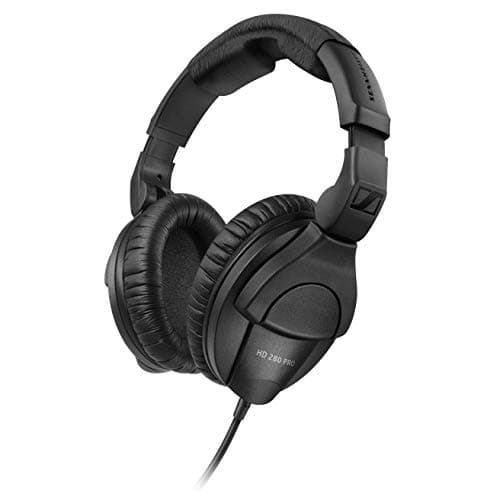
Sennheiser HD 280 PRO — best published isolation
This is the pick for the actual constraint most beginners are under, which is not sound quality but other people. Sennheiser publishes 32 dB of external sound insulation. Nobody else on this page publishes a number, and a published number is the difference between a claim and a specification — the whole premise of how we work.
The cost of that number is grip. It is the tightest-fitting pair here and the heaviest at 273 g, and clamping pressure is the most common complaint about it. It is also 64 Ω, the highest impedance on the page, so it is the quietest of the four from a weak output. It is repairable in a way the others are not, though: the cable is listed as replaceable and the pads and headband padding are sold as spares.
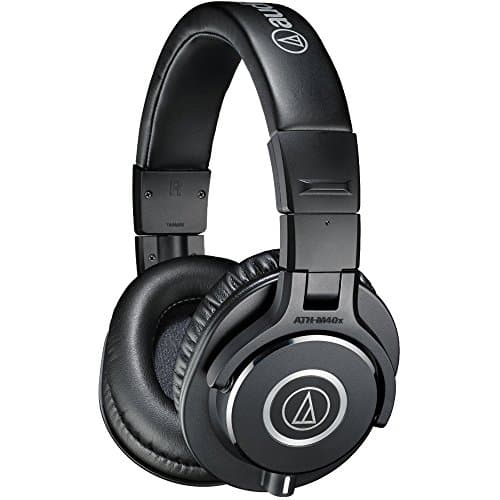
ATH-M40x — best if you will record
At 35 Ω it is the easiest load here, which makes it the loudest of the four from a matchbox amp — a slightly counterintuitive result, since it is also the most expensive. It ships with both a coiled and a straight cable and the cable is detachable, so a failed lead is a spare part rather than a new headphone.
The catch is what you are paying for. Against the M20x you are buying a second cable, a pouch, a detachable connector and a wider published frequency range. If you are only ever going to plug into one device and practice, the M20x already does that job and the difference is not one most beginners will hear.
What not to buy for this
Wireless anything. Covered above, and it is the single most common mistake. Latency is not a preference.
Open-back or semi-open studio headphones. Widely and correctly recommended for mixing. Wrong tool here, because the leak is the point of the design.
The 250 Ω version of any of these. Same badge, different job. It wants a desk amplifier.
A separate headphone amplifier or DAC. Not at this stage. The thing on the end of your guitar already is one, and adding a box between them buys nothing you will notice in year one.
If you play acoustic
None of this applies unless your acoustic has a pickup and an output jack. An acoustic guitar with no electronics produces no signal to send anywhere, and it is already quiet enough that the problem headphones solve does not exist. If quiet practice is the goal on a purely acoustic instrument, the honest answers are playing more softly and practicing to a click rather than buying anything.
If you do want to plug the acoustic in, that is a fixable gap rather than a dead end: a removable acoustic pickup clamps into the soundhole or mounts to the bridge without modifying the guitar, and it is what makes everything on this page apply to an acoustic at all.
Where this sits in the order of buying
Behind the tuner, behind strings, behind a case — and immediately alongside whatever you bought to make silent practice possible in the first place. A headphone amp with no headphones is a paperweight, and this is the cheapest purchase on the site that converts one piece of gear you already own into hours you would not otherwise have played. The electric starter kit puts the rest of it in sequence.
What we did not doWe have not played any of this gear. Every guide in this category says it tested twenty tuners; we would rather say plainly that we tested none. What we did instead is on this page in full: published specifications with their sources, the makers' own manuals read rather than paraphrased, and a note wherever a company publishes nothing at all.