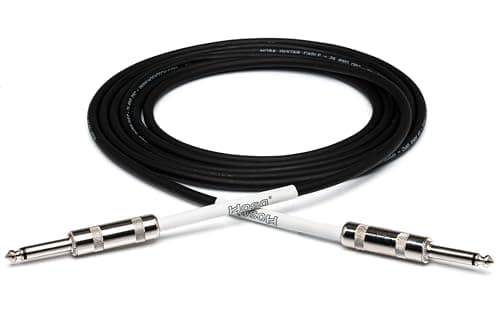
Our main cable page argues that the best guitar cable is the one that comes with a warranty, and that is still the position. This page is the other half of the same question: what happens if you do not want to spend that much, what exactly you give up, and which cheap cable gives up the least.
The short answer up front. A cable under fifteen dollars will not sound worse than an expensive one when it is new. What it gives up is a replacement promise and, usually, any published figure describing how it is built. Those matter in year three, not week one.
One thing no price bracket protects you from: a lead that is not an instrument cable at all. Instrument cable vs speaker cable sets out the published construction difference and which of the two swaps can actually damage an amp.
The criteria, in the order they decide it
1. Warranty — the thing expensive cables actually sell
The premium cable market runs on lifetime replacement. That is a real product feature and it is most of the price gap. A cable that dies gets replaced free rather than re-bought, which over a decade of a cable being trodden on and yanked out by the lead is a genuine saving.
None of the three budget cables here publishes a warranty statement on the listing we checked. That is the honest headline of this page and it is exactly what you are buying instead of.
2. Published construction, which almost nobody prints
The figures that would let you compare cables properly are conductor gauge, shield type and capacitance in picofarads per foot. Capacitance is the one that has an audible consequence: more of it over a long run rolls off high frequencies.
Not one cable on this page publishes a capacitance figure— not the budget three and not the Fender. That is worth sitting with, because capacitance is the entire technical basis of the "cheap cables sound worse" claim, and the industry does not publish it at any price point.
0 of 4
Cables here whose maker publishes a capacitance figure
Capacitance is the only specification with a genuinely audible consequence over a long cable run, and nobody at any price publishes it. Every spec card here says so.
3. Connector type and whether an angled end is included
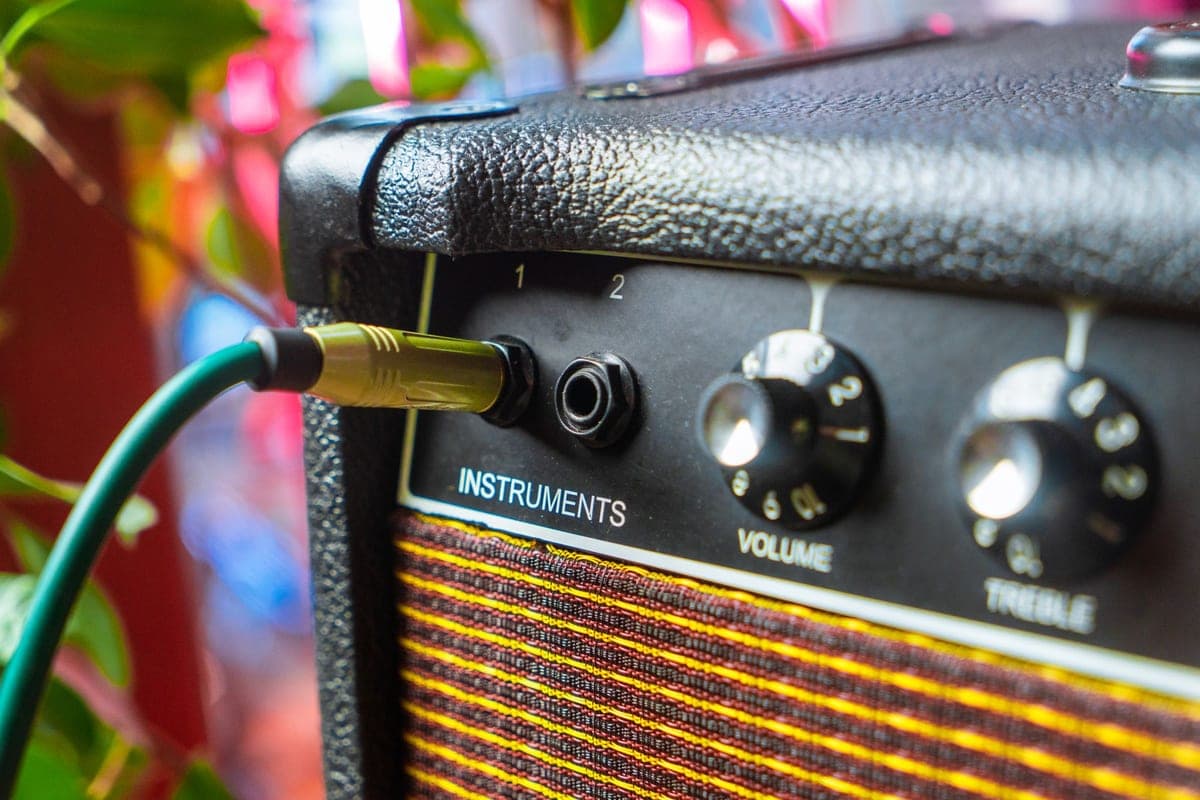
A right-angle plug matters more than it sounds. On a Stratocaster-style guitar the jack is on the face of the body, and a straight plug sticks out where your forearm goes. On a Les Paul-style guitar the jack is on the side and a straight plug is fine.
Some cables charge extra for the angled version. One here includes it as standard.
4. Jacket, because kinks are how cheap cables actually die
Budget cables rarely fail electrically. They fail where the cable meets the plug, after enough cycles of being coiled badly, trodden on, and pulled out by the cable instead of the jack. A braided or woven jacket resists that better than smooth PVC; a molded strain relief matters more than either.
The picks
Hosa GTR-210 — best cheap spare
The long-standing budget default, with all-metal connectors at a price below most single sets of strings. Buy it as the cable that lives in the gig bag so that a dead cable is an inconvenience rather than the end of a rehearsal.
Hosa is also stocked everywhere, which is a real feature for a consumable: you can replace it the same day, anywhere.
Against it: no published warranty, no published capacitance, and at this part number it is straight-to-straight only — so on a face-mounted jack it is the least comfortable of the three. It publishes the least about its own construction of anything here.
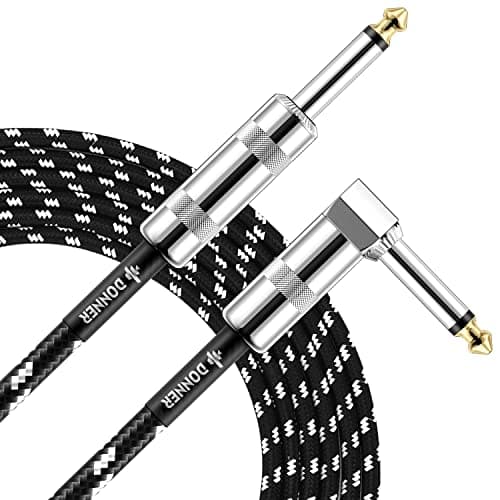
Donner 10 ft right angle — most published construction
The cheapest cable on this page and, slightly against expectation, the one that tells you the most about itself: 24 AWG oxygen-free copper conductors, a high-density stranded copper double shield, metal connectors. That is more construction detail than Fender publishes for a cable at twice the price.
The right-angle end is included rather than an upcharge, which makes it the natural choice for a Stratocaster-style guitar.
Against it: gold-plated contacts are a marketing feature rather than a tonal one, and the listing leads with them. No published warranty and no capacitance. And it is the least established brand here if something goes wrong — the spec sheet is the strength, not the support.
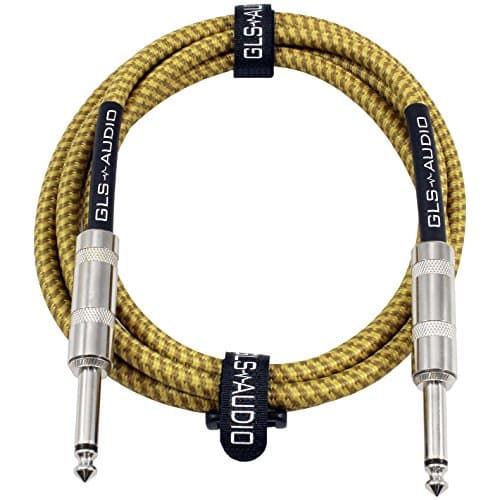
GLS Audio braided 10 ft — best built of the cheap three
Oxygen-free copper under a braided tweed jacket, in the format that resists the kinking that kills cheap cables. It is the top of the budget bracket and it is the one we would buy to actually use daily rather than to keep as a spare.
It also offers straight and angled ends, so the jack-position problem is solvable without changing brand.
Against it: it is roughly double the Donner, which at this end of the market is a meaningful multiple. A braided jacket picks up more lint and carpet fluff than a smooth one. And it publishes no capacitance or warranty either, so the extra money buys build rather than a promise.
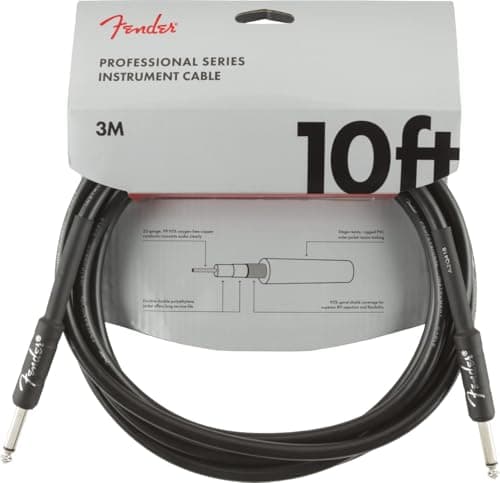
Fender Professional Series — where the warranty starts
Included as the boundary marker rather than as a budget pick. This is roughly double the GLS again, and what the money buys is a brand with a replacement process and an anti-kink construction claim.
If you play out, or if the cable is the only one you own, this is where we would stop being frugal — and it is the argument the main cable page makes at length.
Against it: it publishes no capacitance figure either, so you are paying for a brand and a warranty rather than for a measurably better cable. For a bedroom player with one short run to a small amp, the audible difference against the Hosa is nil.
Side by side
What each maker publishes| Cable | Conductor | Shield | Angled end | Warranty | Capacitance |
|---|
| Hosa GTR-210 | Not published | Not published | Not at this part number | Not published | Not published |
| Donner 10 ft | 24 AWG OFC | Double, stranded copper | Included | Not published | Not published |
| GLS Audio braided | Oxygen-free copper | Not published | Option | Not published | Not published |
| Fender Professional | Not published | Published as shielded | Option | Brand process | Not published |
Read the last column. The specification that the entire expensive-cable argument rests on is published by nobody, at any price on this page.
Does a cheap cable actually sound worse?
Over a short run into a small amp — the situation almost every reader of this site is in — no, not audibly. The physics that makes cable choice matter is capacitance accumulating over length, and at ten feet there is very little length for it to accumulate over.
Where it starts to matter is a long run, or several cables and pedals chained together. That is also the point at which a buffered pedal near the front of the chain becomes the real fix rather than a more expensive cable — the tuner pedal roundup covers which tuners buffer and which bypass.
The honest summary: at ten feet, buy on build and warranty, not on tone.
How to make any cable last
Pull the jack, never the cable. This is the single biggest cause of death at any price.
Coil it over-under rather than round your elbow. Wrapping a cable the same way every time twists the conductor inside the jacket until it breaks.
Unplug when you finish. On many guitars the output jack is the battery switch for active electronics, and on all of them a plugged-in cable is a lever waiting to be tripped over.
What we would actually buy
For a bedroom player with one amp: the Donner, because it costs the least and publishes the most, and an angled end is included. Keep the Hosa in the bag as the spare. Move up to the Fender when the cable starts leaving the house, because at that point the replacement promise is the feature you are buying and none of the cheap three offers one.
What we did not doWe have not played any of this gear. Every guide in this category says it tested twenty tuners; we would rather say plainly that we tested none. What we did instead is on this page in full: published specifications with their sources, the makers' own manuals read rather than paraphrased, and a note wherever a company publishes nothing at all.