The acoustic pickup page ends on a sentence it does not follow up: a guitar amp voiced for electric guitar is not a flattering match for an acoustic pickup, and an acoustic-specific amp or a PA is the better long-term answer. This is that follow-up.
It also starts with the part that will save some readers the whole purchase, because for a lot of people on this site an acoustic amp is the wrong buy.
Three cheaper answers to check first
If you only want to practice quietly, a headphone amp costs a fraction of anything on this page and, with a pickup fitted, works on an acoustic. It is the cheapest route to amplified practice and it is silent, which an amp is not.
If you are playing anywhere with a PA, you do not need an amp at all — you need a DI box or a preamp with an XLR output, and the venue's system does the rest. This is how most professional acoustic players actually work, and it is the reason a stage full of acoustic acts often has no acoustic amps on it.
If you already own an electric guitar amp, try it before spending. It will sound worse than an acoustic amp, for reasons below, and "worse" may still be perfectly adequate for playing along with a friend in a living room.
An acoustic amp earns its money in one specific situation: you want to be heard, unaided, in a room, with your guitar sounding like a guitar. If that is you, read on.
Why an electric guitar amp is the wrong tool
An electric guitar amp is a musical instrument in its own right. It is deliberately voiced — a pronounced midrange, rolled-off extreme treble, and a speaker chosen to add character rather than to reproduce faithfully. Everything that makes it good at electric guitar makes it bad at acoustic.
An acoustic amp is aiming at the opposite target: reproduce the signal the pickup sends, across as full a frequency range as possible, with as little character added as the designer can manage. It is closer to a small PA speaker than to a guitar amp, and that is the correct way to think about the whole category.
The audible result of using the wrong one: an acoustic through an electric amp sounds boxy and mid-heavy, with the string detail and the top-end air missing. It is not broken. It just does not sound like your guitar.
0 of 4
Amps here whose maker publishes a feedback notch filter
Feedback is the defining practical problem of amplifying a hollow instrument, and not one listing we checked states a notch filter or phase switch. Every spec card here marks that as unpublished.
The criteria, in the order they decide it
1. Power, and what each figure actually buys
Watts are the crudest specification here and the one everyone shops on, so it is worth converting them into situations.
15 watts is a bedroom. Loud enough to hear yourself clearly over your own unplugged playing, not loud enough to compete with anything.
40 watts is a room — a coffee shop, a house party, a rehearsal with one other acoustic player. This is where most people buying a first acoustic amp should land.
Beyond that you are into territory where a PA is usually the better answer, because the venue probably has one.
One honest caveat on watts: they are not comparable between an acoustic amp and an electric one. An acoustic amp is trying to reproduce a full-range signal cleanly, which takes far more power than making a midrange-voiced speaker distort pleasantly. Forty acoustic watts is not twice as loud as twenty electric ones.
2. Two channels, because the second one is a microphone
Every amp on this page has two inputs, and the second is an XLR for a microphone rather than a second guitar. That tells you what this category is built for: one person, playing and singing.
What differs is whether the two inputs are genuinely separate channels with their own gain, or two jacks feeding one shared set of controls. Fishman publishes separate gain per channel on the Loudbox Mini Charge. For anyone who sings, that is the difference between mixing and compromising.
3. Feedback control, and the gap in this category
An acoustic guitar is a hollow box with a hole in it, pointed at a speaker. Above a certain volume it will howl, and this is the single most common frustration of amplifying one. Good acoustic amps address it with a notch filter or a phase invert switch.
Not one of the four listings we checked publishes either. That is a real gap and we have marked it as unpublished on every spec card rather than assuming the feature is present because the price suggests it should be. If feedback control matters to you, check the specific manual before you buy — do not take our word or a listing bullet for it. An amp with no notch filter is also the case where a soundhole cover earns its keep, because it attacks the resonance at the guitar instead.
4. Effects, which matter more here than they sound
A bare piezo pickup into a clean full-range amp is a dry, slightly hard sound. A little reverb is not decoration in this context — it is what makes the signal sound like an instrument in a room rather than a direct feed. Three of the four here publish reverb; Fishman publishes chorus as well on the Micro.
The picks
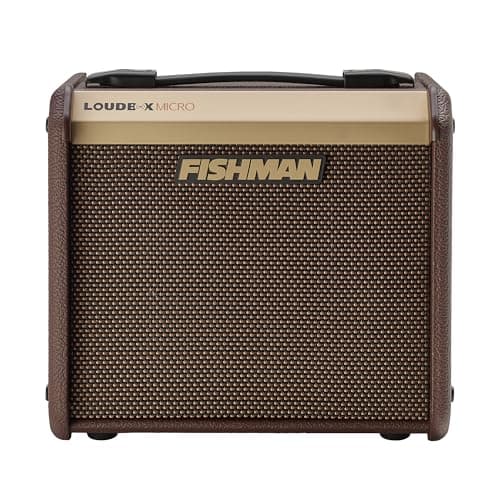
Fishman Loudbox Micro — best first acoustic amp
Forty watts, two channels — instrument and microphone — digital reverb and chorus, a 1/8 inch aux input, from the company that effectively defined this category, at roughly half what the Loudbox Mini Charge costs. For most people buying their first acoustic amp, this is the one.
Forty watts is the useful number, and having chorus as well as reverb gives a dry piezo signal two ways to sound less dry.
Against it: Fishman publishes no headphone output, so silent practice is out entirely. The 5.25 inch cone is small for reproducing a full acoustic range and you can hear that against the Acoustasonic 40's bigger cabinet. No feedback notch is published. And forty watts is a coffee shop, not a band with a drummer.
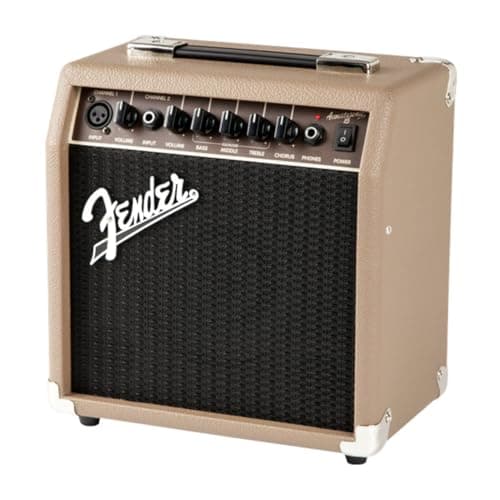
Fender Acoustasonic 15 — cheapest, and the only one with headphones
The lowest price on the page, and the only amp here whose listing publishes a headphone output. For a beginner that matters more than the watt count: it means the amp doubles as the silent-practice solution rather than needing a second purchase.
It also has the XLR mic input, at the bottom of the price range, and at 11.5 by 11.19 by 7.13 inches it is small enough to live on a desk.
Against it: fifteen watts is a bedroom figure and will not hold up against anything. The whizzer cone is Fender's answer to high-frequency response and it is not full-range reproduction in the way the bigger amps manage. No published feedback control. And stock was thin when we checked.
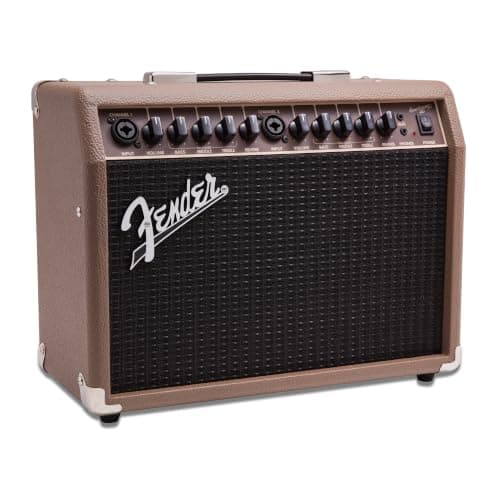
Fender Acoustasonic 40 — most air moved for the money
The same two-input front panel as the 15 with nearly three times the power in a far bigger cabinet — 9.8 by 17.6 by 15.5 inches. That extra cabinet volume is what the Micro cannot match, and on a low-frequency instrument it is audible.
If your use case is filling a room with an acoustic guitar and a voice, this is the most speaker you can get at this price.
Against it: large and heavy next to everything else here. Fender publishes no headphone output for this model, unlike the 15, so it loses the silent-practice trick. No feedback notch published. And it publishes reverb but no chorus, where the similarly priced Fishman publishes both.
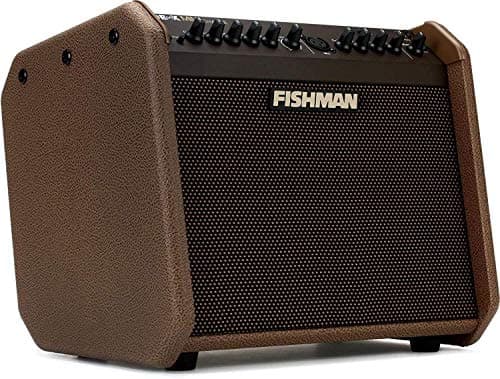
Fishman Loudbox Mini Charge — best where there is no socket
Battery powered, with Bluetooth 4.0 and dedicated instrument and mic channels each with its own input gain. If the reason you want an amp is busking, a farmers market, a garden or anywhere without a wall socket, that single specification outranks every tonal argument on this page.
The separate input gain per channel is also the most real mixing control here — two volume knobs is not the same thing.
Against it: by far the most expensive amp on the page. Fishman publishes no battery-life figure on the listing we checked, which on a product whose entire premise is the battery is a striking omission. It is heavier than the mains-only options because it is carrying a battery. And for anyone who only plays at home it is money spent on a capability that never gets used.
Published specifications, side by side
What each maker publishes| Amp | Power | Channels | Headphone out | Effects | Feedback control |
|---|
| Fishman Loudbox Micro | 40 W | 2, instrument + mic | Not published | Reverb, chorus | Not published |
| Fender Acoustasonic 15 | 15 W | 2 inputs, 1/4" + XLR | Yes | Not published | Not published |
| Fender Acoustasonic 40 | 40 W | 2 inputs, 1/4" + XLR | Not published | Reverb | Not published |
| Fishman Loudbox Mini Charge | Battery | 2, separate input gain | Not published | Not published | Not published |
Read the last column, then the headphone column. Those two are where this category is least forthcoming, and they are the two that most often decide whether an amp actually gets used.
What else you need
A pickup, first. An amp does nothing for a guitar with no electronics. Acoustic pickups covers the removable options that do not mean drilling the guitar.
A cable. Ten feet is plenty for a room and at that length cable quality has very little audible effect — the budget cable page sets out what the cheap ones actually give up.
A tuner you can read on a stage. Plugging in makes tuning problems more obvious, not less. See the acoustic tuner roundup.
Getting a usable sound out of it
Start with the tone controls flat. Acoustic amps are built to be neutral; the temptation to immediately add treble and bass usually undoes the thing you paid for.
Cut, do not boost, to fight feedback. Feedback happens at one frequency at a time. Finding and reducing that band works; turning everything down works but costs you the reason you bought an amp.
Do not point the amp at the guitar. The single cheapest feedback fix is geometry. Behind you, or to the side, and angled away from the soundhole.
A soundhole cover is the last resort and it works. A rubber or plastic plug in the soundhole kills the resonance that causes the howl. It also changes how the guitar sounds unplugged, which is why it is last.
What an acoustic amp will not do
It will not make a bad pickup sound good. The amp reproduces what it is given. A cheap piezo into a good amp is a clearly reproduced cheap piezo.
It will not sound like the record. Amplified acoustic on recordings is usually a microphone, or a microphone blended with a pickup, processed afterwards. Knowing that in advance saves disappointment.
It will not replace a PA at any real volume. Past a room, the venue's system is both louder and better, and a DI box is what connects you to it.
What we would actually buy
Practicing at home and nothing more: none of these — fit a pickup and buy a headphone amp, which is cheaper and silent. Playing to rooms, one guitar and one voice: the Fishman Loudbox Micro, which is the best combination of power, channels and effects here. Wanting an amp that also covers silent practice: the Acoustasonic 15, accepting that fifteen watts is a bedroom. Busking: the Loudbox Mini Charge, and check the battery figure with Fishman directly before you commit, because the listing does not carry one.
What we did not doWe have not played any of this gear. Every guide in this category says it tested twenty tuners; we would rather say plainly that we tested none. What we did instead is on this page in full: published specifications with their sources, the makers' own manuals read rather than paraphrased, and a note wherever a company publishes nothing at all.