Two pages on this site end at the same unfinished sentence. The acoustic pickup page tells you a pickup needs something to plug into, and the acoustic amp page says that if the venue has a PA you want "a DI box or a preamp with an XLR output" instead of an amp. Neither says which one, or why.
This is that page. And the reason it exists is not tone controls. It is impedance.
Why a piezo pickup needs a special input
Most acoustic pickups fitted under a saddle are piezo crystals. They produce a very high-impedance signal, and if the input they meet is too low they lose low end and sound hard and quacky. Radial publishes the plainest explanation in the category:
"Most manufacturers employ a 1 meg-ohm input on their interfaces… The problem is that piezo transducers tend to sound very peaky, squawk and end up losing bottom-end unless they see a much higher load."
That is the whole category in two sentences. A preamp or a piezo-friendly DI presents a much higher input impedance, and the tone you were blaming on the pickup improves before you touch an EQ knob.
10 megohms
The input impedance four different makers independently publish for piezo
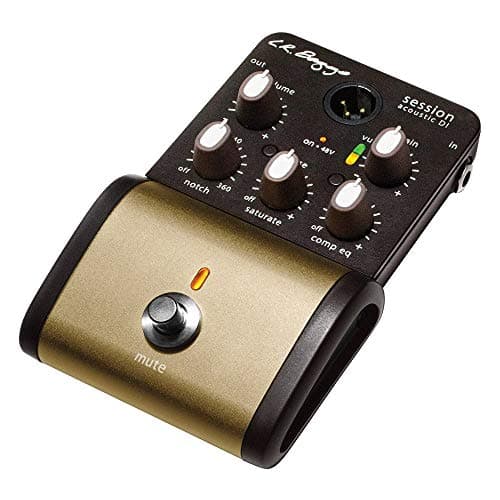
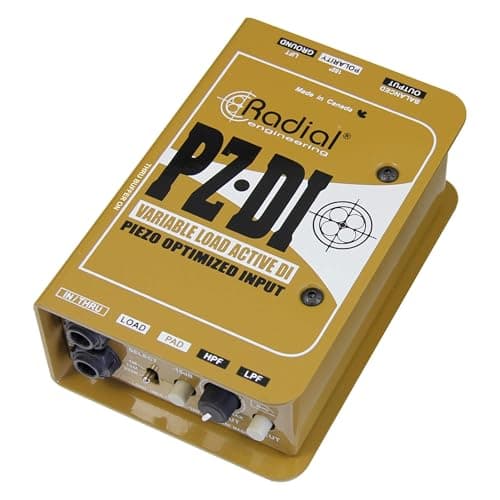
LR Baggs publishes 10 megohms on the Session DI and Venue DI, Fishman publishes 10 M ohms on the Platinum range, and Radial's PZ-DI offers 10 M as its highest setting. A standard guitar amp input is typically 1 megohm.
The criteria, in the order they decide it
1. Published input impedance
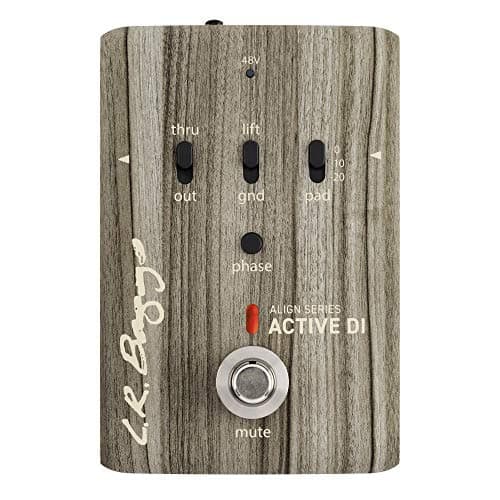
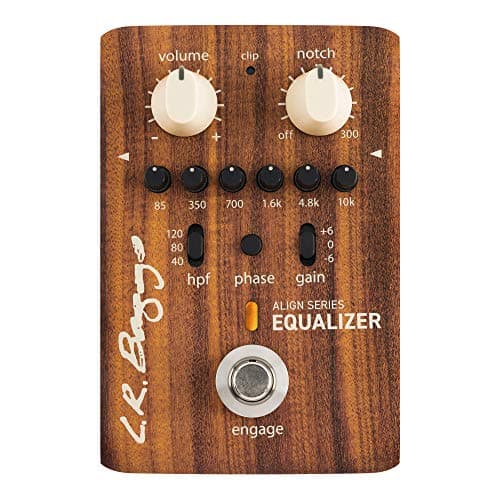
This is the one specification worth shopping on, and happily almost everyone publishes it. Among the products here: Fishman's Platinum Pro EQ and LR Baggs' Session DI both publish 10 megohms; the Align Equalizer publishes 5.1 megohms; the Align Active DI publishes 2.2 megohms; and Radial's PZ-DI lets you switch between 10 M, 1 M and 220 k.
Two cautions worth knowing before you shop wider. Behringer's ADI21 is marketed as super-high impedance but its manual publishes 1 megohm — a tenth of the figure the others use. And Radial's two-channel PZ-Pre defaults to 6.8 k ohms unless you engage a recessed piezo buffer switch. Neither is dishonest; both are the sort of thing you only catch by reading the manual.
2. Notch and phase, which are the feedback tools
An amplified acoustic feeds back, and two controls fix most of it. Fishman's quick-start puts the order plainly: if feedback starts, change the phase switch; if it persists, switch the notch in and dial the offending frequency out.
Published ranges differ and they matter, because acoustic feedback usually sits low. The Align Equalizer publishes -20 dB sweepable from 40 to 300 Hz. Fishman's notch runs 45 Hz to 1 kHz. The Session DI has a notch but publishes no range at all. The two plain DIs here, the Align Active DI and the PZ-DI, have phase but no notch.
3. Whether there is actually an XLR on it
A preamp is not automatically a DI. The Align Equalizer has six bands, a notch and a phase switch — and a quarter-inch output only, so it cannot feed a PA by itself. If the point of the purchase is plugging into a mixing desk, check for the XLR before you check anything else.
4. Power, and how long a battery lasts
Published battery life in this category ranges from 200 hours (LR Baggs Align Session) down to 30 hours (Fishman Platinum Pro EQ), and the pattern is not random: the pedals with built-in tuners drain fastest. LR Baggs' Venue DI publishes the reason in its own current draw — 12 mA without the tuner, 66 mA with it.
Phantom power is the other half of this. The Session DI and the Align Active DI both run on 48V from the desk if you want. The PZ-DI runs on nothing else. And the Venue DI publishes an explicit refusal: "the preamp cannot be phantom powered through the D.I." If you gig without a spare 9V in the case, that distinction decides the purchase.
5. Transformer isolation, if you have ever heard the hum
A balanced XLR output can be built two ways: with an active circuit, or with a transformer that physically isolates your rig from the desk. Transformers cost more and are the stronger answer to ground hum, and almost nobody in this category publishes which one you are getting.
The exception is LR Baggs' Venue DI, whose manual states that "the transformer-coupled D.I provides full isolation through the D.I. output". None of the five products on this page publishes a transformer — the LR Baggs pedals here describe all-discrete signal paths, and Radial's PZ-DI block diagram shows an active output with an isolated internal supply. Each has a ground lift instead, which is the switch you reach for when hum appears.
6. What you are not buying
No maker on this page claims a preamp fixes a bad pickup, and neither do we. It matches the impedance, shapes the tone and gives the desk a balanced signal. That is a real improvement and a limited one.
Published specifications, side by side
What each maker publishes| Product | Input impedance | Notch | XLR out | Battery life |
|---|
| Fishman Platinum Pro EQ | 10 M ohms | 45 Hz–1 kHz | Yes, 600 ohms | 30 hours |
| LR Baggs Session DI | 10 megohms | Yes, range not published | Yes, 470 ohms | 125–150 hours |
| Radial PZ-DI | 10 M / 1 M / 220 k | No | Yes, 200 ohms | No battery, phantom only |
| LR Baggs Align Active DI | 2.2 megohms | No | Yes, 620 ohms | 180 hours |
| LR Baggs Align Equalizer | 5.1 megohms | -20 dB, 40–300 Hz | No | 110 hours |
The picks
Fishman Platinum Pro EQ — best acoustic preamp
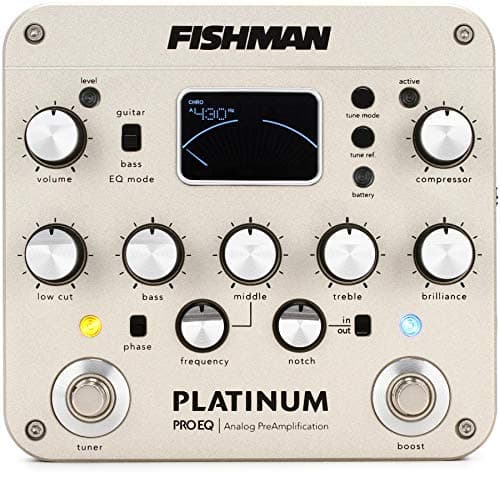
It is the only box here that covers every job: a 10 megohm input, five EQ bands with a sweepable mid, a sweepable notch, a phase switch, a chromatic tuner that mutes the outputs, a compressor, a boost, an effects loop and a balanced DI with a pre/post switch and ground lift. If you are buying once and want no second purchase, this is it.
Against it: 30 hours of published battery life is the shortest here by a distance, and Fishman publishes no phantom power for this model, so you are carrying spares or an adapter. It is also the most expensive pick. And Fishman's own spec table misprints the notch range as 45 Hz to 370 kHz, where the body text says 45 Hz to 1 kHz.
LR Baggs Session DI — best without EQ to get wrong
A different philosophy: instead of tone controls it has three bands of compression that LR Baggs describes as touch-sensitive EQ, plus a saturate control borrowed from studio practice, a notch and a phase button, on a 10 megohm input. Plug in, set two knobs, sound finished.
Against it: if a room has one problem frequency, you cannot simply cut it — there are no EQ bands, and the compression band centers are not published. Its manual also states battery life twice and disagrees with itself, at 125 and 150 hours. Stock was thin when we checked.
Radial PZ-DI — best impedance control
The only box here that treats impedance as a control rather than a fixed design decision: 10 M, 1 M or 220 k, selectable, so one box suits a bare piezo, an active system and a magnetic soundhole pickup. Add a variable low cut from 5 Hz to 500 Hz, a phase reverse, a ground lift that keeps working on phantom power, and a three-year transferable warranty.
Against it: phantom power is the only way to run it — no battery, no DC socket — so it is useless plugged into an amp at home. There is no EQ and no notch. And stock was very thin when we checked.
LR Baggs Align Active DI — cheapest real DI here
If all you need is a balanced output an engineer will be happy with, this is the least you can spend on one from a specialist acoustic maker: XLR with a three-position pad, ground lift, phase, mute footswitch, 180 hours of published battery life and phantom power as an option.
Against it: 2.2 megohms is the lowest input impedance of the LR Baggs pedals here, which matters most with exactly the bare piezo pickups this category is built around. No EQ, no notch. Stock was thin when we checked.
LR Baggs Align Equalizer — best EQ-only option
Six fixed bands at published frequencies, a notch with a published depth and range, a phase button and a high-pass, in a small pedal based on the circuit of the Para Acoustic DI. If your amp already has a DI output and what you lack is tone control, this is the honest buy.
Against it: there is no XLR, so it is not a DI and cannot feed a PA on its own. Its 5.1 megohm input sits below the 10 megohms of the DI-equipped pedals. Stock was thin when we checked.
Considered, and not featured
Four products came out of the research that we would happily point at but could not include, and the reasons are worth publishing.
LR Baggs Venue DI. On specification it is arguably the most complete acoustic preamp made: 10 megohms, five EQ bands with two sweepable mids, a notch published at -21 dB sweepable from 60 to 320 Hz, a tuner that mutes, a 0–9 dB boost, an effects loop and the only transformer-coupled output in this research. It is not on the page because the listing we checked was not purchasable at the time. It also publishes the shortest battery life of the LR Baggs range, 40 hours, and states it cannot be phantom powered.
Radial PZ-Pre. A two-channel preamp with a notch from 56 to 330 Hz and two separate phase switches. The catch is buried in the manual: the input is 6.8 k ohms by default and only reaches 10 megohms when a recessed piezo buffer switch is engaged. For a page built on impedance, that is a trap we would rather describe than recommend.
Behringer ADI21. The obvious budget answer, and out of stock everywhere we looked. Worth knowing anyway: it publishes a 1 megohm input, no notch filter and no phase switch, so the two feedback tools this category is built around are both missing.
Fishman AFX Pro EQ Mini. A five-band acoustic EQ with phase in a tiny enclosure, but there is no XLR and no battery — it is a pedalboard tool that needs external 9V power, not a DI.
Do you need one at all?
If your guitar has an onboard preamp, the kind with a battery box and controls in the side, the impedance job is already done inside the guitar. What a pedal adds is EQ, a notch and a balanced output.
If you only ever play into an acoustic amp at home, the amp input is designed for this and you may need nothing — the acoustic amp page covers that route.
If the venue supplies a DI box, many do, and it will be a general-purpose one. That is the situation where the impedance argument above actually bites, and where bringing your own is worth the case space.
If you have no pickup yet, start there instead — acoustic pickups covers the ones you can fit without drilling the guitar.
Setting one up without a soundcheck argument
Flat first, then cut. Boosting to fix a room adds feedback headroom problems; cutting the offending band does not.
Use the low cut. Radial publishes the mechanism: the PA's low frequencies make the guitar top resonate, and cutting the bass going to the PA reduces that feedback loop.
Phase before notch. It is free, instant and often enough, which is why Fishman lists it first.
Ask before you lift the ground. A ground lift fixes hum from a loop between your rig and the desk. If it does nothing, put it back.
Bring a decent cable. A high-impedance signal over a poor cable is the other half of a thin acoustic sound — the budget cable page sets out what the cheap ones give up.
What we would actually buy
One box for everything, gigging regularly: the Fishman Platinum Pro EQ, with a spare 9V in the case. Wanting a finished sound with two knobs: the LR Baggs Session DI. Playing where there is always phantom power and you want the impedance to match the pickup: the Radial PZ-DI. Needing only a balanced output: the Align Active DI. Already have a DI and need tone and a notch: the Align Equalizer.
What we did not doWe have not played any of this gear. Every guide in this category says it tested twenty tuners; we would rather say plainly that we tested none. What we did instead is on this page in full: published specifications with their sources, the makers' own manuals read rather than paraphrased, and a note wherever a company publishes nothing at all.