A headphone amp plugs directly into an electric guitar's output jack and feeds amp modeling into a pair of headphones. No cable, no speaker, no volume conversation with anyone else in the building.
The argument for buying one before a combo amp is not tone. It is hours. A beginner improves by playing often, and playing often means playing at times when a speaker in the room is not welcome.
The two approaches
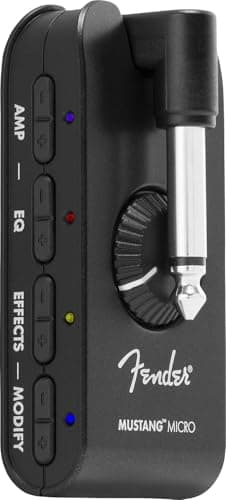
Multi-model — Fender Mustang Micro
Fender publishes twelve amp models and twelve effect combinations with a modify control, a 1/8" stereo headphone output, Bluetooth audio streaming in, and USB-C for recording to a computer.
The Bluetooth is the feature that earns its place: backing tracks and lesson videos come through the same headphones as the guitar, which removes the awkward arrangement of a phone speaker competing with headphones.
Fender's owner's manual gives up to six hours of battery-powered playing per charge, recharged over the same USB-C socket. It states no test conditions for that figure.
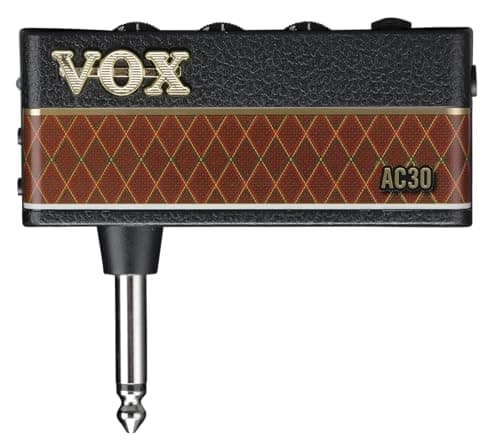
Single-voice — Vox amPlug 3
Each amPlug is one amp voice with two channels, sold as separate models: AC30, UK Drive, US Silver and Boutique. You pick the flavor when you buy.
Vox publishes its battery life under stated conditions: 10 hours with alkaline cells with effects or rhythm on, and 16 hours with them off. It also publishes the stereo reverb time range — 400 ms to 8 s. Publishing a reverb time in milliseconds on a device this cheap is unusual and worth noting.
Published specifications | Fender Mustang Micro | Vox amPlug 3 |
|---|
| Amp voices | 12 | 1 per unit, 2 channels |
| Effects | 12 combinations | Reverb, rhythm; varies by model |
| Battery life | Up to 6 h per charge | 10 h / 16 h alkaline (FX on / off) |
| Bluetooth audio in | Yes | No |
| USB recording | Yes, USB-C | No |
| Reverb time published | No | 400 ms – 8 s |
What headphones to use
Closed-back headphones. Open-back designs leak sound, which defeats the purpose in a shared house, and they have less low end, which matters more than you would expect on a guitar signal.
This is not the place to spend, and wired headphones are simpler than Bluetooth ones — a Bluetooth headphone adds latency, and latency between playing a note and hearing it is genuinely disruptive to practice. Beyond that, the specifications that decide it are impedance and plug size, not sound. Headphones for guitar practice compares four closed-back wired pairs on exactly those.
16 hours
Vox's published battery life for the amPlug 3, effects off
Fender's owner's manual gives up to six hours per charge for the Mustang Micro, with no test conditions stated.
The physical caveat
A headphone amp sticks out of the guitar's output jack, and on guitars with a top-mounted jack that means it protrudes where your forearm rests. Both the Fender and the Vox rotate in the jack to help with this, and on some guitars it is still awkward.
It is also a small object in a socket, which means it gets knocked. A short right-angle patch cable between the guitar and the unit solves both problems if it bothers you.
What you lose against a real amp
The room. A speaker moving air in a space is part of what makes an electric guitar feel like an instrument rather than a signal. Headphones do not reproduce that, and it is the honest reason people still buy combos.
Playing with anyone. Nobody else hears you.
Feedback and interaction. The physical coupling between a loud speaker and a guitar body is not simulated by anything at this price.
None of that matters much in year one. Hours of quiet practice matter enormously. The practice amp roundup covers the other direction.
What we did not doWe have not played any of this gear. Every guide in this category says it tested twenty tuners; we would rather say plainly that we tested none. What we did instead is on this page in full: published specifications with their sources, the makers' own manuals read rather than paraphrased, and a note wherever a company publishes nothing at all.