Buy the D'Addario Screeching Halt if your soundhole is about 4 inches across — it is tapered rather than flat, so it holds in a hole that is not exactly the nominal size. If your guitar is smaller, Ernie Ball is the only maker here publishing a second diameter, 3 3/8 in, which turns this from a guess into a measurement.
Before you spend anything: the controls already on your preamp will remove a good share of this, and one maker publishes the exact procedure. That is the first section.
The free fix, as a maker publishes it
Martin's user guide for the Prefix Stereo Blender is the most specific published document we found on amplified-acoustic feedback, and it is useful whether or not you own that system, because it names the two ranges feedback actually arrives in.
- Lower range, open low E up to the fourth-fret G sharp. Martin's instruction: play up through those notes until the instrument starts to "rumble or howl", then "low frequency 'cavity resonance' feedback can usually be squelched by setting the Notch control between one o'clock and two o'clock on the dial".
- Upper range, A and above. "Flip the Phase switch back and forth until you find the position that sounds best and subdues mid-bass feedback. Mid-bass feedback generally occurs when you play bass notes above the fourth fret G sharp on the low E string."
Two things follow from that. The first is an order of operations: notch for the low rumble, phase for the one above it, volume last. The second is a diagnosis. If your howl arrives on the open low E and the notes just above it, it is cavity resonance — the body of the guitar behaving as a box with a hole in it. That is the kind a plug is for.
4 in
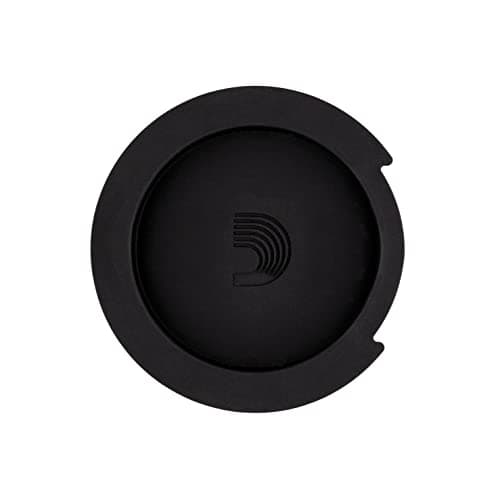
The only soundhole diameter D'Addario will commit to, and the measurement to take before you order
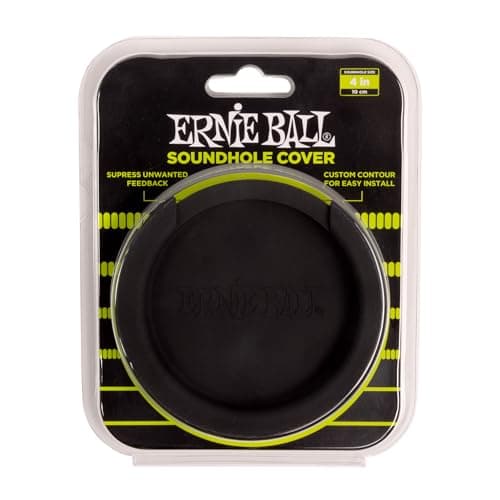
Its published fit is 'most standard 4 in sound holes'. Ernie Ball publishes 4 in (10 cm) and a second 3 3/8 in (8.6 cm) version. Nobody publishes anything in between.
What a cover does, and what it costs you
A soundhole cover blocks the port of the box. Our reasoning, not a maker's claim: the low resonance that makes an amplified acoustic howl depends on air moving in and out of that hole, and blocking it moves and damps the resonance. What the makers do publish is the outcome rather than the mechanism — D'Addario says the plug "allows you to play your electric acoustic at far greater volume, without unwanted feedback or howling", and Ernie Ball publishes that its cover "suppresses unwanted noise and feedback, maximizing the output of acoustic-electric guitars".
Here is the part neither page mentions, and it is the reason this is ranked as a stage-and-practice accessory rather than a permanent fitting: a cover quiets the guitar acoustically too. Of course it does — it is blocking the hole the sound comes out of. Plugged in through a pickup you will barely notice. Unplugged, your guitar is now a quiet guitar. Take it out when you finish.
Why an amplified acoustic howls and an electric does not
A solid-body electric is a plank with magnets in it. An acoustic is a tuned box with a hole in it, pointed at a loudspeaker that is reproducing the sound the box just made. That loop is the whole problem, and it is why feedback is a defining practical issue for amplified acoustics and barely an issue for beginners on an electric.
Martin's guide splits the loop into the two ranges quoted above, and the lower one carries a name worth keeping: cavity resonance. The box and its opening have a resonant frequency the way a bottle does when you blow across it, and on a full-size steel-string that frequency sits around the open low E. Everything a plug does, it does to that.
What you have fitted matters too, and this is where it joins up with the rest of the site. A piezo or under-saddle pickup senses the vibration of the whole instrument, resonance included. A magnetic soundhole pickup senses only the steel strings and ignores air movement, which is why acoustic guitar pickups records that almost every acoustic player who performs loudly ends up with a magnetic pickup, whatever they think of the tone. If you are choosing the pickup and the feedback fix at the same time, choose them together.
One consequence worth stating: a soundhole cover and a magnetic soundhole pickup are both things that live in the same hole. Check they physically coexist before buying the second one — neither maker's page addresses the combination.
The criteria, in the order they decide it
1. The diameter of your soundhole
Measure it, across the middle, in inches. A full-size dreadnought or grand auditorium is usually close to 4 in. Parlor, travel and classical guitars are routinely smaller — Ernie Ball lists a 3 3/8 in cover for exactly that reason and announced a 3 3/4 in classical version separately. A cover that is too small falls through; one that is too large will not seat.
2. Tapered plug or flat cover
This is the real difference between the two products here. D'Addario's is tapered, published as allowing "a great fit in most Soundholes" — a cone finds its own diameter inside a range. Ernie Ball's is a flat cover that sits on the rim, which is a cleaner fit when the diameter is right and a worse one when it is not. If you are unsure of your measurement, the taper is the safer purchase.
3. What it is made of, where it touches the finish
Both publish this and both publish the same answer: soft rubber, stated as safe for the guitar's finish. That is worth checking on anything that sits in contact with a lacquered top for hours, and it is the sort of claim a no-name cover does not make.
4. Whether you need electronics instead
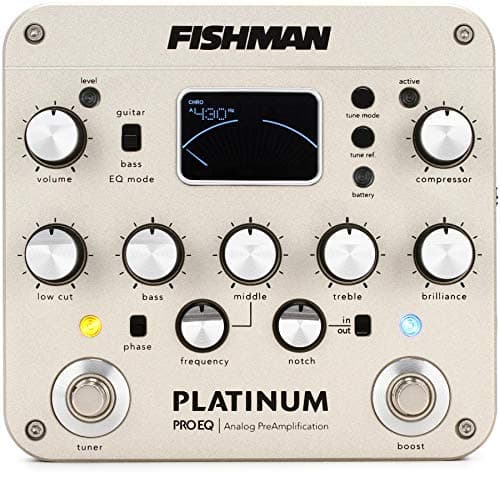
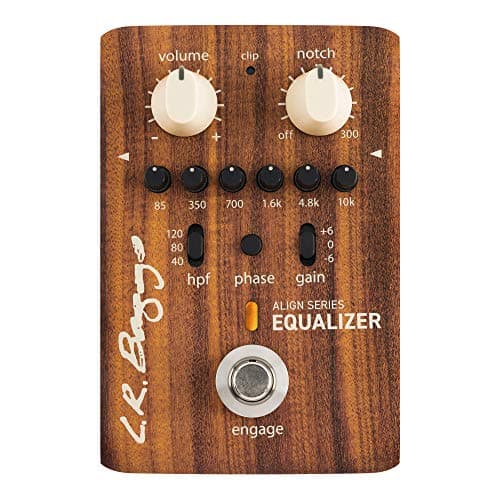
A plug addresses cavity resonance. It does nothing for a feedback squeal higher up, nothing for a room that is simply too loud, and nothing for a pickup fighting the wrong input impedance. If you have worked the notch and phase and fitted a plug and it still howls, the answer is a preamp with a sweepable notch — the Fishman Platinum Pro EQ publishes one from 45 Hz to 1 kHz plus a phase switch, and the LR Baggs Align Equalizer publishes a −20 dB notch sweepable from 40 Hz to 300 Hz. Both are specified in full on acoustic preamps.
Those published ranges are worth comparing against Martin's diagnosis above. The low E on a guitar is about 82 Hz and the fourth-fret G sharp about 104 Hz, which sits squarely inside both notch ranges. The electronics and the plug are aimed at the same problem from opposite ends.
Published figures for the two covers | D'Addario Screeching Halt | Ernie Ball P09618 |
|---|
| Published fit | Most standard 4 in sound holes | Approximately 4 in (10 cm) |
| Second size published | None | 3 3/8 in (8.6 cm) |
| Shape | Tapered plug | Flat cover |
| Material in contact | Soft rubber insert, stated finish-safe | Rubber, stated not to scratch |
| Feedback reduction figure | Not published | Not published |
| Effect on unplugged tone | Not published | Not published |
| Fitting | By hand, no modification | By hand, no tools |
What we did not doWe have not played any of this gear. Every guide in this category says it tested twenty tuners; we would rather say plainly that we tested none. What we did instead is on this page in full: published specifications with their sources, the makers' own manuals read rather than paraphrased, and a note wherever a company publishes nothing at all.
Nobody publishes your soundhole diameter
This page keeps telling you to measure, and there is a reason it cannot tell you the number instead: guitar makers do not publish it.
Take Taylor's specification page for the Baby Taylor, which is unusually complete. It publishes scale length, every wood in the instrument, the nut and saddle material, the bridge pins, the tuners and even which strings the guitar ships with. There is no soundhole diameter anywhere on it. That is typical rather than unusual — the figure is not considered a specification by the people who build the instruments, and it is the one figure this purchase turns on.
So the sequence is: a tape measure across the widest part of the hole, then a product. Thirty seconds, and it is the difference between a cover that seats and a cover in a drawer. If the measurement lands between the two published sizes, buy the tapered plug rather than the flat cover — a cone has a working range and a disc does not.
The other product D'Addario files here, and why we did not pick it
D'Addario sells the Screeching Halt alongside something called the O-Port, and groups them together as acoustic sound control. They are not the same kind of product and it is worth knowing which one you are looking at.
A plug blocks the hole. The O-Port is a ring that sits in it, and D'Addario's published pitch for the pair is that you "can shape your acoustic sound, even when you're unplugged". That is a tone product, and on the page we checked it carries no feedback claim at all and no published sizes.
We have left it off this page on exactly that basis. It is not that it does not work; it is that there is nothing published to rank it on in a page about feedback, and buying a tone-shaping ring to solve a howling problem is a guess at twice the price of the thing that is sold for the job.
What we could not find published
Three gaps are worth stating plainly, because every page on this subject writes around them.
- No decibel figure. Neither maker publishes how much feedback a cover removes, in any unit, under any condition.
- No tone claim in either direction. D'Addario makes none at all; Ernie Ball's "maximizing the output" is about the amplified signal, not the acoustic one.
- No guidance on leaving one in. Nobody says whether a cover should live in the guitar. Our view, labeled as ours: take it out when you unplug, because a plugged soundhole is a quiet guitar and a quiet guitar gets played less.
Order of operations, cheapest first
- Turn the guitar down and the amp up, or stand further from the speaker. Free, and more effective than anything below.
- Work the notch, then the phase, in Martin's published order. Free if your preamp has them.
- Fit a soundhole cover. Under ten dollars, and the single biggest step for cavity resonance.
- Buy a preamp with a sweepable notch if it still howls. This is the expensive rung and it should be last.
What we would actually buy
Measure the soundhole, then the Screeching Halt if it is near 4 in and the Ernie Ball 3 3/8 in version if the guitar is smaller. Keep it in the case pocket rather than the guitar. If you are already past that and still fighting it, the Align Equalizer is the cheapest way into a real sweepable notch, and the Platinum Pro EQ is the one box that does the notch, the phase and the DI together.