Strings do not wear out so much as get dirty. Two things kill them: the oil, salt and dead skin your hands deposit on every surface, and the debris that packs into the gaps between the windings on a wound string and stops it vibrating freely.
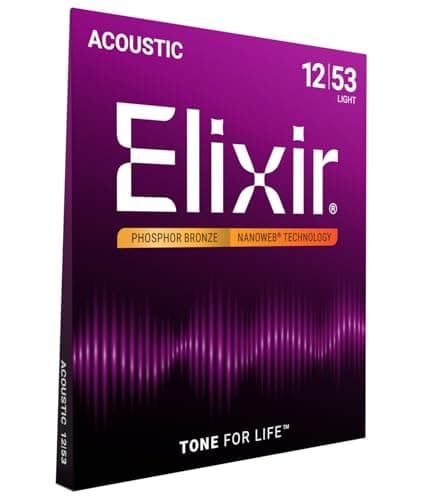
A coating is a thin polymer layer that seals the string against both. Elixir describes NANOWEB as an ultra-thin coating that covers the entire string and keeps gunk out of the gaps between the windings — which is a precise description of the mechanism.
NANOWEB is not the only coating Elixir sells, and the other one is the one it recommends for sore beginner fingertips. NANOWEB vs POLYWEB settles that on Elixir's own published wording, using the two sets that share an alloy and all six gauges.
What you actually get
Longer bright life. This is the whole product. Where an uncoated set on sweaty hands can go dull in a week or two, a coated set commonly stays bright for a month or more. Elixir's published claim is that their strings retain out-of-the-box tone longer than any other brand's.
Less finger squeak. The coating is smoother than bare winding, so sliding a hand along a wound string makes noticeably less noise. This matters far more than most people expect once they hear it — squeak is very audible on a recording and on an acoustic in a quiet room.
A slightly different feel. Smoother, slicker. Some players love it and some find it artificial. It is a real difference, not a marketing one.
What you give up
The day-one zing. A brand-new uncoated string has a bright, slightly metallic edge that a coated string never quite reaches. If you love the sound of a fresh set — and many people specifically do — coated strings never give you that peak.
Money, up front. Coated sets cost several times an uncoated set. Whether that is expensive depends entirely on how long you keep them.
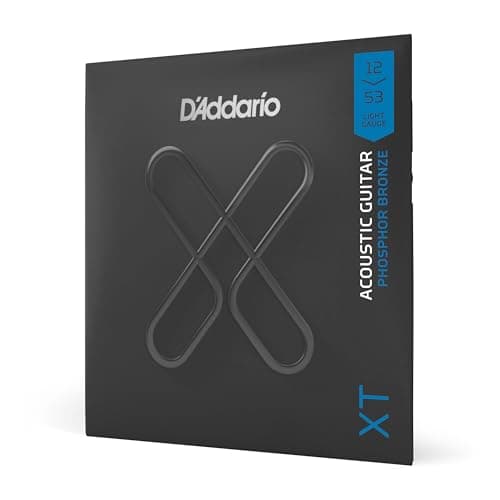
Comparability. Elixir publishes gauges and no tension figures. D'Addario's XT keeps the published-tension discipline of their uncoated line, which makes it the easier coated set to compare against the uncoated one you are leaving.
The comparison | Uncoated | Coated |
|---|
| Bright life | Days to a couple of weeks on sweaty hands | Often a month or more |
| Cost per set | Lowest in the category | Several times higher |
| Finger squeak | Pronounced on wound strings | Noticeably reduced |
| Peak brightness | Higher on day one | Slightly lower, but sustained |
| Feel | Textured winding | Smooth, slick |
| Tension published | Yes for D'Addario | Yes for D'Addario XT, no for Elixir |
The three cases where coated wins clearly
- Your hands are hard on strings. Some people's sweat chemistry kills a set in a week. If that is you — and you will know, because strings go black and dull unusually fast — a coating is not a luxury, it is the fix.
- The guitar sits unplayed for weeks. Uncoated strings corrode slowly even untouched. A guitar picked up twice a month keeps a coated set fresh for months.
- You hate changing strings. A real reason. If the practical barrier is the twenty-minute job rather than the money, paying for fewer changes is a rational trade.
When uncoated is the better buy
If you play daily and change strings every month or two regardless, you will never reach the point where a coating pays for itself — you will be throwing away a coated set while its coating is still doing its job.
And if you specifically like the sound of fresh strings, cheap uncoated sets changed often give you that peak repeatedly, which coated sets structurally cannot.
30 seconds
Wiping the strings with a dry cloth after every session
The cheapest life extension available on any set, coated or not. It removes the oil and salt that do most of the damage.
Whether the premium is worth paying is arithmetic rather than opinion, and it turns entirely on how often you would otherwise change strings — are Elixir strings worth it works it through, including the case where the answer is no.
Coating and alloy are separate levers on the same problem and they stack: a coating keeps dirt out of the windings, while the alloy decides how fast the metal corrodes on its own. Phosphor bronze vs 80/20 covers the second one.
What we did not doWe have not played any of this gear. Every guide in this category says it tested twenty tuners; we would rather say plainly that we tested none. What we did instead is on this page in full: published specifications with their sources, the makers' own manuals read rather than paraphrased, and a note wherever a company publishes nothing at all.
The middle option
D'Addario's XT sits between the two on price and on lifespan, with the coating applied to the wound strings. Owner accounts generally place its life below Elixir's and its feel closer to an uncoated string. If the Elixir price is the obstacle rather than the concept, that is where to look.
Whichever you choose, the biggest variable is still how often you change them. How often to change strings works through the signals that say it is time.