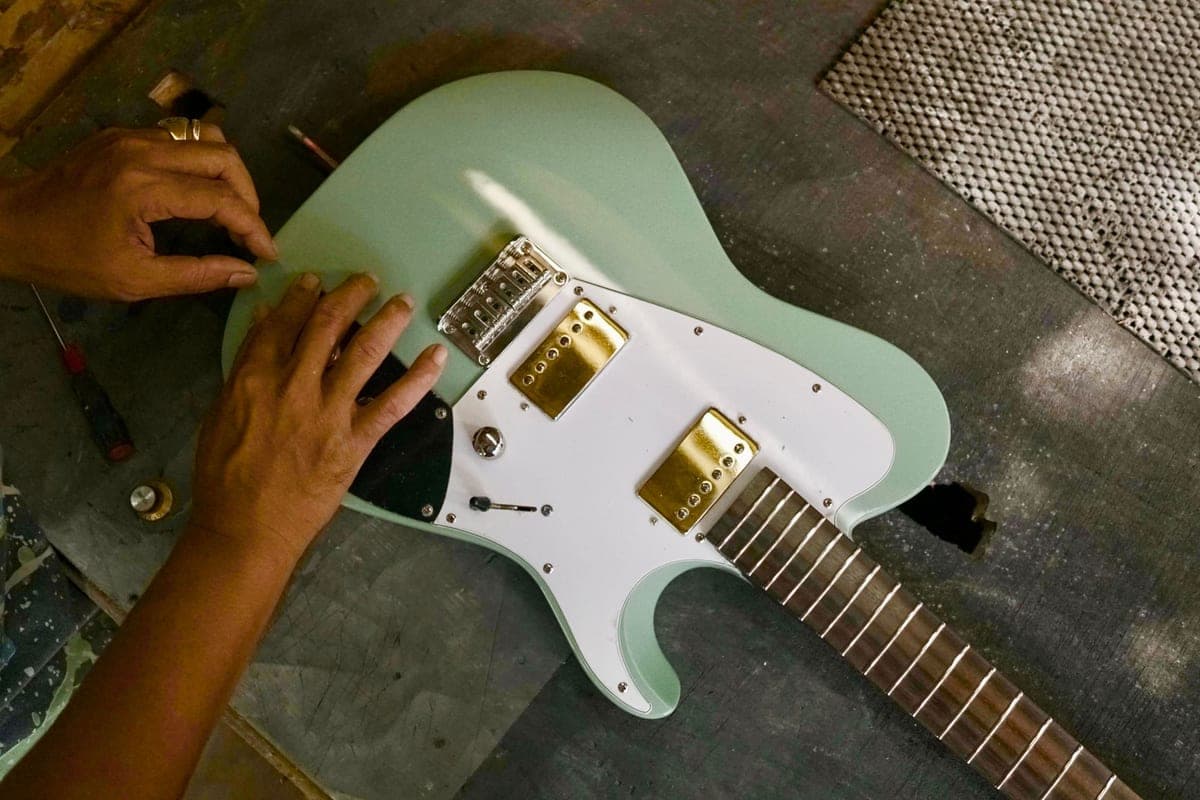
Open any guitar setup kit and you will find wrenches, hex keys and drivers. Open the box again and look for something that measures: a rule, a feeler, a radius template. On most kits there is nothing, and our own setup kit page says so plainly, because it is the single most consequential omission in that whole category.
Without a measurement, every adjustment is a guess evaluated by feel, and feel is the thing that has already told you something is wrong. The tools on this page cost less than one kit wrench each and they are the difference between diagnosing a guitar and fiddling with it.
The four measurements a setup is made of
1. Action — string height at the twelfth fret
The one everybody means when they say a guitar is hard to play. It is measured from the top of the twelfth fret to the bottom of the string, usually on the sixth and first strings, and it is the number that turns "this feels high" into something you can compare against what the maker specifies.
Knowing your action is 3.2 mm when the maker specifies 2.4 mm is a diagnosis. Knowing it feels high is a mood. That is the entire argument for this page.
2. Relief — how much the neck bows forward
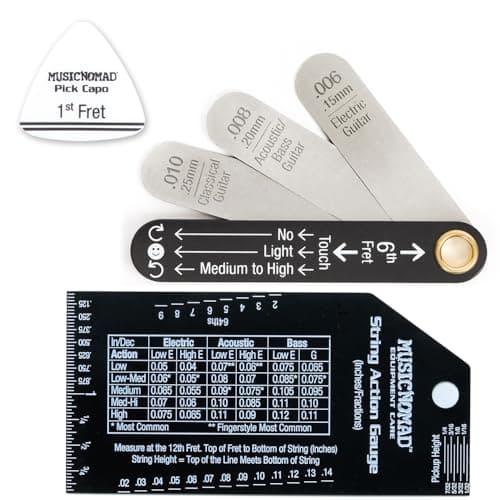
A guitar neck is not meant to be perfectly flat. It carries a very slight forward bow, and the amount is measured as the gap between the string and a middle fret while the string is held down at both ends. The gap is small enough that you need a feeler gauge to measure it at all: MusicNomad publishes .006, .008 and .010 inch feelers as the three common targets, and that is the range the whole argument happens in.
Relief is the measurement that most often explains high action, and it is adjusted at the truss rod. Which brings us to the important part.
.006–.010
Inches of neck relief that MusicNomad publishes as the common targets
The entire adjustment range that causes most playability complaints is four thousandths of an inch wide. You cannot judge that by eye, and nobody can.
3. Fret rock — the high fret that no adjustment fixes
Lay a short straight edge across three adjacent frets and rock it. If it pivots, the middle fret is higher than its neighbors, and that fret will buzz at any action and any relief. It is a levelling job for a technician and no amount of truss rod turning will help.
This is worth checking first, because it is the failure mode that makes people chase a setup that was never the problem. All three tools here do it: the MusicNomad action gauge doubles as a fret rocker.
4. Nut height and fingerboard radius — the two you probably will not act on
Nut slot height explains a guitar that is hard to play in the first three frets specifically. Fingerboard radius matters when setting individual saddle heights on an electric. Both are real measurements and both are genuinely useful — and neither leads anywhere a first-year player should go alone, because filing a nut slot too deep is unrecoverable without a new nut.
Measure them by all means. Knowing the number is how you have a useful conversation with a technician instead of an argument.
The picks
MusicNomad MN602 — best first gauge
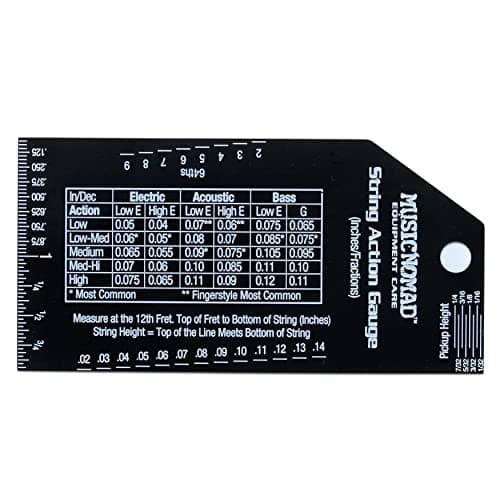
One piece of etched stainless steel. It carries metric, imperial and 64ths scales, so it matches whatever units your guitar's maker publishes rather than forcing you to convert; it has the recommended heights for different instrument types printed on the tool itself; and it doubles as a fret rocker.
If you buy one thing from this page, buy this. It answers the question "do I need a setup" for the price of a couple of coffees, and the answer it gives is a number you can take to a technician.
What it cannot do: relief, nut height or radius. It measures action and finds fret rock, and that is the whole tool. The steel edges are also sharp enough to mark a finish if you drag it, so treat it like a tool and not like a ruler.
MusicNomad Rod Gauge & String Action — best relief plus action
Adds the measurement that should happen before anyone touches a truss rod: the three relief feelers at .006, .008 and .010 inch, plus a pick capo to hold the first fret down while you measure. The action gauge from the MN602 is included.
The pick capo is a smaller thing than it sounds and it solves the genuine problem with measuring relief, which is that it takes three hands. One to hold the first fret, one to hold the string down at the body end, one to hold the feeler. The capo does the first job.
Against it: no nut height or radius gauges, and the listing does not state the material the way the single MN602 does, which we have marked as unpublished rather than assuming it is the same steel. And measuring relief tells you the number, not whether you should turn anything — that judgment is the part the setup kit page draws a line around.
MusicNomad Precision Setup Gauge Set — best complete set
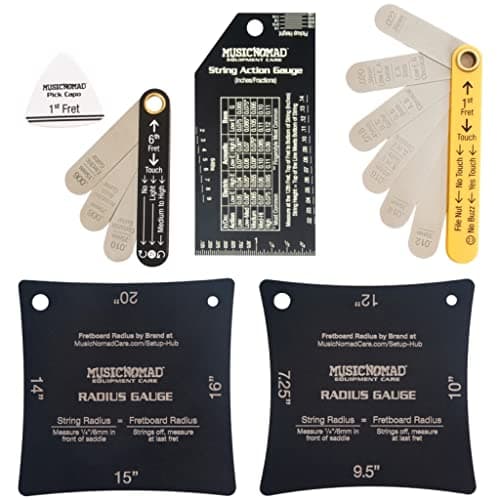
Six pieces, and unusually for this category the listing publishes every size in it: relief feelers at .006, .008 and .010 inch; radius gauges at 7.25, 9.5, 10, 12, 14, 15, 16 and 20 inches; nut height gauges at .016, .018 and .020 inch with three more at .012, .014 and .022; the action and fret-rocker gauge; and a pick capo. All stainless steel with laser-etched sizes.
The 24-page booklet is the part that justifies the price. A bag of gauges tells you numbers. The booklet tells you the order to take them in, which is the actual skill, and it is the thing you cannot buy separately.
Against it: it costs several times the single gauge, and nut height and radius are measurements a first-year player will take once out of curiosity and then not act on. Buying this in month one is buying the answer to questions you have not asked yet.
What each one measures
Published contents | MN602 | Rod Gauge & Action | Precision Setup Set |
|---|
| String action | Yes | Yes | Yes |
| Fret rocker | Yes | Yes | Yes |
| Neck relief | No | .006", .008", .010" | .006", .008", .010" |
| Nut height | No | No | Six sizes, .012–.022" |
| Fingerboard radius | No | No | Eight, 7.25"–20" |
| Pick capo | No | Yes | Yes |
| Instruction booklet | Measuring instructions | Measuring instructions | 24 pages |
| Material published | Stainless steel | Not published | Stainless steel |
Read down the relief column. That is the single row that decides whether the cheapest option is enough for you, because relief is the measurement that most often explains the complaint that brought you here.
How to use the number once you have it
Measure action at the twelfth fret on the sixth and first strings. Compare against what your guitar's maker publishes, if they publish anything — many do not, and the general targets printed on the MN602 are the fallback. Then decide which of three situations you are in.
Within spec and it still feels hard. The problem is probably nut slots, or it is your hands still building strength in the first months. Neither is fixed by adjusting anything.
Well above spec with normal relief. Saddle height. On an electric that is a screwdriver job. On an acoustic it means sanding the saddle, which is irreversible in the wrong direction and worth paying for the first time.
Well above spec with too much relief. Truss rod, and this is where guitar action too high takes over. It is also where this site stops giving instructions, because a truss rod is a steel rod under tension inside the neck and turning it wrongly damages necks permanently.
The honest alternative
A professional setup usually costs less than the full gauge set and takes a technician under an hour. If your guitar is uncomfortable right now, that is the fastest route to one that is not, and you learn something by asking what they changed and what they measured.
Buy the single action gauge anyway. It costs very little, it tells you whether the setup is worth booking, and it lets you check the work when you get the guitar back. That is a genuinely useful thing to own even if you never adjust anything yourself. Does my guitar need a setup is the checklist to run first.
What we did not doWe have not played any of this gear. Every guide in this category says it tested twenty tuners; we would rather say plainly that we tested none. What we did instead is on this page in full: published specifications with their sources, the makers' own manuals read rather than paraphrased, and a note wherever a company publishes nothing at all.