Nothing you can buy will take the soreness away, and the thing that does take it away is time — Fender publishes "a week or more" of short daily sessions. What money can genuinely change is how hard you have to press: a set of extra-light strings such as D'Addario's EJ15, and a cheap action gauge to find out whether the guitar itself is making this worse. Silicone fingertip protectors are a real product with a real use, and that use is a fingertip that has already blistered, not learning chords.
This page is in the order a beginner should work through it, cheapest and most effective first.
What a maker actually publishes about this
Very little of the advice on this subject comes from anyone who makes guitars. Fender is the exception and publishes two articles on it, so these are the figures and the wording this page is built on.
- "Fingertip soreness is temporary and can last a week or more. It doesn't require treatment, although icing and numbing creams can provide short-term relief."
- "Give it a good 10-15 minutes a day so you don't push those fingertips too hard at first and regret it later."
- "Fingertip soreness can be expected, but severe muscle or wrist pain can be an indication of poor technique."
- On strings: "A lighter gauge of strings will help fretting or bending the strings. Heavier gauges might cause more pain, but you'll toughen up your fingertips faster."
- On the guitar: "If the strings are set too high from the fretboard, it will be more difficult to fret a note."
A week or more
The only duration any guitar maker we found will publish for fingertip soreness
Fender's wording, from its own article on finger pain. Nobody publishes a callus timetable, because it depends on how often you play and on how hard you are pressing.
1. Change how you practice before you change anything else
Fender's 10–15 minutes a day is the most valuable line in this whole subject, and it costs nothing. Two short sessions build fingertips faster than one long one, because the skin is being asked to adapt rather than to survive. A ninety-minute first session is how people end up with a blister and a week off.
The other free change is pressure. Beginners grip far harder than the note requires — Fender names this directly, and it is also the difference between fingertip soreness, which is expected, and wrist or forearm pain, which is a signal to stop and look at technique. Try fretting a chord, then backing the pressure off until it buzzes, then adding just enough to clear the buzz. That is the force the note actually needs.
2. Find out whether the guitar is the problem
A guitar with high action makes every string feel like a heavier string. This is the single most common reason a cheap first guitar hurts more than an expensive one, and it has nothing to do with your hands.
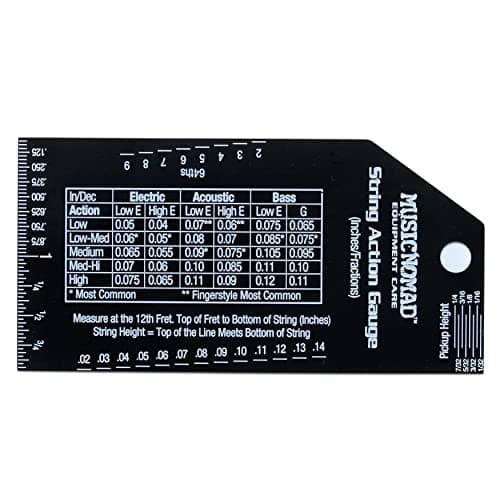
You cannot judge this by eye, which is why a string action gauge costs about the same as a set of strings and settles the question in thirty seconds. Measure, compare against the makers' published figures, and you know whether to buy strings or book a setup. Guitar action too high has the measuring method and the published targets; action gauges ranks the tools themselves.
3. Then, and only then, change the strings
Lighter strings genuinely reduce the force at the fingertip, and the reduction is measurable rather than a feeling. A light acoustic set (.012–.053) pulls 160.5 lb across the neck on D'Addario's published figures. The extra-light EJ15 (.010–.047) is the same material and construction at a lower gauge.
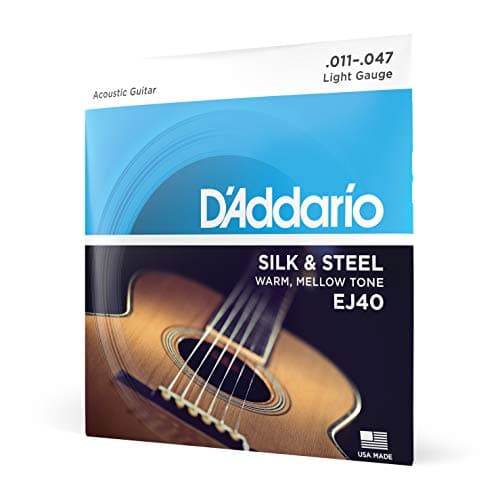
Silk and steel is the other route — silk under the wrap lowers tension without dropping the printed gauge as far. It is the softest-feeling thing most beginners can put on a steel-string, with the honest caveat that almost nobody in that category publishes a tension figure at all, which silk and steel strings goes into.
A full ranking of what reduces effort, by published gauge and tension, is on the easiest guitar strings to play. This page is about the order; that page is about the shortlist.
What Fender actually recommends putting on the guitar
Fender publishes gauge recommendations for beginners, which is more than most makers do: .009 to .042 or .010 to .046 for an electric, and .011 to .052 for an acoustic. That acoustic figure is one step lighter than the .012 to .053 light set most steel-strings leave the factory with — including small guitars sold to beginners, where Taylor publishes D'Addario .012–.053 as the stock set on the three-quarter-size Baby.
So the first string change is frequently a step down from what the shop sold you, not an upgrade. That is worth saying plainly because it is cheap, reversible, and sitting right there as published advice from an instrument maker rather than as a forum opinion.
The other half of Fender's string note is the part people quote less: "Heavier gauges might cause more pain, but you'll toughen up your fingertips faster." There is a real trade here and it is yours to make. Lighter strings get you playing sooner; heavier ones build the skin faster. Our view, which is a judgment and not a published figure: a beginner who quits is not building anything, so take the lighter set.
A two-week plan, using only the published numbers
Everything in this plan comes from the Fender guidance above, arranged into an order. It is not a medical protocol and nobody publishes one of those for guitar.
- Days 1–3. Two sessions of 10 to 15 minutes, as Fender suggests, rather than one long one. Stop while it is sore rather than when it is raw.
- Day 3. Measure the action. If it is above the maker's published range, this is the week to book the setup — everything else on this list is working against a guitar that is fighting you.
- Days 4–7. Same sessions, deliberately lighter fretting pressure. Fret a chord, back off until it buzzes, add just enough to clear it.
- Day 7. If the skin is still giving out before the session does, change to a lighter set. One set of strings costs less than one lesson.
- Days 8–14. Add time rather than intensity. Fender's published window for soreness is "a week or more", and most of the people who get past it do so in this fortnight.
If you reach the end of two weeks and a specific finger or a specific string is still the problem, stop blaming the skin. That pattern is a guitar problem, and the checks are at the bottom of this page.
4. Fingertip protectors: what they are for
Silicone fingertip protectors are one of the most searched-for guitar accessories there is, and they are also the clearest example on this site of a product category that publishes nothing.
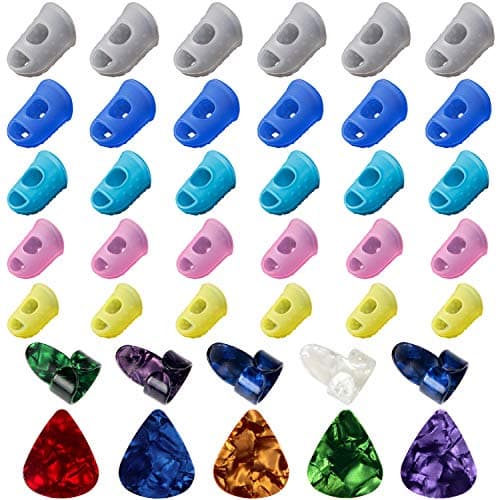
The packs sold on Amazon give you a piece count and the word "silicone". No maker publishes the wall thickness, the hardness, or a measurement for any of the five sizes in the pack. There is no guitar maker's recommendation behind them either — with one exception, and the exception is instructive. Fender mentions finger protectors exactly once: "If you've gone too far and played until you develop blisters or your fingers bleed … take a step back and use a bandage or finger protector to make sure you heal properly."
That is a recommendation for damage that has already happened, not for everyday practice. It matches what the product physically does: it puts a layer of silicone between your fingertip and the string, which protects the skin and, at the same time, deadens the note, blunts your sense of where the string is, and makes bends slip. For somebody learning chord shapes, those are the three things you most need.
So they are on this page, ranked last, with a six-point-two score and an honest description of what they cost you. They are worth owning for four dollars. They are not the answer to the question.
What each option actually changes| Option | What it changes | What it costs you | Published basis |
|---|
| Shorter, more frequent practice | Lets the skin adapt instead of tearing | Nothing | Fender: 10-15 minutes a day |
| Less fretting pressure | Removes force you were never required to apply | Nothing | Fender names over-gripping directly |
| Lower action | Less travel and force for every note on the neck | A setup, or a gauge and an afternoon | Makers publish action targets |
| Extra-light strings | Lower tension at the same pitch | Thinner tone, buzz under a heavy hand | D'Addario publishes tension per string |
| Silk and steel | Softer feel without dropping gauge as far | Shorter string life, no published tension | Gauges published; tension is not |
| Fingertip protectors | A silicone layer over damaged skin | Deadened notes, no feel, slipping bends | Nothing published beyond the material |
What we did not doWe have not played any of this gear. Every guide in this category says it tested twenty tuners; we would rather say plainly that we tested none. What we did instead is on this page in full: published specifications with their sources, the makers' own manuals read rather than paraphrased, and a note wherever a company publishes nothing at all.
Things people suggest that we will not
Two folk remedies come up constantly and neither has anything published behind it. Superglue on the fingertips is widely repeated and no guitar maker, string maker or adhesive maker recommends it for skin. Rubbing alcohol to harden the skin is the same situation. We are not going to tell you either is safe, because nobody who would have to stand behind that claim has made it.
Fender does mention icing and numbing creams, and is careful about what it claims for them: they "can provide short-term relief". Relief is not the same as progress, and the same article is clear that playing is the thing that actually builds the calluses.
When soreness is telling you something else
Fingertip soreness is expected. Pain in the wrist, the forearm or the joints is not, and Fender flags it as a sign of poor technique rather than of progress. If that is what you have, the answer is not lighter strings — it is a change in how you are holding the instrument, and a teacher for an hour is cheaper than the gear in this article.
One other check worth doing: if only one finger hurts, or one string is consistently the problem, look at the guitar rather than the hand. A high nut slot, a sharp fret end or a single string sitting too far off the board will do exactly that, and all three are covered under does my guitar need a setup.
What we would actually buy
A set of EJ15 extra-lights and a string action gauge, together about the price of two coffees and a sandwich, in that order. If the action measures fine and the strings are already light, buy the EJ40 silk and steel set and be patient. Buy the fingertip protectors only if you have already played yourself raw — and then take the two days off that the blister is asking for.