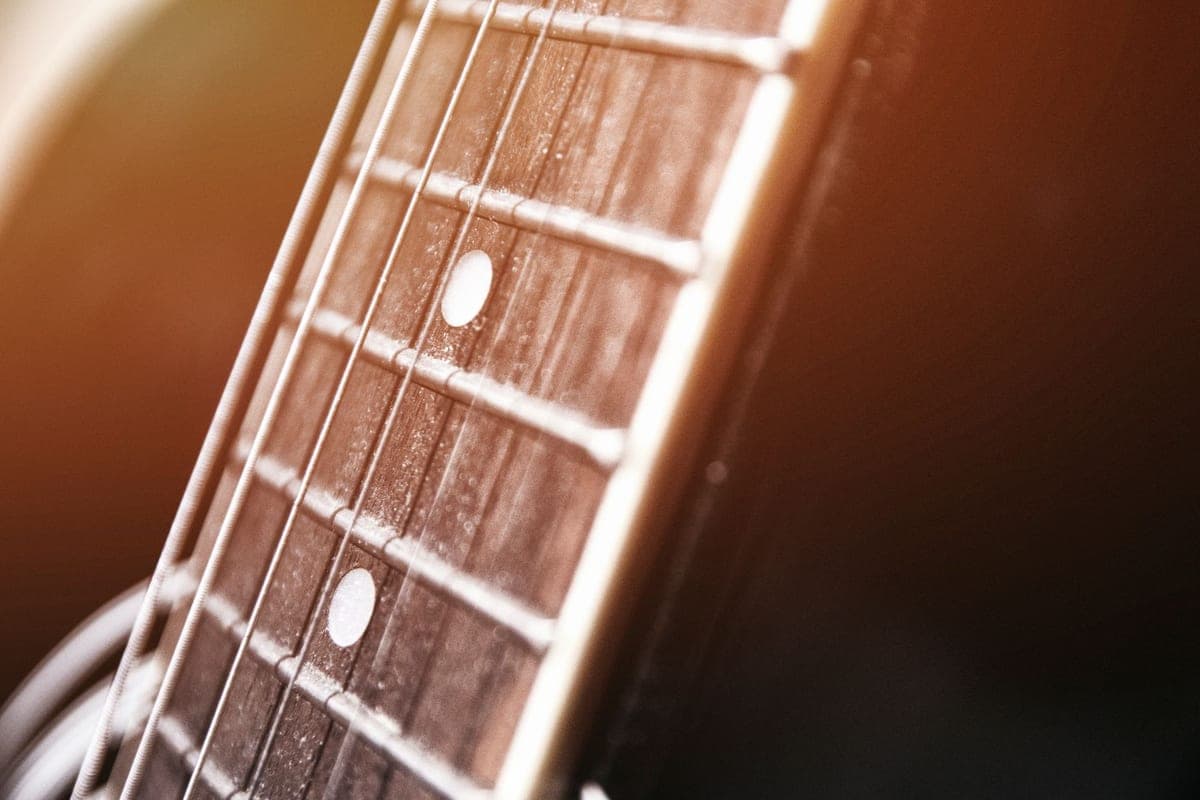
You slide your hand down the neck and it catches. Run a fingertip along the edge of the fingerboard and you can feel each fret end standing proud of the wood, like a row of tiny blunt staples. Córdoba describes the sensation exactly: "You will feel the sharp fret ends begin to jut out from the side of the fingerboard."
This has a name — fret sprout — and unusually for a guitar problem, the cause is not in dispute. Every major acoustic maker publishes the same mechanism, and one of them publishes a consequence that changes what you should buy.
What is actually happening
MusicNomad states the mechanism most plainly: "Fret sprout is caused by the fretboard wood shrinking due to lack of moisture and low humidity. Because the wood shrinks and the metal frets do not, the ends of the frets are left exposed, causing them to feel sharp along the edge of the fretboard."
Nothing has grown. The frets are exactly where the factory put them. The wood around them got narrower, and the fret ends that used to sit flush with the edge are now hanging over it.
Taylor puts sharp fret ends in a list of symptoms it treats as a set, and the list is worth reading because it tells you what else to check: "The arch in the top sinks, taking the bridge with it; the neck bows forward, necessitating a truss rod adjustment; and the fingerboard shrinks in width, causing the sharp ends of the frets to extend beyond the edge of the neck." Its own symptom checklist lists it as "Sharp fret ends extend beyond the edge of fret-board."
So sharp fret ends are rarely a lone fault. If you can feel them, look for a sinking top and a neck that has moved as well, because the same dry air caused all three.
MusicNomad also publishes when this happens, and it matches when most people notice it: "Low humidity is common in winter months when your heater is on or when running an air conditioner during summer."
How much movement are we talking about?
Taylor is the only maker we found that publishes an actual figure for how much guitar wood moves, and it explains why a few weeks of dry weather is enough to change how a neck feels.
16" → 15.9"
Taylor's published example: spruce cut at 47% relative humidity, then held at 30%
Taylor's wording: "let's say we condition a spruce top in a room that is 47 percent RH, and then cut that spruce to a width of 16 inches. If we then were to lower the room's RH to 30 percent, that same piece of spruce would shrink to 15.9 inches in width — shrinkage of almost 1/8 of an inch!" A fingerboard is narrower than a top, so the absolute movement is smaller — but a fret end only has to move a few thousandths to catch your hand.
The humidity number, and where makers disagree with themselves
Everybody publishes a target range. They do not all publish the same one, and two of them publish two different ranges in their own documentation. This is a genuine inconsistency and we would rather show it than average it into a number nobody actually said.
Published relative humidity ranges, as each maker states them| Maker | Published range | What else they publish |
|---|
| Taylor | 45–55% on its dry-guitar page; 40–60% on its spot-fix page | Below the range, the guitar is “in danger of cracking”; its own factory runs at 74°F and 47% RH |
| Martin | 45–55%, plus 72–77°F | Damage from conditions outside that range is “not covered under warranty” |
| Córdoba | 45–65% in its body text; 45–55% in the spec block on the same page | Below 30%, the top “will most likely begin to distort and eventually crack” |
| Alhambra | 40–60% | Below 40%, “the wood can crack and the string pitch can drop” |
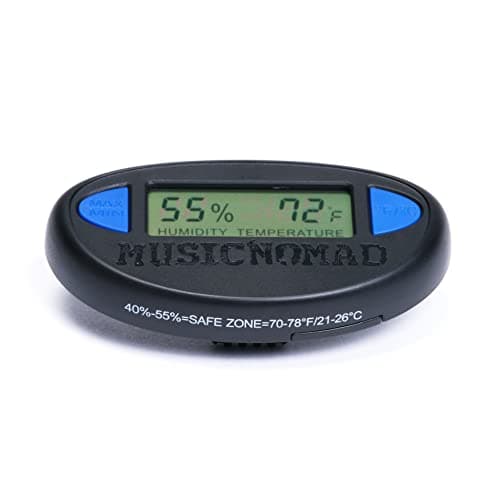
| MusicNomad | 40–55%, plus 70–78°F | Frames humidity as reducing shrinkage over time, not as a cure |
The practical read: anywhere in the mid-40s to mid-50s satisfies every maker on that list at once, and the thing all of them warn about is the bottom end. Martin is the one to take most seriously, because it attaches a warranty consequence to it.
You cannot act on any of this without measuring. A hygrometer is the cheapest item on this page and the only one that tells you whether you have a humidity problem at all — hygrometers compares the ones worth buying, and do I need a humidifier answers the question this page keeps pointing at.
The sentence that decides what you buy
Here is the finding that makes this page worth writing. Almost everything written about fret sprout implies that fixing the humidity fixes the frets. Taylor publishes the opposite, in its own words:
"A guitar humidifier will restore the body. It will also affect the neck, but to a lesser degree. The frets may remain sharp, and may need to be filed even after the proper humidity level has been restored."
That is the only direct maker answer to the question we could find, and it points at a file. Taylor does publish that the body recovers — a dry guitar's "moisture content and its shape can be restored" — so the distinction it draws is deliberate: the box comes back, the fret ends may not.
MusicNomad frames humidity the same way, as prevention rather than cure: keeping a guitar humidified "will help the fretboard to retain moisture and shrink less over time." Its actual fix section is entirely about filing.
No maker anywhere publishes that fret sprout reverses on re-humidifying. Buy the humidifier because it protects the top, the neck and the bridge. Do not buy it expecting the fret ends to retract.
Two necks where filing is the wrong answer
MusicNomad is unusually relaxed about this being a home job — "With the right tools and a little practice it's very easy to fix at home" — which makes its two published exceptions much more credible. Both are about what is on the edge of the fingerboard, not about your skill.
A bound fingerboard. "Fret sprout is not fixable for most bound necks, as you would need to file the finish and binding, which would leave the sides of the fretboard uneven and discolored." MusicNomad names the guitars: "Bound fingerboards are common on Gibson Les Pauls, SGs, ES-335s, and more." If there is a pale strip of plastic or wood running down the edge of your fingerboard, stop.
A finished fingerboard edge that has already lifted. "Many necks, particularly maple Fender and gloss-finished models, have finish over the fretboard edges. When fret sprout occurs on these necks, the finish often lifts, creating a light circle of clear finish around the fret ends. In this case it's very easy to accidentally chip and damage the finish when filing. If you see this 'popping' effect, it's best to take the guitar to a qualified luthier or tech."
And the general warning, which is about permanence rather than difficulty: "If you slip with the file you can gouge the finish, which can't be polished out." That is why the safe edges on a fret-end file are a specification and not a marketing feature.
One retailer sets a higher bar than the maker does, and it is worth knowing about even though it is not a manufacturer statement. Thomann describes the MusicNomad file as "primarily aimed at users who are skilled with their hands and have a very good eye for detail, such as professional guitar techs or seasoned hobby techs who know exactly what they are doing." The maker says easy; the retailer says expert. Set your own expectation somewhere in between, and practice the motion before you touch the guitar.
It may come back once, and then stop
This is the other genuinely useful thing MusicNomad publishes, because it stops you thinking the first fix failed:
"As new guitars go through seasonal change, the fretboard will shrink and expand. If you fix fret sprout and your guitar goes through more extreme dry seasonal change, you may see the fret sprout return. Once your guitar has gone through a few seasons, you'll find that the fret sprout no longer occurs."
So on a guitar in its first year or two, expect to possibly do this twice. That is a reason to buy a file that will survive being used more than once, and a reason not to pay a technician twice if the neck is plain and unbound.
Three different tools, and MusicNomad publishes what each is for
"A fret file" is not one thing, and buying the wrong one is how people end up with a neck that is safe to hold and unpleasant to play. MusicNomad is the only maker here that publishes a clear division of labor between its own tools, so we will use its scheme.
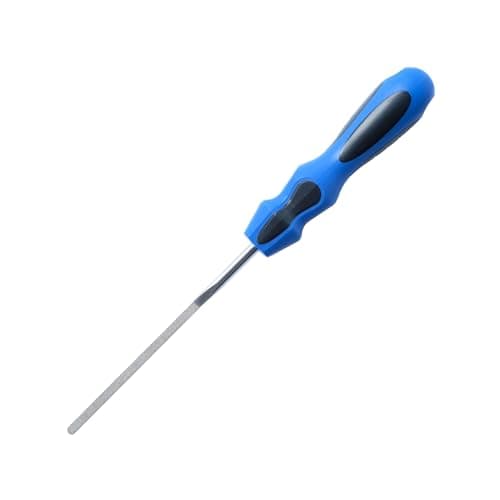
The dressing file (MN830) rounds the end. This is the tool for the symptom. Its cutting surface is a 280 grit diamond coating on two sides, which MusicNomad says "allows for even, smooth and precise filing that both cuts and polishes simultaneously". The other two sides are safe edges — one flat, one slightly radiused and marked with an arrow on the handle — and all four corners are rounded. Those details are the specification that matters, because they are what stops the file marking the fingerboard next to the fret you are working on.
The beveling file (MN831) sets the angle. A different job: MusicNomad publishes two built-in angles for it, noting that "23° is ideal for most playing styles" while "3° is ideal for leveling and flush filing the fret tangs and fret ends". This is the tool for re-cutting the bevel along a whole fret edge, which is more work than fixing sprout and is not what most people here need.
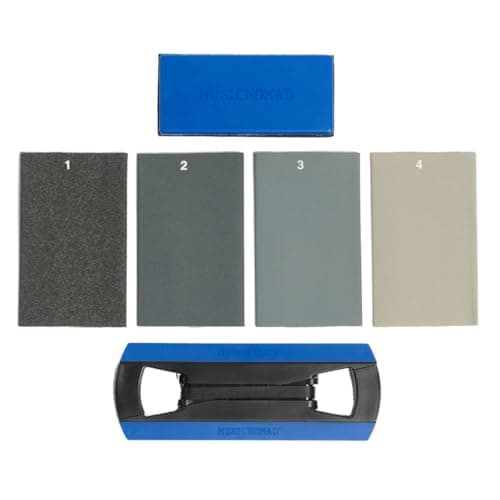
The polishing kit (MN860) finishes it. MusicNomad publishes that its Tracers kit has "a hard side to polish the fret bevels and a soft side to polish the fret corners", across four Micro-Mesh grits. A filed fret end is flat and slightly dull; this is what turns it back into something your hand slides over without noticing.
MusicNomad also sells an eight-piece fret sprout kit which it says "gives you all three of these tools in one kit", and an eighteen-piece fret tool set. If you only have the one symptom, the dressing file plus something to polish with is the honest minimum, and the bevel file is the one to leave on the shelf.
The order to buy in
First, a hygrometer. Without one you are guessing at the cause, and every other purchase on this page is downstream of the reading. It is also the cheapest thing here.
Second, humidity control — but for the right reason. It protects the top, the bridge and the neck, which is where the expensive damage happens. Taylor and Martin both publish cracking as the risk. It will not retract your fret ends.
Third, and only if the neck is plain, a fret-end file. Unbound, unfinished at the edges, no lifted clear coat. This is the tool that actually solves the symptom you came here for.
Fourth, something to finish with. A freshly filed fret end is flat and slightly dull. Polishing the corners is what makes the neck feel right rather than merely safe, and it is a different job from filing — fret polishing covers the distinction and the abrasive grades.
What this is not
Sharp fret ends are not fret buzz, and they are not high action. If notes rattle, that is a different symptom with different causes — fret buzz is the page. If the strings are simply hard to press down, that is action. And if you have several of these at once, the guitar probably wants a full going-over: does my guitar need a setup is the triage.
Nor is a sharp fret end dangerous to the guitar. It is uncomfortable, it snags sleeves, and it makes sliding chords unpleasant. The damage risk in this whole story sits with the dry air, not the frets.
What we would actually buy
A hygrometer, today, whatever else you decide. Then, if the reading is below 40% and the guitar is worth more than the humidifier, two-way humidity packs — because the cracked top is the failure that costs real money and the sharp frets are the one that merely annoys you.
The file is worth owning only if your neck is unbound and unfinished at the edges, and if you are prepared to practice the stroke first. If you have binding, a lifted finish or any doubt at all, the answer is a technician, and it is a cheap job for them.