A setup kit is a box of tools that fit guitar hardware properly. That is genuinely useful — guitar screws are small, soft, and easy to round out with a household screwdriver — and it is also where a lot of beginners buy a kit and then use it to do something they should not.
So this page starts with the line rather than the products.
What these kits are actually for
Safe, and worth learning: tightening the output-jack nut on an electric (it always works loose); tightening tuner screws and strap buttons; adjusting saddle height on an electric with individual saddles; adjusting pickup height; removing and refitting scratchplates and control covers.
The line: the truss rod. It is a steel rod under tension inside the neck and it controls the neck's forward bow. Turned the wrong way, too far, or too fast, it damages necks permanently. Every one of these kits includes wrenches for it and none of them includes the judgment.
Beyond the line entirely: filing nut slots (cutting one too deep is unrecoverable without a new nut) and any fret work. Neither belongs in a first-year toolkit.
9
Truss-rod fittings covered by one 11-piece wrench set
Six Allen sizes plus three socket sizes. That coverage is the actual reason to buy a set rather than a single wrench.
Why the truss-rod set is the one worth owning
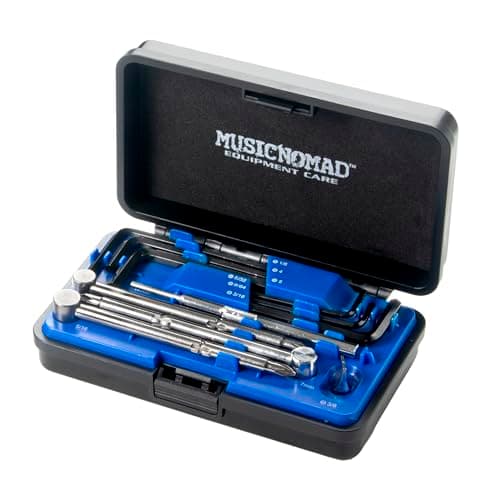
The practical problem it solves is real: nobody knows which truss-rod fitting their guitar takes until they look, and the answer varies by brand, model and year. MusicNomad's 11-piece set publishes its contents — six Allen key sizes, three socket sizes (1/4", 5/16" and 7 mm), a magnetized PH#1 driver for truss-rod cover screws and a 3/8" blade bit.
Using the wrong-size wrench on a truss-rod nut rounds it out, and a rounded truss-rod nut is a much bigger problem than the adjustment you were attempting. If you are going to touch it at all, having the right fitting is not optional.
Contents, side by side
Published contents| Kit | Published contents | Best for |
|---|
| MusicNomad 11 pc truss rod set | 6 Allen sizes, 3 socket sizes (1/4", 5/16", 7 mm), spoke wheel tool, PH#1 magnetized driver, 3/8" blade bit | Truss-rod fitting coverage |
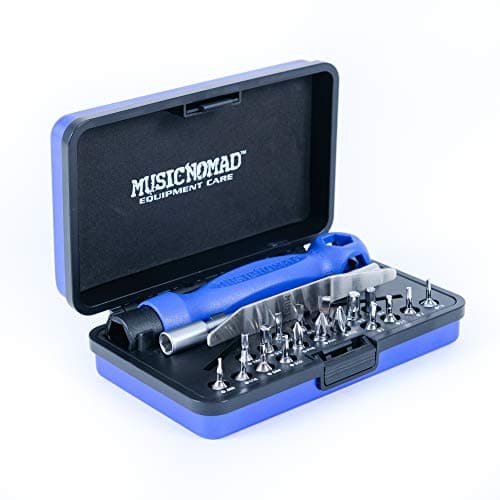
| MusicNomad 26 pc tech set | 18 screwdriver bits (Phillips, flat, Allen), 7 hex wrenches, 1 spanner wrench | Everything except the truss rod |
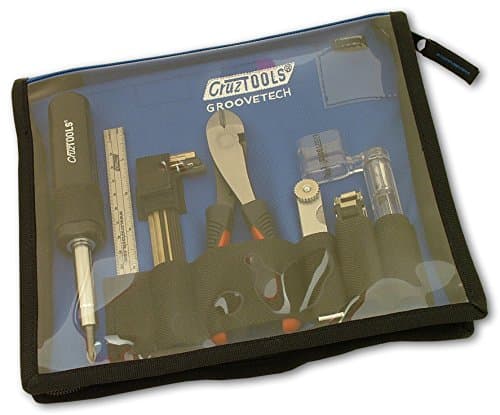
| CruzTools GrooveTech Guitar Player Tech Kit | Not published in a form we could retrieve | A kit that lives in the gig bag |
Note the third row. CruzTools' kit has a strong reputation among working players and the company publishes almost nothing about its contents online. We are not going to list contents we could not source, so the row says so.
What none of these include
Measuring tools. A string action gauge and a set of feeler gauges are what turn "this feels high" into a number you can act on. None of the kits above includes them, and without them any adjustment is guesswork.
If you are serious about learning setups, buy the measuring tools before the wrenches — the action gauge roundup covers which ones measure what. Knowing your action is 3.2 mm at the twelfth fret when the maker specifies 2.4 mm is the useful part; turning something without knowing that is how guitars end up worse.
The cheaper answer, honestly
A professional setup usually costs less than any of these kits and takes a technician under an hour. If your guitar is uncomfortable right now, that is the fastest and safest route to a guitar that is not, and you learn something by asking what they changed.
Buy the tools when you have decided you want to learn the craft, not as a way of avoiding a bill. Does my guitar need a setup helps you work out whether you need one at all.
What we did not doWe have not played any of this gear. Every guide in this category says it tested twenty tuners; we would rather say plainly that we tested none. What we did instead is on this page in full: published specifications with their sources, the makers' own manuals read rather than paraphrased, and a note wherever a company publishes nothing at all.