Every other page in the gifts section is built on one promise: you should not need to know anything about their guitar. A tuner fits any headstock, picks fit any hand, a care cloth fits any finish.
Buying for a child is the one case where that promise partly breaks, and it breaks in a specific, predictable place. Children usually play smaller guitars, and a handful of accessories are sized to the instrument. Get one of those wrong and the gift is a return trip rather than a present.
So this page is organized around a single question: does this accessory care how big the guitar is? Five things that do not, three that do, and the specification the whole category refuses to print.
First, what size guitar are they likely to have
Children's guitars are sold as fractions — 1/8, 1/4, 1/2, 3/4, 7/8 — and the fraction refers to the body and scale length rather than to anything precise. Thomann publishes a size-by-height guide that maps roughly as follows: 1/8 around 100 cm tall, 1/4 for 110 to 130 cm, 1/2 for 120 to 140 cm, 3/4 for around 130 to 150 cm, 7/8 for around 140 to 160 cm, and full size from about 180 cm.
Two honest caveats on that table, both of which the source itself makes. The age ranges overlap heavily, and height matters far more than age. And it is a general reference rather than a rule — children vary enormously in arm length and hand size at the same height.
For gift purposes you do not need the exact fraction. You need to know whether the guitar is full size or not, and if it is not, roughly how much smaller. One photo from a parent settles it.
5 of 8
Accessories on this page that do not care what size the guitar is
The tuner, the picks, the headphone amp, the headphones and the care kit all fit any instrument. The strap, the case and the stand are the three that do not.
The five that fit any size
1. A clip-on tuner — the safest gift on this page
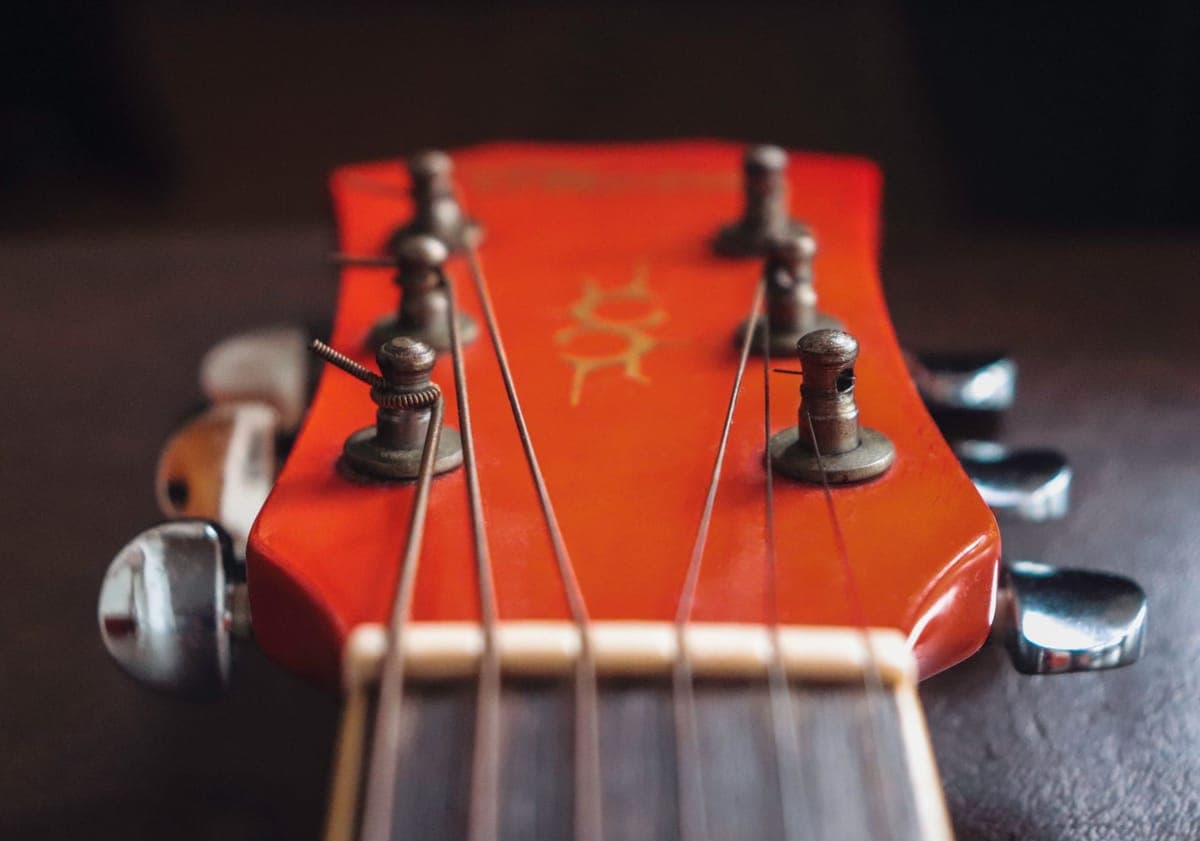
A clip-on clamps to the headstock and reads vibration through the wood. Headstocks on children's guitars are narrower than full-size ones and the clamp accommodates that without any thought, because the clamp is sprung and the range is generous at both ends.
Korg publishes plus or minus 1 cent accuracy for the Pitchclip 2, about 24 hours of battery from a single CR2032, and 17 g with the battery fitted. That last number matters more here than on an adult page: 17 g on the end of a small headstock is genuinely nothing, and a heavy tuner on a light guitar is noticeable.
It is also the accessory that most changes whether a child keeps playing. An out-of-tune guitar makes practice sound like failure when it is not, and children are considerably less likely than adults to work out that the instrument is the problem. Everything about why this is the first purchase is in the tuner roundup.
2. A pick variety pack — let them choose
Dunlop publishes six Tortex Standard gauges — .50, .60, .73, .88, 1.0 and 1.14 mm — and color-codes them, and the variety pack contains two of each. For a child that is better than picking one for them, because the right gauge is a physical fact about a hand and nobody can guess it from outside.
A thinner pick flexes more and smooths out an uneven strum, which flatters a beginner's right hand. Whether a particular child gets on better with .50 or .73 is not something you or we can determine. The pack settles it in an afternoon for the price of a coffee, and the pick thickness guide explains what changes between them.
The honest catch: children lose picks at an extraordinary rate. That is an argument for the pack rather than against it.
3. A headphone amp — the gift the rest of the household notices
This is the pick that most often gets missed, and for a child with an electric guitar it is the one with the largest effect on how much they actually play.
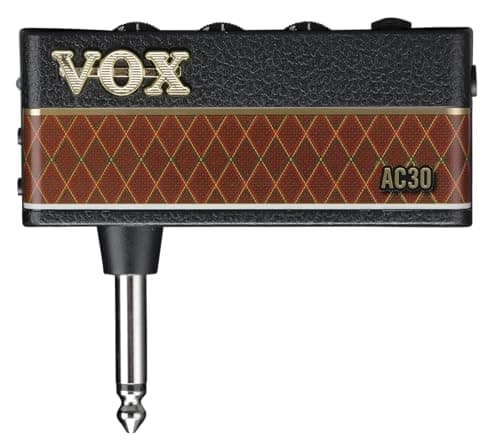
A headphone amp plugs into the guitar's output jack and puts a full amp into headphones. No speaker, no volume negotiation, no being told to stop because someone is on a call. Practice stops being a household event that has to be scheduled and becomes something that can happen for twenty minutes after homework.
Vox publishes 10 hours of battery life with effects or rhythm on and 16 hours with them off for the amPlug 3, which is unusually specific for this category — Fender's manual gives up to six hours per charge for its equivalent, with no test conditions stated. The full comparison is in the headphone amp roundup.
Against it: it only works on an electric or an acoustic with a pickup, so check before buying. It also protrudes from the output jack, which on some guitars sits where a forearm rests — a smaller player may find that more awkward than an adult would.
4. Headphones to go with it — and weight is the specification
A headphone amp with no headphones is a paperweight, and the pair in the drawer is usually wireless earbuds, which add latency between the note and the sound. For playing, that is genuinely disruptive.
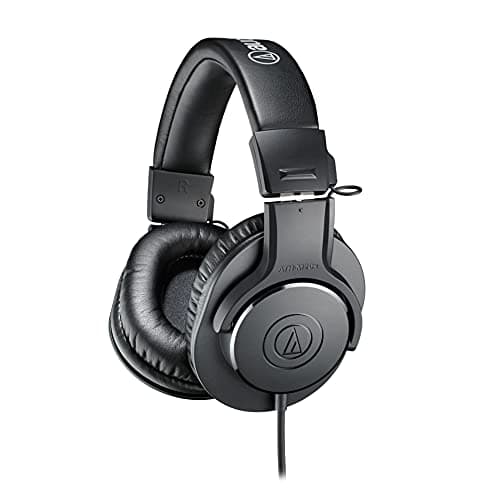
For a child, the specification that matters most is one adults barely think about: weight. Audio-Technica publishes 200 g without the cable for the ATH-M20x, which is the lightest of the four pairs we cover. It is also 47 ohms, low enough for a battery-powered headphone amp to drive properly, and it ships with a 3.5 mm plug plus a screw-on 6.3 mm adapter so it fits both a matchbox amp and a full-size one.
Against it: the 3 m cable is fixed and long, which around a child is more trailing lead than an adult would put up with. The whole argument, including the plug sizes different amps use, is in headphones for guitar practice.
5. A care kit — small, consumable, size-blind
Cleaning products do not care how big the guitar is. What they do care about is the finish, and this is the one place to check rather than assume: MusicNomad publishes that its Guitar ONE polish is safe on all gloss finishes including nitrocellulose and explicitly not recommended for satin or matte.
Most inexpensive children's guitars are gloss polyurethane, which is the easy case. If the guitar has a satin neck or a matte body, a dry microfiber cloth is the whole safe routine — how to clean a guitar covers which is which.
The three that do care about size
A strap, and the number nobody publishes
This is the one that catches people, and it is worth being precise about what we do and do not know.
Ernie Ball publishes an adjustment range of 41 to 72 inches for its Polypro strap. That is the strap we recommend to adults on leather vs nylon precisely because the published range covers essentially every grown player. Whether 41 inches shortens far enough for a particular child is a question about that child, and it is not one we can answer from a specification sheet.
What we can say is what we found looking: no child-specific guitar strap we checked publishes a length range at all. The products exist and the listings describe them as children's straps without printing the number that would let you check the claim. That is the same gap this site keeps finding, and we are not going to fill it with a guess.
The practical answer: measure the child with a piece of string from the strap button at the base of the guitar, over the shoulder, to the heel of the neck, and compare against the published minimum before you buy. Or skip the strap. A child learning seated does not need one, and it is fifth on the first-guitar checklist for adults for the same reason.
A case or gig bag — buy the fraction, not the word
A bag sized for a full-size dreadnought will hold a 3/4 guitar the way a coat hanger holds a scarf. It fits, and it protects nothing, because protection comes from the instrument not moving inside the bag.
Bags and cases for children's guitars are sold by the same fractions as the guitars, so this is solvable if you know the size. If you do not know it, do not guess — this is the item to leave off the list. Where a maker publishes internal dimensions, use them; a lot of makers publish only the outside of the case, which tells you nothing about whether the guitar goes in. That gap is called out by name on gig bag vs hard case. If you do know the size — because the guitar is already in the house and you can measure it — gig bags for 3/4 and 1/2 size guitars ranks the bags whose makers publish interior dimensions.
A stand or wall mount — check the neck, not the guitar
A guitar within arm's reach gets picked up several times a day; a guitar in a case in a cupboard gets picked up on Sundays. For a child that behavioral effect is the single strongest argument for any accessory on this page.
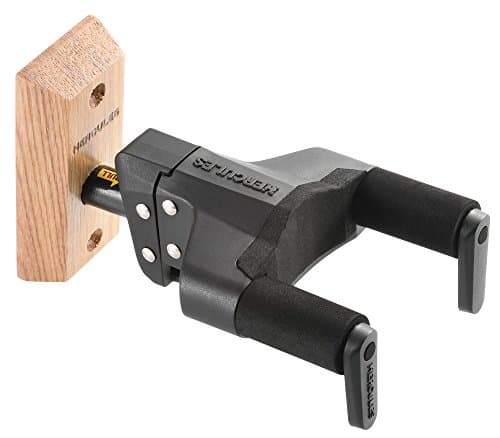
The size question here is the neck rather than the body. Hercules publishes that the yoke on its wall mount adjusts down to a 28 mm neck, which covers children's guitars, ukuleles and mandolins. The Auto Grab yoke also closes around the neck under the instrument's own weight, so there is nothing for a child to remember to fasten — which is the right design for this buyer.
Two honest marks against it. Hercules states on its own listing that it is not compatible with nitrocellulose finishes; a cheap child's guitar will almost certainly be polyurethane, but check if the instrument was expensive. And Hercules publishes no load rating, which String Swing does — the full comparison is in the wall hanger roundup.
A wall mount also needs a stud and a drill, which is a parent decision rather than a gift decision. If that is a problem, a floor stand is the fallback — bearing in mind it is the easiest thing in a child's room to knock over.
Size sensitivity, at a glance
Does this accessory care how big the guitar is?| Accessory | Size-sensitive? | What to check first |
|---|
| Clip-on tuner | No | Nothing — the clamp range covers any headstock |
| Picks | No | Nothing |
| Headphone amp | No | That the guitar is electric, or has a pickup |
| Headphones | No | Weight, if the child is small |
| Care kit | No | The finish: gloss, satin or matte |
| Strap | Yes | The published minimum length against the child |
| Case or gig bag | Yes | The guitar's size fraction, and internal dimensions |
| Stand or wall mount | Yes | The neck width the yoke adjusts down to |
What to avoid buying for a child who plays
Strings. Gauge, alloy and coating are three separate choices and a smaller guitar often takes a lighter set than a full-size one. Wrong on any axis and it goes in a drawer. If a parent tells you the exact set, it is a fine small gift; otherwise skip it.
A capo. Steel-string and nylon-string capos are not interchangeable — a classical guitar has a flat fingerboard and a steel-string capo will pull the middle strings sharp on it. Plenty of children start on nylon. See the capo hub if you know which they have.
A practice amp with a speaker. Well meant, and the household consequence is the opposite of the headphone amp above. If the goal is more practice rather than more volume, buy the quiet option. The other direction is covered in the practice amp roundup.
A metronome. It is the accessory that most improves playing and least improves enjoyment. For an adult who has decided to get serious, that trade is worth making. For a nine-year-old three weeks into lessons, it is a gift that says homework.
If you only buy one thing
Buy the tuner. It fits any guitar at any size, it costs less than most toys, it is the accessory that most reliably stops a beginner concluding they are bad at this, and there is no version of a child with a guitar for whom it is the wrong present.
If the guitar is electric and the house is not large, buy the headphone amp and a pair of headphones instead, and expect it to change how often the guitar comes out of its bag. Both are covered at a range of budgets in gifts under $50 and gifts under $100.
What we did not doWe have not played any of this gear. Every guide in this category says it tested twenty tuners; we would rather say plainly that we tested none. What we did instead is on this page in full: published specifications with their sources, the makers' own manuals read rather than paraphrased, and a note wherever a company publishes nothing at all.