A pick is a piece of plastic worth pennies, and it changes your sound more than most things costing a hundred times as much. The variable that matters is thickness, and this is one of the few corners of guitar gear where the numbers are published plainly.
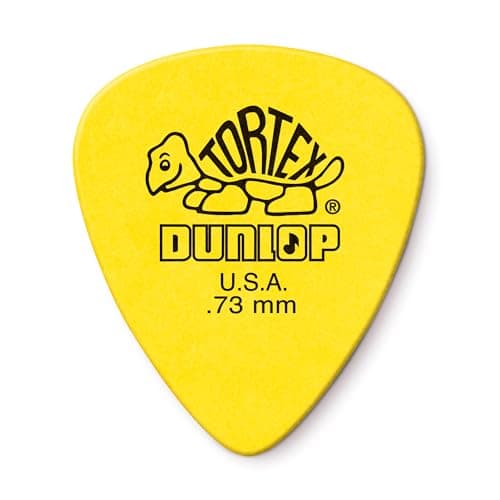
Dunlop publishes six thicknesses for the Tortex Standard — .50, .60, .73, .88, 1.0 and 1.14 mm — and color-codes each gauge across the whole range, so you can identify one across a room.
Published Tortex Standard gauges| Thickness | Feel | Best at | Worst at |
|---|
| .50 mm | Very flexible | Light strumming, jangly chords | Single-note clarity |
| .60 mm | Flexible | Strumming an acoustic | Fast picking |
| .73 mm | The middle | Almost everything | Nothing badly |
| .88 mm | Firm | Chords with definition, mixed playing | Very light strumming |
| 1.0 mm | Stiff | Single notes, control | Smooth strumming |
| 1.14 mm | Very stiff | Lead playing, precision | Anything strummed softly |
What thickness physically changes
Flex. A thin pick bends as it crosses a string, which softens the attack and evens out an uneven strumming hand. A thick pick does not bend, so everything your hand does reaches the string — wonderful once your hand is doing the right thing, unforgiving before then.
Attack. Thin picks produce a click as they snap past each string, which is audible and part of the jangly acoustic sound people associate with light picks. Thick picks produce a rounder, more defined note onset.
Volume. A thick pick transfers more energy into the string, so it is louder at the same hand effort.
Control over individual strings. This is where thin picks fall down. Picking one string at a time cleanly needs a pick that does not deflect on contact.
0.64 mm
The range between the thinnest and thickest Tortex Standard
Six published gauges across less than a millimeter, and it is the largest tonal change available for under a dollar.
Where to start
.73 mm — the yellow Tortex — is the most-recommended single gauge in guitar and it deserves the reputation. Stiff enough for single notes to speak, flexible enough that strumming does not sound like an attack.
If you only strum chords, try .60 mm. If you mostly pick single notes, try .88 mm.
And it is entirely normal to keep two. Many players use a lighter pick for strumming and a heavier one for lead, and switch.
The twenty-minute experiment
Buy a variety pack. Play the same thing with each gauge — a chord progression you know, then a single-note line — for a few minutes each. Notice two things: which one makes chords sound the way you want, and which one lets you hit a single string cleanly without thinking.
If those are different picks, keep both. If they are the same pick, buy a dozen of it.
This is a better answer than any recommendation an article can make, because it depends on your hand size, your grip strength and how hard you naturally play — none of which we can see from here.
Material, briefly
Tortex has a matte, slightly chalky surface that grips dry fingers well and produces a warm, rounded attack. It wears slowly and evenly.
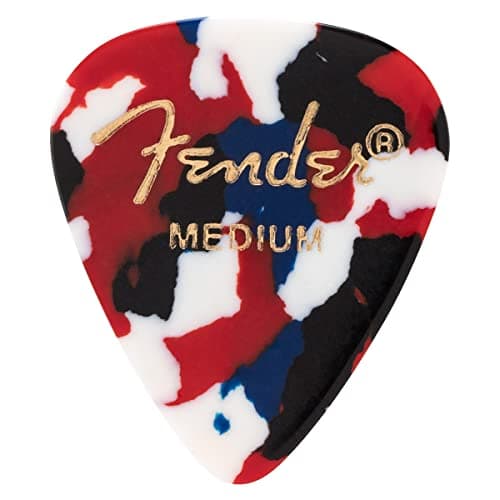
Celluloid — the glossy Fender 351 — is brighter and slicker. It sounds sharper on an acoustic and slides more easily out of damp hands. Fender names its gauges thin, medium and heavy rather than publishing millimeters, which makes cross-brand comparison harder.
Nylon is grippier and flexes more at the same thickness, which makes gauge numbers unreliable across materials — a .73 mm nylon pick does not feel like a .73 mm Tortex one.
Shape
The standard 351 shape is the rounded triangle everyone pictures and the correct starting point. Sharper jazz shapes give more precision and less surface for strumming; large triangles suit big hands and firm grips.
None of this matters until thickness is settled, because thickness dominates every other variable.
Once it is settled, the next question is why two picks printed at the same millimeter figure feel different in the hand. That is the material, and nylon, celluloid and Delrin compared explains what each one changes.
What we did not doWe have not played any of this gear. Every guide in this category says it tested twenty tuners; we would rather say plainly that we tested none. What we did instead is on this page in full: published specifications with their sources, the makers' own manuals read rather than paraphrased, and a note wherever a company publishes nothing at all.