Wall hanger vs stand makes the case for hanging: a wall mount cannot be knocked over, and a guitar you can pick up in one movement gets played several times a day where a guitar in a case gets played on Sundays. If you have accepted that argument, this page is about which mount, and the criteria are not the ones the product photos suggest.
You are about to fix a bracket to a wall and hang an instrument off it by the headstock, over a hard floor, for years. Two specifications decide whether that is a good idea, and most makers publish neither.
The two specifications that matter
1. Load rating — what is it actually rated to hold
Of the four mounts here, exactly one publishes a figure: String Swing's hardwood CC01K, at 15 lb per hanger with a lifetime structural warranty. Hercules publishes none. Rockstand publishes none. String Swing's own horizontal mount publishes none.
A typical solid-body electric weighs well under 15 lb, so in practice all four are almost certainly adequate. That is not the point. The point is that three of these four are asking you to hang an instrument on a bracket whose maker will not say what it holds, and one of them will and backs it with a warranty. On a site that ranks on published specifications, that is not a close call.
2. Nitrocellulose compatibility — the one that ruins a finish
Nitrocellulose lacquer is a thin, soft finish used on many higher-end and vintage-style guitars, and it reacts with certain plastics and foams. Leave a nitro-finished neck resting on the wrong rubber for long enough and the finish softens, goes cloudy, or the padding prints itself permanently into it. It is not reversible without a refinish.
This is the specification most buyers have never heard of and the one that does the expensive damage. Two of the four mounts here state explicitly that they are not for nitro finishes — Hercules answers no on its own listing, Rockstand says not recommended. String Swing's horizontal mount states it is compatible.
If you do not know what finish your guitar has, the safe assumption for an inexpensive first guitar is polyurethane, which is unaffected. If the guitar was expensive, or is a reissue of anything, find out before you hang it.
1 of 4
Wall mounts here whose maker publishes a load rating
String Swing publishes 15 lb per hanger on the CC01K and backs it with a lifetime structural warranty. The other three publish no figure at all.
The third thing: what is actually in the box
Every mount here needs to go into something solid. A guitar on a bracket applies a constant downward load plus whatever leverage the bracket adds, and plasterboard alone is not a fixing.
Find a stud and screw into it. If there is no stud where you want the guitar, use proper heavy-duty cavity anchors rated well above the load — not the small plastic plugs that come in the box. Rockstand includes screws and no wall plugs, which is worth knowing before the drill comes out on a Sunday.
The picks
String Swing CC01K — the only published load rating
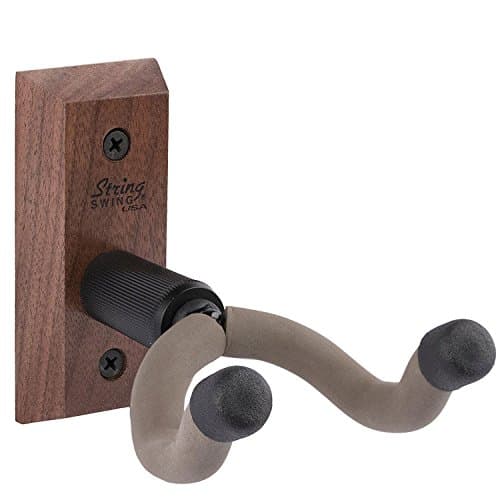
A North American hardwood block with a padded steel yoke that pivots to suit the headstock shape, rated at 15 lb per hanger, with a lifetime structural warranty and made in the USA. It is the mount that answers the question the category avoids.
The pivoting yoke is a genuine engineering feature rather than a marketing one: headstocks vary enormously in width and angle, and a fixed cradle that suits a Fender does not suit a classical guitar. A yoke that rotates finds its own alignment.
Against it: it needs a stud and a drill, which rules it out if you rent. The guitar hangs by its headstock, which worries people — it is fine, a headstock carries far more than the weight of its own guitar in string tension alone, but the worry is real and worth naming. And it is not portable in any sense.
String Swing Horizontal — best for a nitro finish
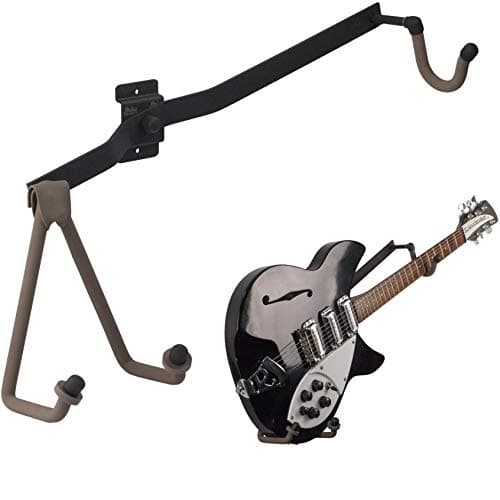
Hangs the guitar sideways rather than by the headstock, which side-steps the objection above entirely, and String Swing states it is compatible with nitrocellulose finishes. It swivels so you can angle the instrument to the room, and it adjusts for right- or left-handed guitars.
It is also the answer for a low ceiling or a space above a desk where a vertical hanger simply does not fit.
Against it: String Swing publishes no load rating for this one, which is a strange omission given they publish one for the CC01K, and we have marked it unpublished. There is a hard body-depth limit of 57 mm, which rules out thicker semi-hollow bodies. And a horizontal mount takes far more wall width than a vertical one.
Hercules HCGSP-38WB+ — most secure hold
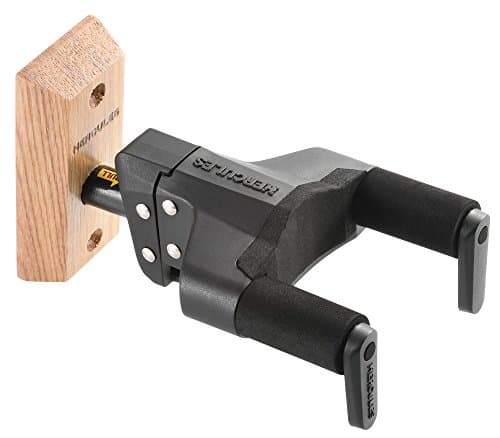
The Auto Grab yoke closes around the neck under the guitar's own weight. It is the best answer on this page to "could it come off", because there is no state in which the guitar is in the cradle and the cradle is open. It adjusts down to a 28 mm neck, so it takes ukuleles and mandolins as well as guitars, and it is the cheapest of the four.
Against it, and this is decisive for some readers: Hercules answers no to nitrocellulose compatibility on its own listing. If your guitar has a nitro finish this is not a mount to consider. It also publishes no load rating, and the arms cannot be rotated once the instrument is in place, so you set the angle when you fit it.
Rockstand Guitar Wall Hanger — best budget with a lock
Powder-coated metal with foam padding and a pin-lock offering three settings, which is a genuine security feature at the bottom of this price range. It converts for left-handed instruments.
Against it: stated as not recommended for nitro finishes; no published load rating; listed for electric guitar and electric bass only rather than acoustics; and screws are included but wall plugs are not. Four caveats is a lot, and they are all knowable before you buy, which is why they are here.
Published specifications, side by side
What each maker publishes | String Swing CC01K | String Swing Horizontal | Hercules 38WB+ | Rockstand |
|---|
| Load rating | 15 lb per hanger | Not published | Not published | Not published |
| Nitro-safe | Stated compatible | Stated compatible | Stated NOT compatible | Not recommended |
| Hold | Pivoting padded yoke | Horizontal cradle | Self-closing Auto Grab | Pin-lock, 3 settings |
| Warranty published | Lifetime structural | Not published | Not published | Not published |
| Fits | Guitars generally | Body depth up to 57 mm | Necks from 28 mm up | Electric guitar and bass |
| Wall plugs included | Not published | Not published | Not published | No, screws only |
The first two rows are the page. Everything below them is preference.
Fitting it without regretting it
Find a stud. Not a guess, a stud finder or a knuckle-and-a-nail. Everything else about the installation is downstream of this.
Think about height and traffic. High enough that the body clears furniture and nobody walks into the headstock; low enough that you can lift the guitar off one-handed, because the whole behavioral benefit disappears if it is a two-hand operation.
Not above a radiator, and not in direct sun. Heat and dryness are the environment questions, and a wall over a radiator is the worst place in the room on both counts. If you are in a dry climate or a heated flat, measure with a hygrometer before you commit to a wall.
Accept the dust. A hanging guitar collects household dust on the fingerboard and hardware in a way one in a case does not. It is a cloth once a week, and how to clean a guitar covers what is safe to use.
If you rent, or cannot drill
Then this whole page is the wrong one and a floor stand is the answer. Adhesive and pressure-fit wall mounts exist and we do not recommend one for an instrument, because the failure mode is the guitar hitting the floor and none of them publish a load figure either.
What we did not doWe have not played any of this gear. Every guide in this category says it tested twenty tuners; we would rather say plainly that we tested none. What we did instead is on this page in full: published specifications with their sources, the makers' own manuals read rather than paraphrased, and a note wherever a company publishes nothing at all.