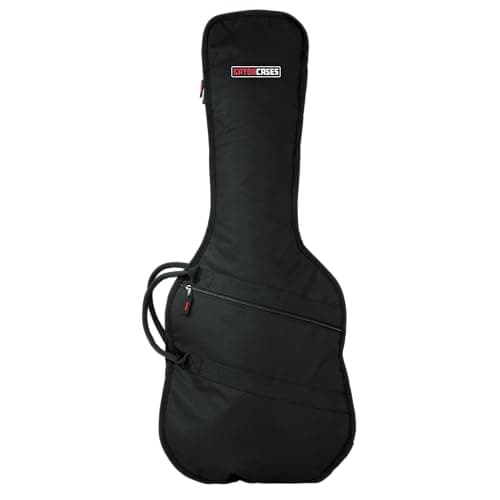
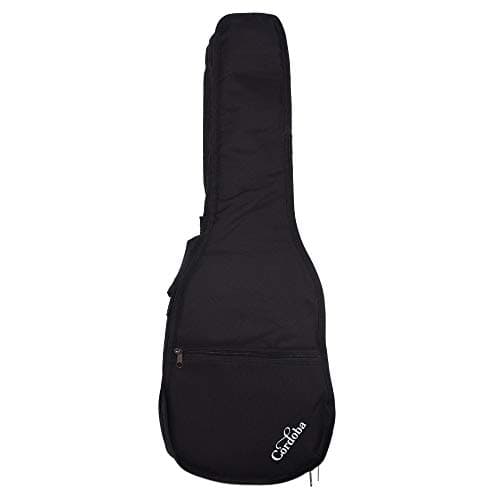
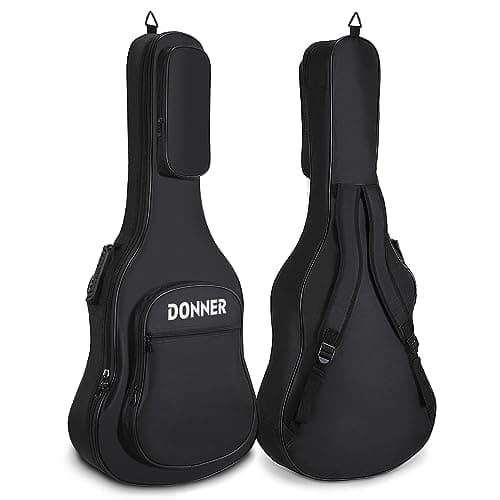
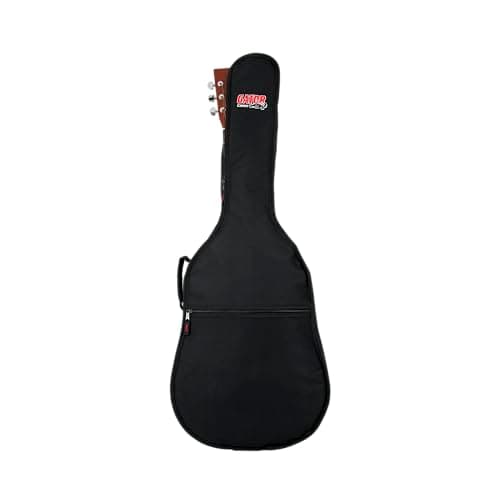
For a 3/4 steel-string, buy the Gator GBE-MINI-ACOU. Not because it is the best-padded bag here — it is not — but because Gator publishes six interior dimensions, so you can measure the guitar on the kitchen table and know before you order. For a half-size classical, Cordoba's Standard Gig Bag, because Cordoba is the only maker that publishes what each size fraction actually means in millimeters.
The reason this page exists is that "3/4 size" is not a standard. It is a rough descriptor applied by every maker independently, and a bag bought on the fraction alone is a coin toss.
First, three measurements and two minutes
Take these with a tape measure before you read any listing. They are the only things that decide whether a guitar goes into a bag.
- Overall length, from the top of the headstock to the bottom of the body. This is the figure most often published and the one most often exceeded.
- Lower bout width, the widest part of the body. A bag that is long enough but narrow will not close.
- Body depth, at the deepest point. This is the one people forget, and it is the difference between an acoustic bag and an electric one.
- Scale length if the guitar is a classical, measured from the nut to the saddle. Classical bags are sold on this figure.
Write them down. Everything below is a comparison against those four numbers.
Why the fraction on the label does not settle it
Cordoba publishes the clearest map anyone in this category offers: in its bag range, 1/4 means a 480 mm scale, 1/2 means 580 mm, 3/4 means 630 mm and full size means 650 mm. That is genuinely useful, and it is also specific to Cordoba. No other maker here commits to it.
0.7 in
The difference in interior body length between Gator's two mini bags, both sold as mini
GBE-MINI-ACOU publishes 19.7 in of body length and 4.3 in of depth; GBE-MINI-ELEC publishes 19 in and 2.5 in. Same word on the label, different bags, and only the second of them will take a solid body properly.
Those two bags are from the same maker, in the same economy range, at the same price. The depth figure is where they diverge most: 4.3 in for an acoustic body against 2.5 in for a solid one. A solid-body electric in the acoustic bag rattles around inside it; an acoustic in the electric bag does not close.
Thomann's published size guide maps the fractions to child height rather than to guitar dimensions — roughly 1/4 for 110 to 130 cm, 1/2 for 120 to 140 cm, 3/4 for about 130 to 150 cm — and those ranges overlap deliberately. It is a buying guide for the guitar, not for the bag, and it is a good reminder that the fraction describes the player as much as the instrument.
The criteria, in the order they decide it
1. Published interior dimensions
This is the whole ballgame, and most of this category fails it. Gator publishes body length, all three bout widths, body depth and overall length for both of its mini bags. Cordoba publishes a scale length. Everyone else publishes an outside measurement, or a guitar length in the product title, or nothing. A bag advertised as "36 inch" is telling you about a guitar it has in mind, not about its own interior.
2. Padding, which matters less than fit
Both Gator economy bags publish a 10 mm foam core behind a 600-denier nylon shell. The Donner bag publishes 0.4 in, which is about 10 mm as well. Cordoba publishes only the words "lightly padded".
Padding figures in this class are all in the same narrow band, and none of them is protection against a drop. Fit matters more, because protection comes from the instrument not moving: a well-fitted 10 mm bag beats a loose 20 mm one. That is the same argument made on gig bag vs hard case, and it is more true at small sizes, not less.
3. Which outline the bag is cut for
At full size nobody confuses a classical with a dreadnought. At 3/4 people do it constantly, because the length figures are close. They are different shapes: a classical has a narrower waist and a shallower body, a small steel-string is deeper with a wider lower bout, and a mini electric is a different object again. Buy the bag cut for the family of instrument you own.
4. Whether it will be carried by a child
Backpack straps are standard across everything here, which matters more than it sounds: a small guitar is usually carried by a small person, and a single shoulder strap on a child is a dropped guitar waiting for a bus stop. All four picks publish dual straps.
What each maker actually publishes| Bag | Interior body length | Depth | Overall length | Padding |
|---|
| Gator GBE-MINI-ACOU | 19.7 in | 4.3 in | 38.5 in | 10 mm foam |
| Gator GBE-MINI-ELEC | 19 in | 2.5 in | 38 in | 10 mm foam |
| Cordoba Standard 1/2 | Not published | Not published | 580 mm scale length | “Lightly padded” |
| Donner 36 in | Not published | Not published | For 36 in guitars | 0.4 in |
A worked example: the guitar that is a 3/4 and a 1/2 at once
Take the most popular small steel-string there is. Taylor describes the Baby Taylor as "a 3/4-size Dreadnought" and publishes its scale length as 22-3/4 in. That is 578 mm.
Now take Cordoba's published map from the section above, where a 1/2 size bag is specified as 580 mm scale and a 3/4 as 630 mm. The same 578 mm instrument is a 3/4 to Taylor and a 1/2 to Cordoba, and both companies are being entirely honest. They are measuring against different traditions — a scaled-down dreadnought against a scaled-down classical — and there is no referee.
This is the whole problem in one example, and it is why a bag bought on a fraction is a gamble while a bag bought on a measurement is not. It also explains why Gator does not print fractions: its small-body bags are specified in inches of body length, bout width and depth, and when the 4G version of the mini acoustic bag does name instruments it names them specifically — Gator publishes that it is "designed to fit mini acoustic such as the Baby Taylor and Martin LX" rather than claiming a size class.
If you want more than 10 mm of foam
Both economy bags here publish a 10 mm foam core. Gator's 4G series is the step up in the same catalog and publishes 20 mm GFLEX padding on all sides, along with the same style of full interior dimensions: 19.7 in of body length, 14.4 in lower bout, 13.4 in middle, 12.4 in upper, 3.5 in body height and 38.4 in overall.
Read those against the economy bag's figures and something useful falls out. The 4G is the same body length and a slightly narrower, noticeably shallower interior — 3.5 in against 4.3 in. More padding, less room. For a slim-bodied travel guitar that is the better bag; for a deeper small dreadnought the economy bag may be the only one of the two that closes. Neither statement is on a marketing page anywhere; both come straight off the published dimensions, which is the argument for buying from the maker that prints them.
The 4G also costs roughly twice what the economy bag does. That is a reasonable trade for a guitar that travels weekly and a poor one for a guitar that goes to a lesson and back, which is the honest reason it is not the top pick here.
The mistake this page exists to prevent
A full-size bag will hold a 3/4 guitar. It will not protect it. The instrument slides inside the bag, which means every knock is delivered to a guitar in motion rather than to the padding, and the neck takes the load at the point where it is already weakest.
Our guitar gifts for a kid page says outright that if you are buying a gift and do not know the size, the bag is the item to leave off the list. That is still the right advice for a gift. This page is for the other situation: you own the guitar, you can measure it, and you want the bag that fits it.
What we did not doWe have not played any of this gear. Every guide in this category says it tested twenty tuners; we would rather say plainly that we tested none. What we did instead is on this page in full: published specifications with their sources, the makers' own manuals read rather than paraphrased, and a note wherever a company publishes nothing at all.
Buying for a guitar you cannot measure
Sometimes the guitar is not in the room: it is a present, or it is still in a box somewhere. The measurements are still the answer, you just have to get them from the maker instead of from a tape.
- Get the exact model name, not the size fraction. "Yamaha JR2" or "Squier Mini Strat" leads to a specification page; "a 3/4 acoustic" leads nowhere.
- Look up the scale length. It is the figure makers publish most consistently, and Cordoba's map turns it into a bag size: 480 mm is a 1/4, 580 mm a 1/2, 630 mm a 3/4, 650 mm full size.
- Expect the body figures to be missing. Most makers publish scale length and woods and stop. Where that happens, match the scale length to the bag family and buy the bag whose interior length has the most margin over the guitar's overall length.
- Do not buy on the child's age. Thomann's guide maps sizes to height, not age, and the ranges overlap by design.
And if none of that is available, the honest answer is the one on guitar gifts for a kid: leave the bag off the list and buy something that fits any guitar. A tuner, a pack of picks or a strap costs less and cannot be the wrong size. The bag can be bought in ten minutes once the guitar is in the house and you can put a tape across it.
When to skip the gig bag entirely
Two cases. If the guitar travels in a car boot with other luggage, or goes anywhere near an aircraft hold, 10 mm of foam is not the product — the best case for flying covers what actually survives that. And if the guitar stays in one room, a stand or a wall hanger gets it played more often than any bag does, which is the argument on wall hanger vs stand.
What we would actually buy
Measure first. Then: the Gator GBE-MINI-ACOU for a 3/4 steel-string, the GBE-MINI-ELEC for a short-scale electric, the Cordoba for a half-size classical, and the Donner only if the budget decides it and you already know the guitar is 36 in overall. If your measurements fall between two bags, buy the smaller one that still closes — a snug bag is the one doing its job.