Guitar cleaning divides into three jobs on three different schedules. Get the schedules right and you barely need products at all.
After every session: thirty seconds, no product
Wipe the strings — top and underside of each, running the cloth along the length. Then wipe the back of the neck and anywhere your forearm rested on the body.
This is the single highest-return habit in guitar care. Sweat and skin oil are what corrode strings and what dulls a finish over years, and removing them immediately is far more effective than any product applied later. A clean, dry microfiber cloth is the entire toolkit.
During a string change: the parts you can only reach now
With the strings off, the fretboard is accessible for the only time in a couple of months.
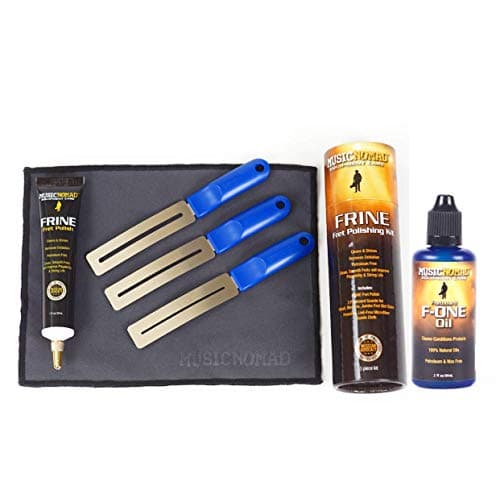
Remove the grime. Dirt builds up against the frets on the fingerboard. A dry cloth handles most of it. For the stubborn build-up, a cloth over a fingernail or a plastic (never metal) tool worked along the fret edge lifts it without scratching the wood.
Then decide whether the board needs oil. Most of the time it does not. See the section below.
Wipe the frets. Tarnished frets feel draggy under bends. A dry cloth is enough for normal tarnish. Metal polishes exist and require masking off the fingerboard, which is more project than most people want.
A few times a year: the body
Only if the finish is visibly dull or marked. Use a product matched to your finish type.
Match the product to the finish| Finish | What to use | What to avoid |
|---|
| Gloss polyurethane / polyester | Guitar polish, sparingly | Household cleaners, anything with silicone |
| Nitrocellulose lacquer | A polish published as nitro-safe | Solvents; long contact with some rubbers and plastics |
| Satin / matte | A dry or barely damp cloth only | Polish of any kind — it creates permanent shiny patches |
| Unfinished / oiled wood | Dry cloth; a wood-appropriate oil occasionally | Polish, water |
MusicNomad publishes that its Guitar ONE is safe on all gloss finishes including nitrocellulose and is not recommended for satin or matte. That is the level of published guidance to look for on any product you buy.
Fretboard oil: less often than you think
Which boards want oil: unfinished rosewood, ebony, pau ferro and similar dark woods. They dry out over years and look gray and chalky when they do.
Which boards do not: finished (glossy) maple. It has a lacquer coat and oil sits on top doing nothing useful.
How often: two or three times a year at most, and only when the board looks dry. Over-oiling is more common than under-oiling and it can soften glue joints around fret ends over time.
How much: a few drops on a cloth, worked in, then wiped off. Not poured on the board. If it looks wet after two minutes, you used too much.
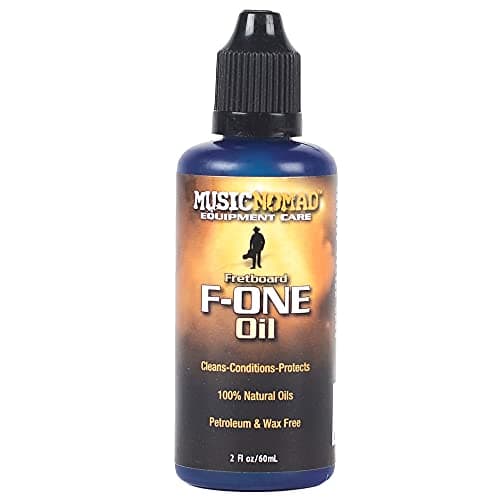
MusicNomad publishes that F-ONE contains no lemon oil, petroleum, wax or water. On a question this contested, a maker publishing its exclusions is the useful signal. More in the fretboard oil roundup.
30 seconds
After every session, with a dry cloth and no product at all
It removes the sweat and skin oil that do most of the damage, and it extends string life measurably.
What not to use, ever
- Household furniture polish. Commonly contains silicone, which contaminates the finish and causes serious problems if the guitar ever needs refinishing.
- Window cleaner or anything with ammonia. Attacks finishes and plastics.
- Water on a fretboard. Unfinished wood absorbs it and swells.
- Paper towel. Wood fiber is abrasive at this scale and leaves fine scratches on gloss.
- Polish on a satin finish. Covered above. It is permanent.
What we did not doWe have not played any of this gear. Every guide in this category says it tested twenty tuners; we would rather say plainly that we tested none. What we did instead is on this page in full: published specifications with their sources, the makers' own manuals read rather than paraphrased, and a note wherever a company publishes nothing at all.
Storage does more than cleaning
A guitar kept in a case in a stable room needs cleaning far less often than one on a stand in a kitchen. If the guitar lives out — which is good for practice — accept that it will need wiping more often, and keep it away from radiators, direct sun and cooking.
For a solid-wood acoustic, humidity matters more than dust. See do I need a humidifier.