Every tuner does the same arithmetic: measure a frequency, compare it to a reference, show you the difference. What separates the three types is not the maths, it is how they get the frequency in the first place — and that determines everything about where each one works.
3
Ways to sense a string: vibration, electrical signal, and air
Only the first two are unaffected by a television in the next room.
Clip-on: vibration through the wood
A clip-on clamps to the headstock and contains a piezo sensor that reads the mechanical vibration traveling through the instrument. Air is not involved, so ambient noise is irrelevant. It works on an acoustic with no electronics, a classical guitar, a ukulele, a violin and an unplugged electric.
Where it wins: everywhere a beginner tunes. A busy shop, a room with a television on, backstage, a lesson with three other people in it.
Where it loses: it is visible on the headstock, and the clip is the part that eventually breaks. It also cannot mute your output, which matters on stage and nowhere else.
Pedal: the electrical signal itself
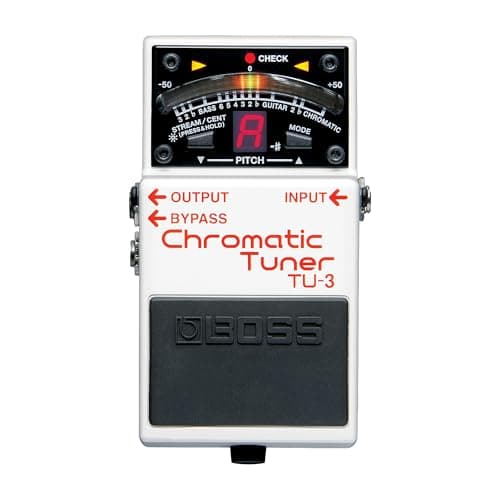
A pedal tuner sits in the signal chain between an electric guitar and an amp and reads the actual electrical output of the pickups. That is the cleanest possible source — no acoustic environment, no mechanical coupling, just the signal.
The feature that justifies the price is muting. Boss states the TU-3 mutes its output when the tuner is engaged, which means an audience hears silence rather than you tuning. TC Electronic's PolyTune 3 adds a polyphonic mode: strum all six strings and it shows which ones are out at a glance, which is genuinely faster between songs.
Where it wins: on a pedalboard, on a stage, and for anyone who tunes between songs in front of people.
Where it loses: it needs power, two cables and somewhere to stand. It does nothing at all for an acoustic without a pickup. And it costs several times a clip-on before you have bought the power supply.
App: the microphone, and the problem with air
A phone app uses the device microphone, which picks up your guitarand everything else in the room. In silence it works perfectly well. In a room with a fan, a conversation or a television, it hunts and jitters, and it becomes hard to tell whether the reading is your string or the room.
Where it wins: it is free, and it is on the device already in your pocket. As a backup for the day the tuner battery dies, it is genuinely useful and there is no reason not to have one.
Where it loses: any room that is not quiet, which is most rooms. It also drains a phone battery you may need for something else, and it puts a notification-generating device in your hands during practice — which is a real cost, if an unmeasurable one.
What actually differs | Clip-on | Pedal | Phone app |
|---|
| Senses | Vibration | Electrical signal | Air (microphone) |
| Works in a noisy room | Yes | Yes | No |
| Works on an acoustic with no pickup | Yes | No | Yes, if quiet |
| Mutes your output | No | Yes | No |
| Needs power | Coin cell | Mains or battery supply | Phone battery |
| Needs cables | No | Two | No |
| Typical published accuracy | ±1 cent (Korg) | ±1 cent (Boss TU-3) | Varies, rarely published |
The honest recommendation
Buy a clip-on. For a beginner, on any instrument, in any room, it is the correct answer, and it stays correct for years. It is also cheap enough that owning one is not a decision.
Add a pedal tuner when you have a pedalboard, not before. The muting is the feature, and muting is only valuable when somebody is listening. Until then a pedal tuner is a heavy metal box that does what a twenty-gram clip already did.
Keep an app installed as a backup. It costs nothing and it covers the day the coin cell dies.
If you are choosing a specific clip-on, the tuner roundup has the four worth considering, the acoustic-specific version narrows it further, and the electric version covers why a solid-body is a harder job for a clip-on than an acoustic is. If you have decided on a pedal, the tuner pedal roundup compares four of them on published accuracy, bypass type and board footprint.
What we did not doWe have not played any of this gear. Every guide in this category says it tested twenty tuners; we would rather say plainly that we tested none. What we did instead is on this page in full: published specifications with their sources, the makers' own manuals read rather than paraphrased, and a note wherever a company publishes nothing at all.