If you have bought a guitar in the last fifteen years, someone has told you to buy a Snark. It is the default recommendation in shops, lessons and forums, and mostly the crowd is right: it is cheap, it works, and the rotating color display is the easiest thing to read on a headstock.
It is also a confusingly numbered range where the differences between models are not always obvious from the box, and where one useful specification is absent across the whole line.
What the model numbers actually mean
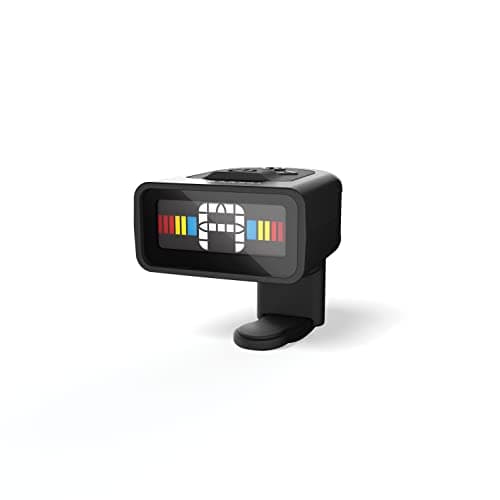
The current flagship is the ST-8 "Super Tight". Retail listings publish a calibration range of A4 = 415–466 Hz, a full-color display that rotates a full 360 degrees, a tap-tempo metronome, a transpose function for tuning with a capo, and a high-sensitivity vibration sensor. Standard versions ship with a CR2032 cell; there is also a rechargeable version with USB Micro-B charging.
Older numbers you will still see — SN-5X, SN-8 — are earlier generations. The SN-5X in particular no longer appears on Snark's own site and is generally treated as discontinued, which matters if you are buying from a marketplace listing rather than a shop.
The practical advice: buy the current ST-8. The older models work, and buying a discontinued tuner to save a very small amount of money is not a trade worth making.
The specification that is missing
We could not find a published accuracy figure — in cents — for any Snark tuner, on any product page, retail listing or manual we checked. The marketing language is "ultra-accurate tuning chip" and "super tight", both of which are adjectives rather than measurements.
To be clear about what that does and does not mean: it is not evidence that Snark tuners are inaccurate. Millions of them are in use and the overwhelming owner consensus is that they get a guitar in tune. It means that if you want to compare tuners on a number, Snark has not given you one, and Korg has.
This site treats an absent specification as a finding worth publishing rather than a row to quietly omit — which is why the Snark's spec card carries a row reading "Not published". A comparison table that silently drops the rows a product cannot fill is a comparison table that flatters it.
Snark ST-8 against the Korg that does publish | Snark ST-8 | Korg Pitchclip 2 |
|---|
| Published accuracy | Not published | ±1 cent |
| Calibration range | A4 = 415–466 Hz | Not published on the spec page |
| Display | Full color, rotates 360° | Monochrome |
| Metronome | Tap tempo, built in | None |
| Transpose | Yes | No |
| Published weight | Not published | 17 g |
| Published battery life | Not published | Approx. 24 h |
What the Snark genuinely does better
The display. A full-color screen on a 360-degree swivel is meaningfully easier to read at a glance than a small monochrome one, especially from the playing position where you are looking at the headstock from an odd angle. This is not a trivial advantage — a tuner you can read without moving your head is a tuner you actually use.
The extras. A tap-tempo metronome and a transpose function on a tuner this cheap are genuinely useful additions. The transpose is the one beginners appreciate later: it lets you tune normally with a capo fitted.
Availability. Snarks are stocked physically almost everywhere, which means replacing one is a walk to a shop rather than a delivery wait. For an item whose known failure mode is a broken clip, that matters.
What it does worse
The clip. The consistent complaint across the whole category, and Snark is not exempt. The plastic hinge is the part that fatigues.
The published record. Covered above. If you want numbers, Korg gives them and Snark does not.
Battery habits. With a lit color display and no published battery life, the practical answer is to fold it shut when you finish and keep a spare CR2032 in the case.
What we did not doWe have not played any of this gear. Every guide in this category says it tested twenty tuners; we would rather say plainly that we tested none. What we did instead is on this page in full: published specifications with their sources, the makers' own manuals read rather than paraphrased, and a note wherever a company publishes nothing at all.
Should you buy one?
Yes, if the display matters most to you and you do not mind that the accuracy figure is unstated. It is a good tuner and it is the one most people are recommended for reasons that are basically sound.
Buy the Korg instead if you want every claim on the box backed by a number you can check, or the D'Addario Micro if you would rather nobody saw a tuner on your headstock at all. The full comparison of all four is in the tuner roundup.