Start with the honest position, because it is not the one a page about tuner pedals normally takes: if you own one electric guitar and one small amp, a clip-on tuner is the better purchase. It costs a fifth as much, it needs no power, and it works on the acoustic in the corner too. The tuner roundup exists for that reason and the ranking there has not changed.
A pedal tuner buys you exactly one thing a clip-on cannot: it mutes the amp. Tuning through a live amp in a room with other people in it is the sound of an apology. The moment you play anywhere other than your own bedroom, that mute is the feature, and everything else on the specification sheet is secondary to it.
The criteria, in the order they decide it
1. Does it mute, and does the mute work when you want it
Every pedal here mutes the output when the tuner is engaged. What differs is what happens the rest of the time, which is the bypass question below. Some tuners also offer an always-on mode where the tuner display runs continuously while the signal passes through; that is a convenience for a working player and irrelevant to a first board.
2. True bypass or buffer, and why it is not a religious question
A true bypass pedal physically disconnects itself from the signal path when it is off. A buffered pedal keeps a small amplifier in the path at all times, which is not damage — it is the fix for the high end that long cable runs lose.
The practical rule is short. With one short cable to a small amp, neither matters and you will hear no difference. With a long cable, or several pedals, or a stage-length run, a buffer near the front of the chain preserves the top end that the capacitance of all that cable is quietly eating. The cable side of that argument is in the guitar cable page.
What matters for a purchase is that you know which one you are buying. Korg's Pitchblack X MINI is buffered at all times with no true-bypass option; the Pitchblack XS lets you switch. TC Electronic publishes a switchable Bonafide buffer on the PolyTune 3. Boss has always been buffered, which is one of the reasons a Boss tuner is so often the first pedal on a board.
3. Published accuracy, in cents
A cent is a hundredth of a semitone. The human ear starts noticing a beat between two notes somewhere around five cents, so any figure below about one cent is beyond what you can hear on a single note and starts mattering only when you are setting intonation at the bridge.
The reason we rank on it anyway is that a maker who publishes a figure has committed to something measurable, and a maker who publishes nothing has not. Korg publishes plus or minus 0.1 cent for both Pitchblack models here, TC Electronic publishes plus or minus 0.02 cent in strobe mode for the PolyTune 3, and Boss publishes plus or minus 1 cent for the TU-3. Every pedal on this page publishes a number, which is not true of the clip-on category, and that is the basis of the ranking below.
4. Power, and the thing nobody tells a first-time buyer
Neither Korg here takes a battery. Both are 9 V adapter only. That is the detail that turns a tuner purchase into two purchases, because a first board usually has no power supply yet and a pedal that cannot run on a battery is inert until one arrives. The Boss goes the other way: it publishes a DC output jack, so once it is powered it can pass power onward to whatever you add next.
Current draw is the other half of it. Korg publishes a maximum of 30 mA for the X MINI and publishes nothing for the XS. If you are planning a daisy chain or a multi-output supply, an unpublished figure is a gap you have to fill by guessing, and we have marked it as unpublished on the spec card rather than filling it in ourselves.
0.1
Cents of accuracy Korg publishes for both Pitchblack models here
Finer than a human ear resolves on a single note. It is the fact that the figure is published at all that earns the ranking.
5. Footprint
A first pedalboard fills up faster than anyone expects, and the tuner is the pedal that gets moved when it does. Korg publishes 45 mm across for the X MINI and 70 mm for the XS. The TU-3 and the PolyTune 3 are both full-size enclosures, which is roughly half as wide again as the XS. On a small board that difference is a whole extra pedal.
The picks
Boss TU-3 — best first pedal tuner
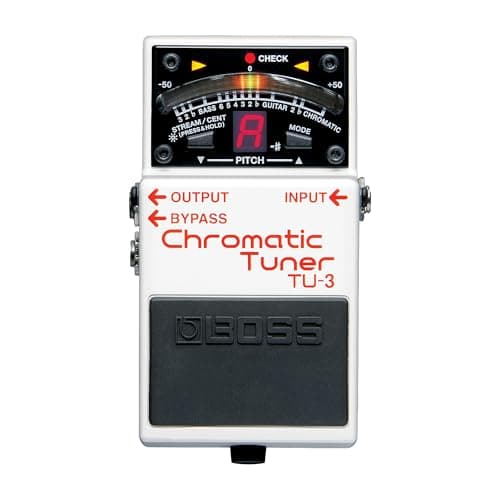
It wins on none of the individual specifications and it wins the page, which is worth explaining. The TU-3 is in a Boss enclosure, which is the most durable format any pedal has ever been sold in; it has been in production long enough that every repair shop knows it; and it is the only pedal here that will still be working after somebody stands on it.
It is also the one whose used market is deep enough that you can buy one for very little, which is a legitimate reason to recommend something on a page aimed at beginners.
It is also the only one here that publishes a DC output jack, so once it is powered it feeds the rest of the board rather than competing with it for a supply.
The honest marks against it: it is buffered with no true-bypass option, it takes a full-size slot on a board where space is the scarcest resource, and its published plus or minus 1 cent is the coarsest figure on this page by an order of magnitude. If your board is already tight, the next pick is the better answer.
Korg Pitchblack X MINI — best specification per millimeter
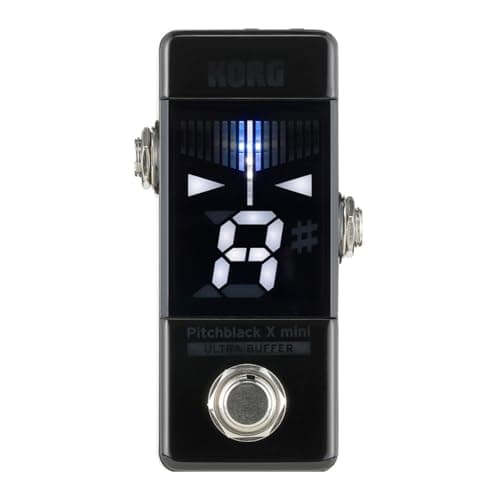
Plus or minus 0.1 cent in strobe mode, in a case 45 mm wide. The PolyTune 3 publishes a finer figure, and it is three times the width to do it. Korg also publishes a detection range of E0 to C8 and a calibration range of A4 = 436 to 445 Hz in 1 Hz steps, which is more specification than most pedals in this category offer at any price.
The catch is bypass. This model is buffered permanently, with no switch, which means it is in your signal path whether the tuner is engaged or not. For most first boards that is fine and arguably an advantage. If you specifically want the option, that is the XS.
The second catch is power. No battery compartment, 9 V adapter only. If you do not already own a supply, budget for one at the same time.
TC Electronic PolyTune 3 — best for checking six at once
Strum all six open strings and the display shows which ones are out at the same time. That sounds like a gimmick and is genuinely useful in one specific situation: between songs, when you want to know whether you need to tune at all rather than working through six strings to find out that you did not.
TC publishes plus or minus 0.02 cent in strobe mode and a switchable true bypass or buffered output, so this is the pedal that gives you both bypass modes and polyphonic tuning in one box. It is the finest published accuracy figure on the page.
Against it: the polyphonic mode is less precise than tuning strings one at a time, and it is the mode people leave it in. It is also full-size, so it costs the same board space as the Boss without the Boss enclosure's reputation for surviving abuse.
Korg Pitchblack XS — best true-bypass option
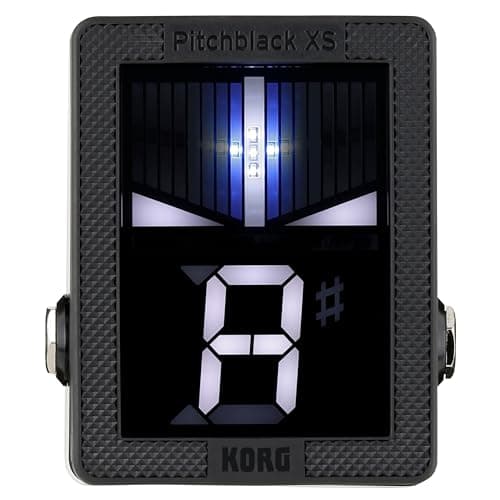
The same published plus or minus 0.1 cent as the MINI, in a case whose footswitch is the border of the screen, and with the switch the MINI does not have: true bypass or Ultra Buffer, your choice.
At 70 by 80 mm and 198 g it is bigger and heavier than the MINI for an identical tuning specification, so you are paying board space for the bypass switch and a larger display. Whether that trade is worth it depends entirely on how full your board is.
Korg publishes no current draw figure for this one, which is the single gap on its spec card and is marked as such.
Published specifications, side by side
What each maker publishes | Boss TU-3 | Pitchblack X MINI | PolyTune 3 | Pitchblack XS |
|---|
| Published accuracy | +/-1 cent | +/-0.1 cent (strobe) | +/-0.02 cent (strobe) | +/-0.1 cent |
| Bypass | Buffered | Buffered only | True bypass or buffer | True bypass or buffer |
| Battery operation | Not on our source | No — adapter only | Not on our source | No — adapter only |
| Published current draw | Not on our source | Max 30 mA | Not on our source | Not published |
| DC output for other pedals | Yes | No | No | No |
| Board width | Full size | 45 mm | Full size | 70 mm |
| Polyphonic mode | No | No | Yes | No |
Read the bypass row and the battery row first. Those two decide more purchases on this page than the accuracy row does, and the accuracy row is the one every other site leads with.
What a tuner pedal will not do for you
It will not tune an acoustic guitar. No pickup, no signal, nothing for the pedal to read. This is the single biggest reason a clip-on remains the right first tuner for most people, and it is worked through properly in clip-on vs pedal vs app.
It will not fix intonation. A tuner tells you the open string is in tune. If the twelfth-fret note is still sharp, that is a bridge adjustment, and on many guitars the underlying cause is action set too high — which is a different problem, covered in guitar action too high.
It will not make you tune more often. The tuner that gets used is the one that is already attached to the guitar. A pedal requires the guitar to be plugged in, the amp to be on and your foot to be on the switch. That is three conditions a clip-on does not have, and it is why the clip-on still wins for the first year.
So who should actually buy one
Buy a tuner pedal when at least one of these is true: you are starting a pedalboard and want the tuner to be the thing that also mutes for silent string changes; you play anywhere other than your own room; or you already own a power supply and the marginal cost is just the pedal.
If none of those are true yet, buy a clip-on, spend the difference on a spare set of strings and come back to this page when the board exists.
What we did not doWe have not played any of this gear. Every guide in this category says it tested twenty tuners; we would rather say plainly that we tested none. What we did instead is on this page in full: published specifications with their sources, the makers' own manuals read rather than paraphrased, and a note wherever a company publishes nothing at all.