String cleaners sit in an odd place. They are the cheapest thing in a guitar shop that claims to make strings last longer, and the category is almost entirely undocumented: three of the four products here do not publish what is in them, how much you get, or whether they are safe on the coated strings most beginners now buy.
So this page ranks them on disclosure as much as on what they do. If a maker will not tell you what you are wiping onto your instrument, that is a finding, and it goes on the card.
What a string cleaner actually does
Strings die from two things: corrosion from sweat and skin oils, and grime packing into the windings so the string stops vibrating evenly. A cleaner attacks the second and slows the first. None of them resurrect a dead set — how often to change strings is the page for that question.
The makers are reasonably careful in how they word it. GHS says Fast Fret keeps strings "sounding bright and new, extending the healthy lifetime of any strings". D'Addario claims XLR8 "enhances string life and tone". MusicNomad explains the mechanism: strings oxidize and corrode from sweat, finger oils and the environment, and the product deep-cleans them so they last longer. Those are claims about slowing decline, not reversing it.
1 of 4
String cleaners here whose maker publishes what is actually in the bottle
Dunlop discloses its formula, but only because a safety data sheet requires it. GHS publishes two negatives — not a spray, no silicone. D'Addario publishes one. MusicNomad describes its blend in general terms.
The criteria, in the order they decide it
1. What is in it, and is that published at all
Dunlop is the only one with a published safety data sheet, and it is the most informative document in the category: Ultraglide is 50 to under 100 percent hydrotreated light petroleum distillates with a trace of d-limonene. That is a solvent, not an oil.
MusicNomad publishes a description rather than a formula — refined natural oils blended with mineral oils, silicone free. GHS publishes two negatives: not a spray, no silicone. D'Addario publishes one: silicone free.
Silicone matters because it is the classic contaminant that causes fisheye problems if a guitar is ever refinished, which is why every maker here mentions it and none of them use it.
2. Whether it is safe where you will inevitably wipe it
You cannot clean strings without touching the fretboard under them. MusicNomad states String Fuel is safe for any finish and conditions unfinished fretboard wood. GHS tells you to use Fast Fret on the strings and fingerboard. D'Addario says XLR8 also conditions the fretboard. Dunlop publishes nothing at all about fretboard or finish safety for Ultraglide, which given the SDS is the gap we would most like closed.
3. Coated strings — the question almost nobody answers
Coated strings are a large share of what beginners buy, and a cleaner designed to strip grime out of windings behaves differently on a polymer coating. Only MusicNomad addresses it: String Fuel is stated safe on coated and nylon strings, where it acts more as a lubricant while still cleaning the surface, and the maker says it can help the coating last longer. GHS, D'Addario and Dunlop publish nothing either way. If you run coated strings, that silence is the deciding factor.
4. The applicator, because it decides how often you bother
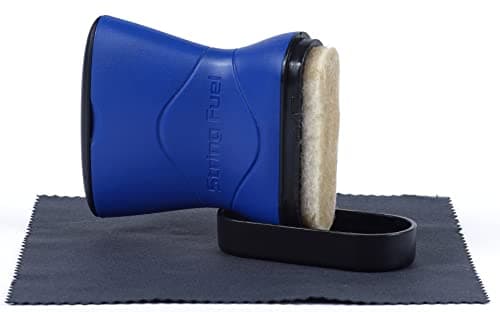
Fast Fret and XLR8 are pads in containers; String Fuel is a 2.5 inch pad that covers all six strings in a pass and stores its microfiber cloth in the handle; Ultraglide is a liquid. MusicNomad publishes a usable life figure — 750 to 1,000 swipes — which is the only quantity anyone in this category publishes.
5. What it costs to keep using
All four are inexpensive, but the running cost differs: String Fuel needs the maker's own refill once the pad dries, while the bottled and tinned products are refilled by buying another one.
Published claims and disclosures, side by side
What each maker publishes| Product | Formula published | Fretboard stated safe | Coated strings | Hazard warning |
|---|
| MusicNomad String Fuel | Described: natural + mineral oils | Yes, any finish | Yes, stated | None published |
| GHS Fast Fret | No — only 'no silicone' | Yes, fingerboard | Not published | None published |
| D'Addario XLR8 | No — only 'silicone free' | Yes, conditions it | Not published | None published |
| Dunlop Ultraglide | Yes, via SDS | Not published | Not published | Danger, aspiration hazard |
The last column is not a reason to avoid the Dunlop — it is a reason to store it like the solvent it is. It is also the only entry in that column because it is the only product whose maker publishes an SDS at all, which is worth remembering before reading the blanks as safety.
The picks
MusicNomad String Fuel — best string cleaner
It answers every question the others leave open. The blend is described, it is silicone free, it is stated safe on any finish and on unfinished fretboard wood, and it is the only product here that commits to coated and nylon strings. The applicator covers the whole set in one pass and the cloth lives in the handle.
Against it: MusicNomad concedes the oil can darken a pale fretboard over time, though it says that is harmless and evaporates. The pad takes the maker's own refill rather than any bottle. And no fluid volume is published for the applicator.
GHS Fast Fret — the long-standing default
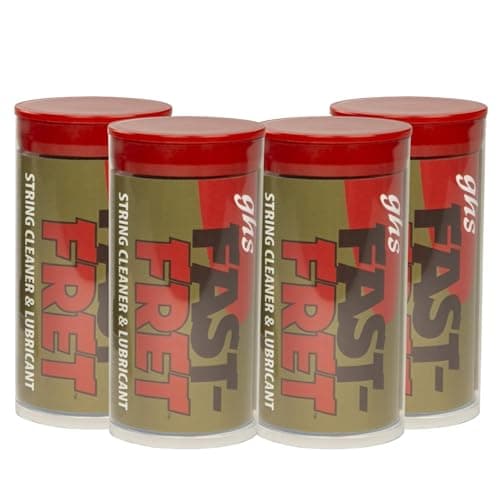
The one most guitar shops have had on the counter for decades, and GHS is clear about the two things buyers actually ask: it is not a spray, and it contains no silicone. Approved by the maker for the fingerboard as well as the strings.
Against it: no ingredients, no volume, nothing about coated strings. And the in-stock listing we found is a four-pack rather than a single, which is more than most players get through in a year.
D'Addario XLR8 — cheapest way in
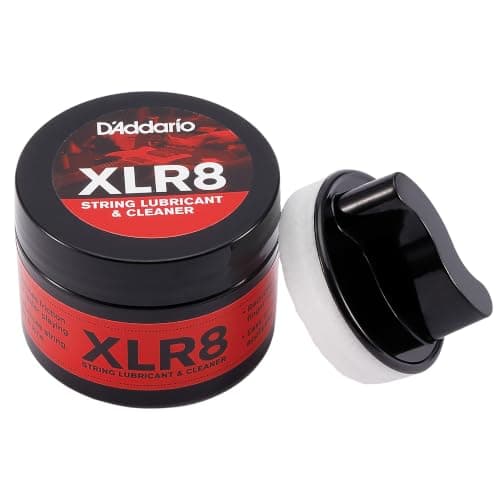
The lowest price here when we checked, in an airtight tin that keeps the applicator from drying out, from the company that probably made your strings. D'Addario states it conditions the fretboard as well.
Against it: the formula disclosure stops at "silicone free", there is no published volume, and nothing is said about coated strings. Stock was thin on the listing we checked.
Dunlop Formula 65 Ultraglide — the one with a published SDS
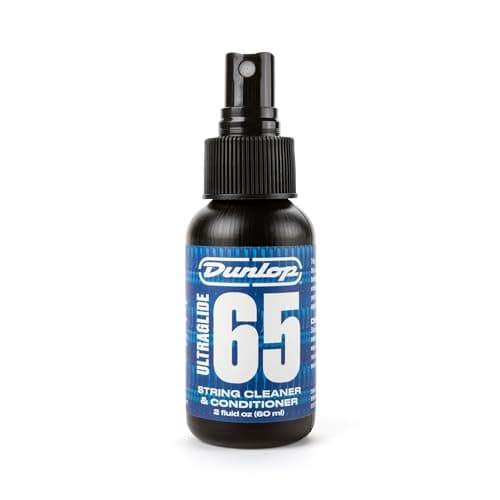
Dunlop calls it the squeak eliminator, and if finger noise on wound strings is your actual complaint it is the product that targets it directly. It is also the only one here where you can read exactly what you are buying.
Against it: what you read is a petroleum distillate carrying a Danger signal word, the statement "may be fatal if swallowed and enters airways", and instructions to keep it out of reach of children and store it locked up. Dunlop publishes nothing about fretboard or finish safety, and no volume.
How to use one without wasting it
Wipe the strings down before you put the guitar away. The sweat and skin oil that corrodes strings is on them now, not next week.
Get under the strings as well as over them. The underside collects the grime that mutes a wound string, and it is the side a cloth never reaches.
Do not soak the fretboard. Conditioning a fretboard is a different job on a different schedule — fretboard oil covers what the makers publish for that, including how rarely it is needed.
Keep it off a nitro finish you care about. Only MusicNomad publishes a blanket finish-safety statement. With the others, keep the product on the strings.
What a cleaner will not do
It will not revive a dead set. Once windings are flattened and the core is corroded, the tone is gone.
It will not fix tuning problems. Strings sticking in the nut is a different product and a different page — a nut and saddle lubricant, not a string cleaner.
It will not replace washing your hands. Free, and it removes more of the cause than any of these do.
What we would actually buy
Most people, and anyone with coated strings: the MusicNomad String Fuel, because it is the only product whose maker addresses coated strings and finish safety in writing. Wanting the traditional applicator and happy with a multi-pack: Fast Fret. Spending as little as possible: XLR8. Chasing finger squeak specifically: Ultraglide, stored out of reach of children as Dunlop instructs.
What we did not doWe have not played any of this gear. Every guide in this category says it tested twenty tuners; we would rather say plainly that we tested none. What we did instead is on this page in full: published specifications with their sources, the makers' own manuals read rather than paraphrased, and a note wherever a company publishes nothing at all.