If you have decided to buy Elixir strings — and whether they are worth it is a separate question with a separate answer — you immediately hit a second decision nobody warns you about. The same guitar strings come in two different coatings, and the packaging tells you almost nothing about which to pick.
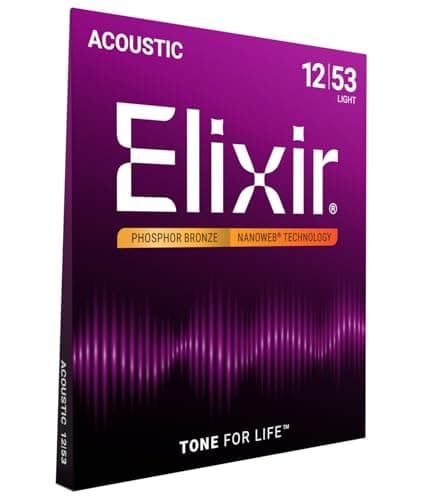
Before anything else, there is a trap in how this comparison is usually done. The most popular Elixir acoustic set is the 16052, which is phosphor bronze with NANOWEB. The most popular POLYWEB set is the 11050, which is 80/20 bronze. Compare those two and you have changed the wrap alloy and the coating at the same time, and you cannot tell which difference you are hearing. Phosphor bronze versus 80/20 is its own audible decision, and it is the louder of the two.
The one pair that isolates the coating
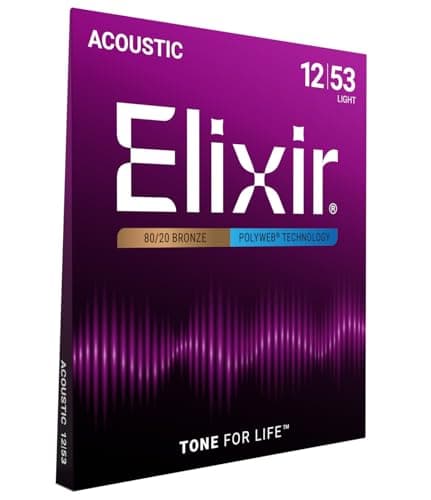
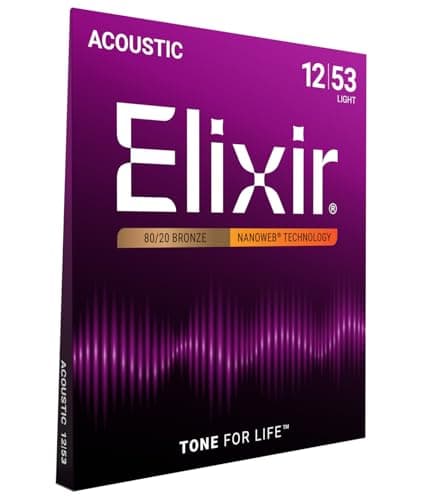
Elixir's 80/20 bronze line is made in both coatings, and the Light sets in each are identical on paper apart from the coating name.
Elixir's published gauge tables for the two Light 80/20 bronze sets | 11050 — POLYWEB | 11052 — NANOWEB |
|---|
| Gauges | .012 .016 .024 .032 .042 .053 | .012 .016 .024 .032 .042 .053 |
| Wrap wire | 80/20 bronze (80% copper, 20% zinc) | 80/20 bronze (80% copper, 20% zinc) |
| Published tone | Warm and “played in” | Bright and lively |
| Published feel | Slick and fast | Smooth |
| Published tone life | Longest-lasting | Longest-lasting |
| Typical street price | The same as each other | The same as each other |
Six identical gauges, the same alloy, the same published tone-life claim, and in practice the same price. That makes this the only honest A/B in Elixir's acoustic range, and it means the choice is purely about tone and feel — there is no budget argument for either one.
What Elixir actually says about each coating
Elixir's dedicated coating-comparison page has become almost entirely images, so the text worth quoting lives on its FAQ. These are its own words.
On NANOWEB: "Strings with NANOWEB Technology sound and feel more like traditional, natural strings. They are bright and lively, and the coating is so thin that you can barely tell it's there." Elsewhere: "NANOWEB Technology strings have a bright tone and smooth feel."
On POLYWEB: "Elixir Strings with POLYWEB Technology have a warm, 'played-in' tone." And: "POLYWEB Technology strings have a warm tone with a slick, fast feel." The 80/20 POLYWEB product page adds that it is "Played for a warm and robust tone that sounds 'played-in' but still retains a remarkably clear mid-range presence" with a "Fast, slick feel" that "allows you to quickly move around the fretboard with ease".
On both together: "While our POLYWEB and NANOWEB Technologies differ in tone and feel, both offer a smooth feel, reduce finger squeak, and deliver extended tone life."
Read those carefully and a pattern emerges. NANOWEB is described in terms of what it does not do — it gets out of the way, you can barely tell it is there. POLYWEB is described in terms of what it adds: warmth, slickness, speed. Neither is presented as better.
The one recommendation Elixir does make
Across everything Elixir publishes, there is a single sentence that points a specific kind of player at a specific coating, and it happens to point directly at the audience this site is written for:
"Players who are just starting to play or have soft fingertips, prefer POLYWEB Technology strings. Others like the slick and fast feel of the POLYWEB Technology."
That is the closest thing to advice in the whole range, and it is worth taking seriously. A thicker, slicker coating puts a little more material between a sore fingertip and a wound string. If you are in your first few months and your fingers hurt, POLYWEB is the one Elixir itself nominates.
If your hands are already conditioned and what you want is long life without the strings feeling different, NANOWEB is the one built around feeling normal.
Tone life: identical claims, and read who is making them
It would be reasonable to assume the thicker coating lasts longer. Elixir does not claim that. It publishes the opposite — that the coatings are equal on longevity:
"All three — OPTIWEB, NANOWEB and POLYWEB — deliver the same extended tone life that players have come to expect from Elixir Strings."
Elixir explains the mechanism the same way for all of them: "The Technology — whether it be OPTIWEB, NANOWEB or POLYWEB — protects not only the outer string surface, but also the gaps between the windings. As a result, according to players Elixir Strings retain their tone longer than any other brand's string."
Note the phrasing there, because it recurs: "according to players", "Players report". Elixir consistently attributes the longevity claim to player feedback rather than stating it as a measured specification, and it publishes no duration figure anywhere — no weeks, no hours, no multiplier against an uncoated string. If you want the arithmetic on whether coated strings pay for themselves, coated versus uncoated works it through on change intervals rather than on maker claims.
Nobody publishes a thickness, including Elixir
No figure
Elixir publishes no numeric coating thickness for NANOWEB, POLYWEB or OPTIWEB — anywhere
We checked the coating comparison page, the full FAQ, both how-to-choose guides, every acoustic and electric product page, and the July 2026 product catalog PDF. The language is always qualitative: ultra-thin, featherweight, and so thin you can barely tell it is there.
This matters because specific micron figures for NANOWEB and POLYWEB circulate widely online and get quoted as though Elixir published them. They trace back to an automatically generated marketplace listing page, not to Elixir. We are not repeating them, and you should treat any page that states a coating thickness as a number with suspicion.
The practical consequence: "slick" versus "smooth" is a description you have to test against your own hands, not a spec you can compare. Which, given the two sets cost the same, argues for buying one of each over two restrings rather than agonizing now.
What you cannot get, which decides it for some people
Availability is the hard constraint that overrides preference, and it is asymmetric. From Elixir's own current product catalog:
Which Elixir coatings exist in which instrument families | NANOWEB | POLYWEB | OPTIWEB |
|---|
| Acoustic phosphor bronze | Yes | Does not exist | No |
| Acoustic 80/20 bronze | Yes | Yes | No |
| Electric nickel | Yes — widest gauge range | Only four sets | Yes |
| Bass | Yes — the only coating offered | No | No |
| Baritone, 7-string, 8-string | Yes | No | 7-string and 8-string only |
| 12-string acoustic | Yes | Yes | No |
There is no phosphor bronze POLYWEB set. It has never existed. If you have settled on phosphor bronze — and plenty of players do, because it is the warmer alloy — then the coating question is already answered for you, and the set to buy is the 16052.
On electric, POLYWEB is down to four sets: Super Light, Custom Light, Light and Medium. No Light/Heavy, no baritone, nothing for seven or eight strings. NANOWEB covers the whole range and is also the only coating Elixir puts on bass strings. If you play anything other than a standard six-string in a standard gauge, availability makes the decision before feel does.
Gauge availability, which is where the two really diverge
The Light sets match exactly. Step outside Light and they stop matching, and each coating has one gauge the other does not offer at all.
Both coatings cover Extra Light 10–47, Custom Light 11–52, Light 12–53, Light/Medium 12–56, Medium 13–56 and a 12-string Light 10–47 in 80/20 bronze. Then they part company. POLYWEB is the only coating offered in a Resonator set, 16–56 — a genuinely heavy gauge with no NANOWEB equivalent. NANOWEB is the only one offered in HD Light, and the only one with baritone and eight-string baritone sets.
The same pattern runs through Elixir's single strings, which is worth knowing if you break one string at a time rather than changing sets. Phosphor bronze singles come in NANOWEB only. 80/20 bronze singles come in both. Electric singles come in all three coatings.
On electric the asymmetry is starker still. POLYWEB is down to four sets — Super Light, Custom Light, Light and Medium — with no Light/Heavy, no baritone and nothing for seven or eight strings. NANOWEB runs from Super Light 9–42 up through Heavy, plus baritone, four different seven-string sets, an eight-string and a twelve-string. If you play anything unusual, the coating question has already been answered by whatever exists in your gauge.
What the coating does not change
Worth stating plainly, because coated strings get blamed for things they do not do. The gauges are the gauges: an 11052 is .012 to .053 exactly like an uncoated 12–53 set, so the tension and the effort to press a string down are unchanged by the coating. The gauge guide covers the decision that does change how hard you work.
The other thing both coatings are published as doing is reducing finger squeak — Elixir lists it for POLYWEB and NANOWEB together, alongside extended tone life. That is a small benefit when you are practicing and a real one if you ever put a microphone in front of an acoustic, because squeak is one of the things that makes an amateur recording sound amateur.
Elixir has also begun listing a fourth technology in its phosphor bronze comparison table, Attune, published as "Crisp and Clear" in tone with a "Natural" feel and the same "Longest-lasting" tone life as the rest. It is not part of the NANOWEB-versus-POLYWEB decision, but if you see it on a shelf, that is what Elixir says about it.
One more thing both coatings share is the claim Elixir makes against everybody else: "Elixir Strings is the only brand to protect the entire string, covering not just the outer string surface but also the spaces between the windings." Take that as Elixir's own competitive claim rather than a tested finding — D'Addario's XT is a coated string too, and we have not measured either. The reason it belongs on this page is narrower: whatever that protection is worth, it is worth the same in both coatings, so it cannot help you choose between them.
Where OPTIWEB fits, and why it is not in this comparison
You will see a third coating on the shelf and it is worth one paragraph so you do not go looking for it in vain. Elixir publishes the scope plainly: "Note: The new OPTIWEB Technology is available on our electric strings only."
Its published character sits at the opposite end from POLYWEB: "OPTIWEB Technology strings sound like an uncoated string, with a crisp tone and natural feel." Elixir describes it as allowing "the string to vibrate with less damping — for a crisp tone with a firm, natural grip that puts you in control of bends, vibrato and sustain." If you play acoustic, none of that is available to you.
Elixir's own answer when you cannot decide
It is refreshingly direct, and we are not going to pretend to know better. From its electric string guide: "Technology choice is a personal preference; try all three and decide which suits you best."
On acoustic that reduces to two, and since the 11050 and the 11052 cost the same and share every gauge, the cheapest way to settle this is to buy one of each and change strings twice. You will have a definitive answer for your hands and your guitar in about two months, which is better than any published description can give you.
What we would actually buy
First few months of playing, fingers still sore: the 11050 POLYWEB. Elixir nominates it for exactly this, and the slicker surface is genuinely kinder on a fingertip that is still toughening up.
Past that, and you want the strings to disappear: the 11052 NANOWEB. Same gauges, same money, the coating you notice least.
Committed to phosphor bronze: the 16052. The question does not apply, because Elixir does not make the alternative.
Not sure coated strings are for you at all: buy the uncoated 80/20 set in the same 12–53 gauge first. It is the control experiment — same alloy, same gauges, no coating, a fraction of the price — and it tells you what the coating is actually doing before you commit to paying for one.