Skip to content
Capo & Cable
Roundup

A 12-string capo has two problems to solve, and most only solve one

A 12-string neck is wider and carries far more tension than a six-string, so capo makers widen the bar and stiffen the spring. The harder problem is that each pair holds two different gauges, and only one maker builds for it.

By Scooter M./Published September 21, 2026

A black and white close-up of an acoustic guitar headstock and tuners

DisclosureSome links on this page are affiliate links. If you buy through one we may earn a commission at no extra cost to you. It never changes a ranking, and we accept no payment for placement. The full version.

The shortlist

Ranked, with the published numbers

Ranked on the specifications each maker actually publishes, on what they refuse to publish, and on what the thing costs today. Tap any row for the full write-up, including who should skip it.

#ProductBest forScorePrice
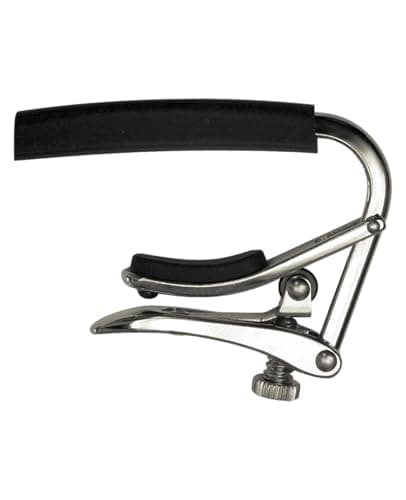
01Shubb Shubb C3 12-String CapoShubbShubb C3 12-String CapoBest 12-string capo8.9$24.95 · View on Amazon
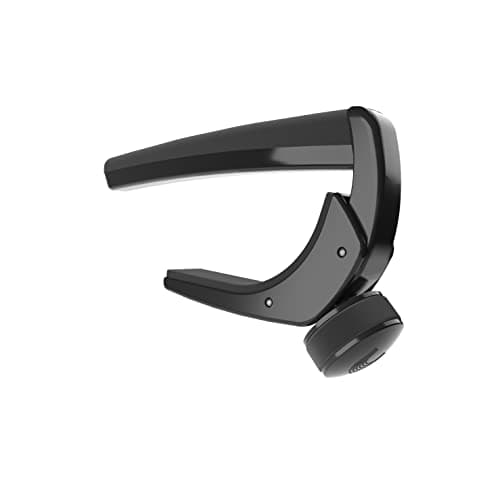
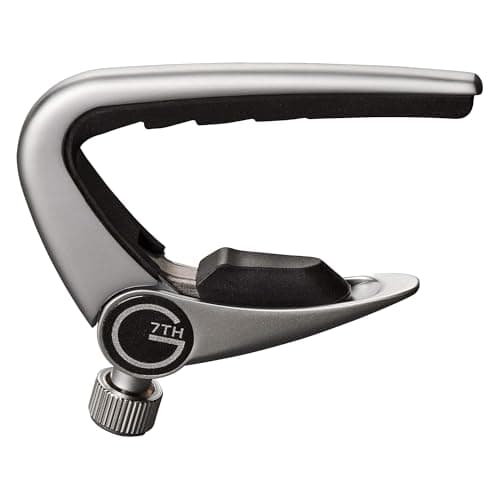
02G7th G7th Newport 12-String CapoG7thG7th Newport 12-String CapoBuilt for the octave pairs8.8$45.99 · View on Amazon
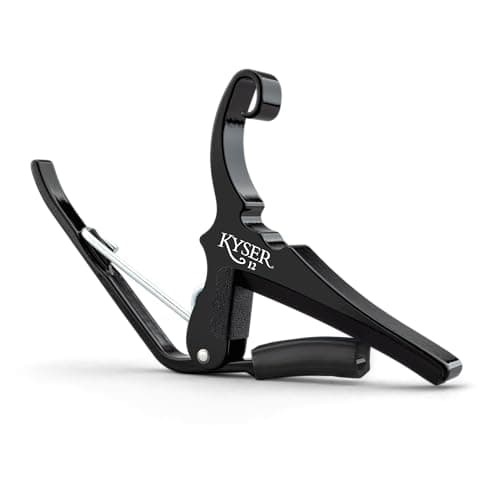
03Kyser Kyser Quick-Change 12-String Capo (KG12B)KyserKyser Quick-Change 12-String Capo (KG12B)Best one-handed8.5$24.95 · View on Amazon
04D'Addario D'Addario Pro Plus Capo (PW-CP-19)D'AddarioD'Addario Pro Plus Capo (PW-CP-19)Best if it must fit both guitars8.2$29.99 · View on Amazon
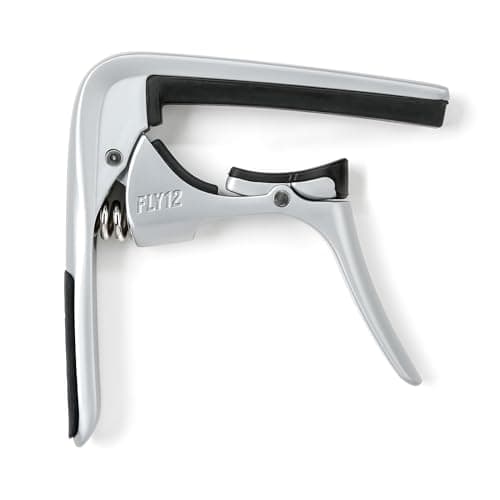
05Jim Dunlop Dunlop Trigger Fly Capo 12-String (66CSC)Jim DunlopDunlop Trigger Fly Capo 12-String (66CSC)Cheapest 12-string-specific8.0$21.21 · View on Amazon

Scores are ours and editorial. They are never published as review or rating markup, because we have not played these instruments — here is how we pick.

Put a standard capo on a 12-string and two things tend to go wrong at once. The bar runs out of neck before it runs out of strings, and the pairs go sharp — usually the wound ones, usually just enough to sound wrong rather than obviously broken.

Those are two different problems. Every maker here has solved the first. One has actually built for the second.

Why a 12-string is harder to capo

The neck is wider. Twelve strings need more room, so the bar has to span further. Shubb is the only maker on this page that publishes a width: its 12-string capos are 2.25 inches, the same as its nylon-string model, and it says that covers just about any six- or 12-string guitar.

There is far more tension. Elixir publishes 251 pounds of total tension for its light 12-string set at a 25.5 inch scale; Martin publishes 324 pounds for its light 12-string. Kyser puts the consequence plainly: more strings, more tension, so the capo body is larger and the spring has to do more.

Each pair is two different gauges. This is the part most capos ignore. A course pairs a heavy wound string with a thin octave string, and a flat bar presses both to the same depth. G7th is blunt about where that leads: historically 12-strings have been notoriously difficult to capo, and the standard approach has been to apply masses of tension, "which inevitably pulls the bass strings sharp".

251 lb

Total tension Elixir publishes for its light 12-string set, at a 25.5 in scale

Martin publishes 324 lb for its light 12-string. A capo on a 12-string is fighting roughly twice the tension of the six-string equivalent, which is why makers stiffen the spring and why stiffer springs pull strings sharp.

The criteria, in the order they decide it

1. Does the bar actually span the neck?

Only Shubb publishes a number. Kyser describes "a slightly larger body", Dunlop says "larger necks", D'Addario and G7th say nothing about width for these models. If your 12-string has an unusually wide neck, Shubb's 2.25 inches is the only figure you can check against it before buying.

2. How is the pressure applied, and can you reduce it?

On an instrument that goes sharp under pressure, adjustability is worth more than it is on a six-string. The Shubb sets its pressure with a screw and repeats it every time. The G7th Newport uses a flip lever whose tension can be adjusted while the capo is on the neck. D'Addario markets adjustable tension as the answer and argues it distributes pressure more evenly across all twelve strings. The Kyser and the Dunlop are springs: fast, and fixed.

3. Does anything address the octave pairs?

One product does. G7th's Compensated String Pad is a ridged rubber pad designed, in the maker's words, like a compensated saddle: it takes account of the different gauges between the bass and octave strings so that all twelve fret at the same time and under the same tension. Whether that fully solves it we cannot say — we have not tested it — but it is the only design here that is even aiming at the problem.

4. What is published if something goes wrong

Kyser publishes a full lifetime guarantee. G7th publishes a free lifetime warranty with registration. D'Addario covers its capos for the life of the capo. Shubb publishes no written warranty at all and instead promises to repair yours. Dunlop publishes no capo warranty; its warranty page covers electronics.

5. The exclusion nobody mentions until you own the guitar

G7th publishes one explicitly: the Newport 12-string is not suitable for Rickenbacker 12-strings, because Rickenbacker reverses the octave string positions within each pair. If that is your guitar, a compensated pad is built for the wrong layout and a plain bar is the safer buy.

Published specifications, side by side

What each maker publishes for its 12-string capo
CapoBar widthTensionOctave pairsWarranty
Shubb C32.25 inScrew, set onceNot addressedNone published
G7th Newport 12Not publishedFlip lever, adjustable on the neckCompensated String PadLifetime, registration
Kyser KG12BNot publishedSpring, fixedNot addressedLifetime
D'Addario Pro PlusNot publishedAdjustableMarketed for octave pairsLife of the capo
Dunlop Trigger Fly 12Not publishedSpring, fixedNot addressedNone published

Four of the five publish no width for a product whose entire reason to exist is a wider neck. That is the gap in this category, and it is why the one maker that publishes a number gets the top slot.

The picks

Shubb C3 — best 12-string capo

A published 2.25 inch radiused bar, machined brass, and the over-center screw mechanism that sets pressure once for your neck and repeats it. On an instrument where excess pressure is the main failure, being able to set the minimum that works is the most useful feature available.

Against it: it is slower to move than a trigger, Shubb publishes no written warranty, and Shubb frames the 12-string case purely as neck width — it says nothing about the octave pairs.

G7th Newport 12-String — built for the octave pairs

The only capo here designed around the gauge difference inside each course, with a patented ridged pad and G7th's claim that all twelve strings fret under the same tension. The flip lever also lets you adjust tension with the capo already on the neck, which no other pick here offers.

Against it: it is the most expensive capo on the page, G7th publishes no width, weight or model number for it, and it is explicitly not suitable for Rickenbacker 12-strings.

Kyser Quick-Change 12-String — best one-handed

If you change key between songs, this is the mechanism. Kyser publishes a lifetime guarantee, states that it is made in its own Texas factory, and is the most explicit maker here about why a 12-string capo exists at all.

Against it: fixed spring pressure on the instrument most likely to be pulled sharp by it, no published width or radius, and no model number on Kyser's own site.

D'Addario Pro Plus — best if it must fit both guitars

D'Addario markets this one for instruments with octave string pairs and argues in its own FAQ that adjustable tension is the right answer for a 12-string. It is a general-purpose capo, so it moves to your six-string when the 12-string is in its case.

Against it: no published width, so you cannot confirm the span; it is not a dedicated 12-string design; and it costs more than the Kyser or the Shubb.

Dunlop Trigger Fly 12-String — cheapest 12-string-specific

Dunlop rebuilt the Trigger for this instrument with a different pivot and a custom spring, and names both the larger neck and the higher tension as the reasons. At this price that is a reasonable first capo for a 12-string.

Against it: Dunlop publishes no width, no material, no weight and no warranty covering capos. Fixed spring pressure. And nothing at all about the octave pairs.

Getting a 12-string in tune under a capo

Use the least pressure that stops the buzz. On an adjustable capo that is a setting; on a spring capo it is placement.

Sit it right behind the fret. Further back needs more force, and more force is what pulls the pairs apart — how to use a capo covers placement properly.

Retune after the capo goes on, not before. With twelve strings you are checking twelve, and the octave strings drift first.

Change the strings before you blame the capo. Old 12-string sets go false at the octaves, and a false string sounds sharp under a capo no matter what is clamping it — 12-string string sets covers what the makers publish.

What we would actually buy

For most 12-strings: the Shubb C3, because a published 2.25 inch bar and a repeatable pressure setting solve the two problems you can verify before buying. For a 12-string that has always gone sharp under a capo: the G7th Newport with the Compensated String Pad, unless it is a Rickenbacker. For live key changes: the Kyser. Spending the least on a purpose-built option: the Dunlop Trigger Fly.

What we did not do

We have not played any of this gear. Every guide in this category says it tested twenty tuners; we would rather say plainly that we tested none. What we did instead is on this page in full: published specifications with their sources, the makers' own manuals read rather than paraphrased, and a note wherever a company publishes nothing at all.
The write-ups

Each one in full, including who should skip it

01Best 12-string capo
8.9/10
Shubb Shubb C3 12-String Capo

Shubb

Shubb C3 12-String Capo

A 12-string neck you capo and leave

The C1 mechanism on a bar that is 2.25 inches wide and radiused for a steel-string board, with a screw that sets the pressure once. It is the only capo here whose maker publishes the width.

Good
  • The only published bar width on this page, 2.25 in
  • Pressure set once by screw, which is the mechanism most likely to spare a 12-string's tuning
  • Same proven mechanism as the C1 that wins the acoustic roundup
Less good
  • Slower to move than any trigger capo here
  • No written warranty, unlike Kyser and G7th
  • Shubb frames the 12-string case as neck width only and says nothing about octave pairs
Skip this if

You change key between songs. The screw is set for the neck, not spun mid-set, and a trigger capo is faster.

Published specification

Bar width2.25 in
Bar shapeRadiused — Shubb files model 3 under radius fretboards
Fits12-string guitar or any steel-string guitar with a wide neck
Mechanism and materialOver-center locking lever with adjusting screw; machined solid brass
WarrantyNone published in writing; Shubb promises free repair instead
Live price$24.95
$24.95 · View on Amazon

#ad Price as of October 17, 2026, from Amazon. Prices change. How this site is funded.

Our scoring

Ease for a beginner8.4
Build9.2
Published-spec clarity8.8
Value at this price8.8
02Built for the octave pairs
8.8/10
G7th G7th Newport 12-String Capo

G7th

G7th Newport 12-String Capo

A 12-string that goes sharp under every other capo

The only capo here built around the actual problem: its patented Compensated String Pad has ridges that account for the different gauges in each octave pair, so G7th says all twelve strings fret under the same tension.

Good
  • The only design here that addresses the octave-pair gauge difference
  • Tension can be adjusted with the capo already on the neck
  • Lifetime warranty published by the maker
Less good
  • The most expensive capo on this page
  • Explicitly excluded from Rickenbacker 12-strings
  • G7th publishes no width, no weight and no model number for it
Skip this if

You play a Rickenbacker 12-string. G7th publishes that this capo is not suitable for them because the octave strings are reversed.

Published specification

String padPatented Compensated String Pad, ridged for the gauge difference in each pair
Maker's claimAll 12 strings fret at the same time and under the same tension
MechanismFlip-lever with tension adjustable while on the neck; low-profile shape
ExclusionNot suitable for Rickenbacker 12-strings, which reverse the octave string positions
WarrantyFree lifetime warranty, registration required
Live price$45.99
$45.99 · View on Amazon

#ad Price as of October 17, 2026, from Amazon. Prices change. How this site is funded.

Our scoring

Ease for a beginner8.6
Build9.0
Published-spec clarity8.0
Value at this price7.6
03Best one-handed
8.5/10
Kyser Kyser Quick-Change 12-String Capo (KG12B)

Kyser

Kyser Quick-Change 12-String Capo (KG12B)

Changing key on a 12-string mid-set

One-handed, guaranteed for life in writing, made in Texas, and the only maker here that says out loud why a 12-string capo is a different product: more strings, more tension, bigger body.

Good
  • Genuinely one-handed, which no screw capo here manages
  • Lifetime guarantee published in full
  • Made in the USA, which Kyser states and no rival here does
Less good
  • Fixed spring pressure with no adjustment, on the instrument most prone to going sharp
  • No published width, weight or radius figure
  • Kyser publishes no model number on its own site for this capo
Skip this if

Your 12-string already goes sharp under a capo. The spring applies what it applies, and there is no way to dial it back.

Published specification

MechanismTrigger-style spring, one-handed
Maker on 12-stringsMore strings, more tension; the slightly larger body covers all 12
MaterialAircraft-grade aluminum
WarrantyGuaranteed for life; repaired or replaced if it ever fails
Bar widthNot published
Live price$24.95
$24.95 · View on Amazon

#ad Price as of October 17, 2026, from Amazon. Prices change. How this site is funded.

Our scoring

Ease for a beginner9.2
Build8.8
Published-spec clarity6.8
Value at this price8.6
04Best if it must fit both guitars
8.2/10
D'Addario D'Addario Pro Plus Capo (PW-CP-19)

D'Addario

D'Addario Pro Plus Capo (PW-CP-19)

One capo for a 12-string and a 6-string

D'Addario's own answer to the 12-string question: an adjustable-tension capo it markets for instruments with octave string pairs, on the argument that even pressure matters more than clamping force.

Good
  • Adjustable tension, which D'Addario argues is the deciding feature on a 12-string
  • Works on your six-string too, so it is not a single-instrument purchase
  • Warranty published for the life of the capo
Less good
  • Not a dedicated 12-string design, and no width published to prove it spans the neck
  • D'Addario publishes nothing about octave-pair gauge differences, only even pressure
  • Costs more than the Kyser and the Shubb
Skip this if

You want a capo designed only for twelve strings. This is a general-purpose capo that D'Addario says suits them, not a dedicated model.

Published specification

Maker's 12-string claimCompatible with all instruments, perfect for 12-strings or any with octave string pairs
Maker's reasoningA capo with adjustable tension distributes pressure more evenly across all 12 strings
MechanismAdjustable tension
Bar widthNot published
WarrantyD'Addario's capo warranty runs for the life of the capo for the original owner
Live price$29.99
$29.99 · View on Amazon

#ad Price as of October 17, 2026, from Amazon. Prices change. How this site is funded.

Our scoring

Ease for a beginner8.6
Build8.4
Published-spec clarity7.4
Value at this price8.0
05Cheapest 12-string-specific
8.0/10
Jim Dunlop Dunlop Trigger Fly Capo 12-String (66CSC)

Jim Dunlop

Dunlop Trigger Fly Capo 12-String (66CSC)

The cheapest 12-string-specific capo from a major brand

Dunlop redesigned the Trigger specifically for twelve strings, with a different pivot and a custom spring, and says so in one sentence that names both problems: larger necks and higher string tension.

Good
  • A 12-string-specific redesign rather than a wider version of the six-string capo
  • Squeeze-on speed at the lowest price here
  • Dunlop names both problems, neck width and string tension, in its own copy
Less good
  • No width, material, weight or warranty published anywhere
  • Fixed spring pressure with no adjustment
  • Nothing published about the octave pairs that cause the tuning problem
Skip this if

You want any specification at all. Dunlop publishes no width, no material and no warranty for this capo.

Published specification

Designed forThe larger necks and higher string tension of 12-string guitars
MechanismSpecially designed pivot mechanism with a custom spring
Maker's claimClear sustain and buzz-free intonation up and down the fretboard without retuning
Bar width and materialNot published
WarrantyNot published for capos
Live price$21.21
$21.21 · View on Amazon

#ad Price as of October 17, 2026, from Amazon. Prices change. How this site is funded.

Our scoring

Ease for a beginner9.0
Build8.0
Published-spec clarity6.0
Value at this price8.8
Questions

Frequently asked

Can I use a regular capo on a 12-string guitar?
Sometimes, if the bar is wide enough to cover the neck. Shubb publishes 2.25 inches for its 12-string model and says that spans just about any six- or 12-string guitar, which gives you a number to measure against. The second issue is tension: a 12-string set can carry roughly twice the total tension of a six-string set, and a capo that clamps harder to hold it tends to pull the pairs sharp.
Why does my 12-string go sharp when I use a capo?
Because each pair contains two different gauges and a flat bar presses both the same amount. G7th describes the usual industry fix as applying masses of tension, "which inevitably pulls the bass strings sharp", and built its Compensated String Pad with ridges to account for the gauge difference.
Is a 12-string capo different from a regular one?
Yes, in width and usually in spring strength. Dunlop says its 12-string Trigger Fly was redesigned for "the larger necks and higher string tension of 12-string guitars", and Kyser describes a larger body for the same reason. Only G7th changes the pad itself.
Which capo works on a Rickenbacker 12-string?
Not the G7th Newport 12-string — G7th publishes that it is not suitable for Rickenbacker 12-strings because those reverse the octave string positions. A conventional wide bar such as the Shubb C3 does not depend on which string in the pair is which.
Do I need an adjustable capo for a 12-string?
It helps. D'Addario argues that adjustable tension distributes pressure more evenly across all twelve strings, and Shubb's screw lets you find the lightest setting that stops buzzing and keep it. A spring capo is faster but applies whatever it applies.
Sources

Where these numbers came from

Every specification on this page came from one of these pages. Where a row reads "not published", it means we checked the page listed and the figure was not there.