One broken string is bad luck. The same string breaking three times in a month is information, and the string is almost certainly not the problem. D'Addario publishes this more bluntly than you might expect a string company to:
"There are several reasons strings may break prematurely unrelated to the strings themselves. Common issues with the instrument, such as small burrs or rough edges at the nut or bridge, are more likely the problem than the string."
Martin publishes the method that turns that into something you can act on: "Analyze the frequency you break strings and the location of the break, and then discuss with an authorized Martin Warranty Repair Center." So before you replace anything, look at the two pieces of the broken string and work out where the failure was.
The break location tells you the cause
Fender publishes a location-by-location breakdown, and it is the single most useful published document on this question. Ernie Ball adds the mechanism at the bridge. Together they cover every place a string actually fails.
Break location, published cause, and the published fix| Where it breaks | Published cause | Published fix |
|---|
| At or near the ball end, at the bridge | Saddles “just too sharp”; burrs, oxidation and imperfections develop with use | File or lightly sand the saddle edge so the string can slide properly; Ernie Ball says replace the saddles if it keeps happening |
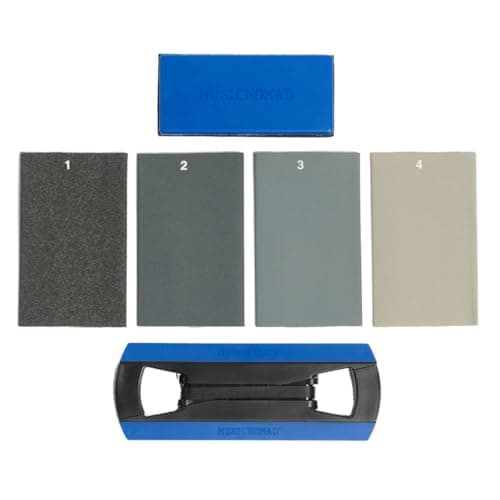
| At the nut | Grime in the slots, plus rough spots worn in by heavier gauges | Clean the slot out with a gentle file or an old wound string; lubricate the slot |
| At the tuning post | Burred edges inside the post hole; a kink in the wire; the string binding at the nut | Work the hole smooth with a cotton swab or old wound string; leave enough wraps that tension does not end at a kink |
| Out on the neck, over a fret | A fret has developed a burr | Smooth the fret; polish it afterward |
| Anywhere, on strings that look dull or flaky | Oxidation, helped along by finger residue and humidity | Change them; Fender publishes a feel test for this |
On the bridge, Ernie Ball publishes both the statistics and the reason: "Most strings break around the bridge. If this is happening repeatedly, you might need to replace the saddles." And why the bridge specifically: "When the string is tightened, the saddle is the point at which the string makes the most contact and has the most tension, therefore needs special attention. If there are sharp or rough areas on the saddles (which are often difficult to detect), strings are much more susceptible to breakage."
That parenthesis — "often difficult to detect" — is why this page leads with break location rather than with inspection. You will often not be able to see or feel the burr that is cutting your strings. The break position finds it for you.
Fender's version of the same fix: "Some bridges can be relentless on strings near the ball end because the saddles are just too sharp. So if your string keeps breaking down by the ball end, take care of those unforgiving edges with a file (or a bit of sandpaper) to allow the string to slide in the saddle properly."
Ernie Ball also publishes what a saddle is supposed to be, which is the clearest way to understand what has gone wrong when strings keep failing there: "A bridge saddle should serve as a smooth point of transition, but over the course of use these metal surfaces can develop burrs, oxidation, and other imperfections." Smooth point of transition is the standard. Anything else is cutting your strings.
Which is why replacing the saddles is a real option rather than a counsel of despair. On most electrics they are inexpensive individual parts and a straightforward swap; on an acoustic the saddle is a shaped blank and its replacement is a technician's job. Either way it is a one-off fix to a problem that is otherwise going to keep costing you a set of strings at a time.
The nut, and the cheapest thing on this page
Fender on the nut: "If your string consistently breaks around the nut, guess what, it is probably an issue with the nut." And the detail that connects it to gauge: "Grime that accumulates in the grooves can not only lead to breakage, but it'll derail your tuning efforts. In addition, Heavier gauge strings wear on the nut, leaving behind rough spots."
That last point is worth pausing on if you have recently gone up a gauge. A nut slot cut for .012 and now carrying .013 is being reshaped by the string every time you tune up — the gauge guide covers what changing gauge does to the rest of the setup.
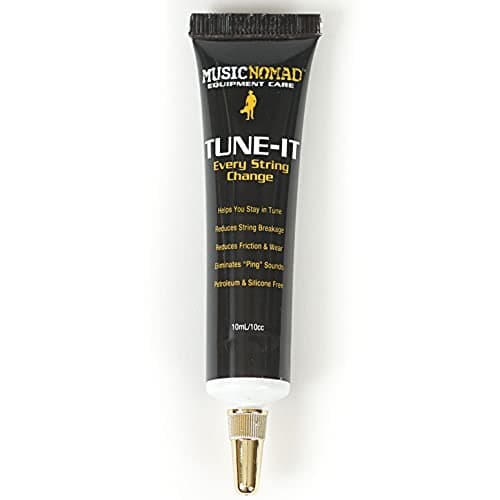
Ernie Ball publishes the preventative: "Nut lubricant is always a good tool to use to make sure that strings aren't binding in the nut slots." It is the cheapest intervention available here, it takes thirty seconds at a string change, and it addresses a cause that two separate makers name.
Winding: the mechanism almost nobody explains
Ernie Ball is the only maker we found publishing why a badly wound string breaks, and the explanation is specific enough to change how you restring.
"When wire is kinked, it puts the string at a disadvantage and weakens the wire at that point, which makes strings more prone to breakage."
3/4 turn
Ernie Ball's published minimum wrap around the tuner post, so that tension does not terminate at a kink
Its wording: "Allow for at least 3/4 of a turn around the tuner post so that the string's tension does not terminate at a kink." The point is not neatness. If the last thing holding the string is the sharp bend where it exits the hole, that bend is carrying the full pull of the string.
The same source publishes the other half, which explains why a string can break at the post when the post is perfectly smooth: "Binding can cause string tensions between the nut and tuner to be greater than south of the nut, which places excessive stresses on the string at the tuner post." A string stuck in its nut slot cannot equalize, so everything you add with the tuning peg piles up in the short length above the nut.
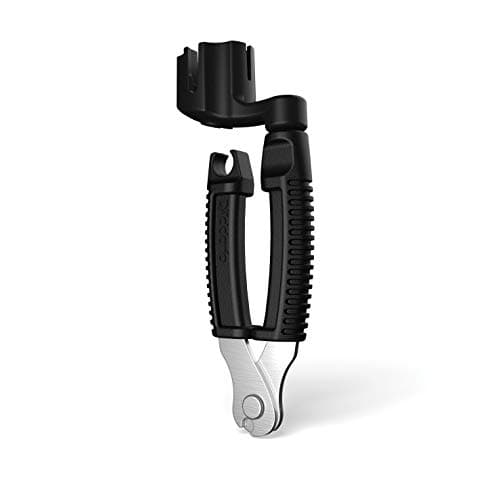
And Fender publishes the post itself as a suspect: "Burred edges inside the tuning posts where the string passes through can also cause breakage. Dirt buildup will also affect the longevity of your strings." Its fix costs nothing: "Think about taking a cotton swab or an old wound string to work it through the hole to smooth it out."
If breakage started when you started changing your own strings, how to change guitar strings is the place to check your winding against.
Tuning past pitch, and the stretching disagreement
Ernie Ball publishes the risk of overshooting when you tune up: "Overshooting can cause strings to actually break or sound dull more quickly." Approach the note from below rather than tuning sharp and coming back down, particularly on the plain top strings.
On hand-stretching a new set, the makers genuinely disagree, and we would rather show the disagreement than pick a side. Fender publishes a stretching procedure as a normal part of a setup: "After you've installed and tuned a new set, hold the strings at the first fret and hook your fingers under each string, one at a time, and tug lightly, moving your hand from the bridge to the neck. Re-tune and repeat several times."
La Bella publishes the opposite: "No, please don't tug or stretch strings as you run the risk of breaking the string." Worth knowing the context — La Bella's catalog is heavily bass-oriented and its neighboring breakage warnings name flat-wound bass strings specifically, so that answer may be scoped more narrowly than it reads. The safe synthesis: gentle, along the string, never a sharp pull at one point, and if you are breaking strings while stretching them, stop stretching them.
Age, sweat and corrosion
Fender publishes the chemistry in plain terms: "Guitar strings are made out of steel (unless you're using nylon). Steel contains iron, which rusts when exposed to oxygen... that process is helped along by the residue left behind from your fingers. Humidity is also a friend to the oxidation process."
It also publishes the test for when to give up on a set: change them "if they feel or sound dead, are discolored or flaking, or won't stay in tune." Martin publishes a simpler version of the same signal: "when strings require re-tuning often, it is time to change the strings."
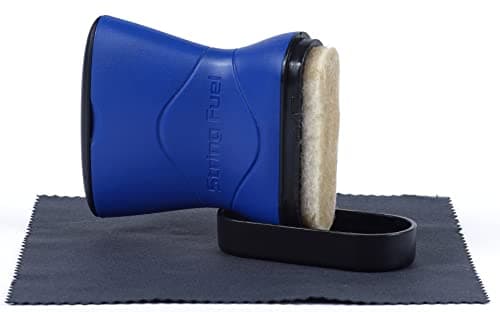
If your strings are reaching that state faster than they should, how often to change strings covers the interval, and a wipe-down product is the cheap way to slow it. That is a different purchase from a stronger string, and for most people it is the more useful one.
Some of it is you, and makers say so
Ernie Ball: "String attack, pick thickness, and finger oils are just a few factors that contribute to some players breaking more strings than others." Fender is more specific about the pick: "Heavy picks wear on strings with repeated use, especially strings with a thinner gauge."
Martin offers a concrete adjustment rather than just an observation: "If you are a heavy strummer, a medium gauge string may be preferable." A heavier set has more metal to lose before it fails, which is the whole argument.
On a twelve-string, thin plain strings break more or less by design — the octave pairs take the same tuning stress with far less metal, and twelve-string sets covers that separately.
The only maker who will replace a broken set
We checked the published warranty terms of every major string brand we could reach. One has a written breakage promise and the rest do not.
Ernie Ball's Paradigm guarantee, verbatim: "If any string in a set of Ernie Ball strings bearing the Paradigm Guarantee rusts or breaks within ninety (90) days from the date of purchase, Ernie Ball will replace the entire set of strings, when a qualifying Guarantee claim is made." With a published limit: "THERE IS A MAXIMUM OF THREE CLAIMS PER YEAR PER CONSUMER REGARDLESS OF THE NUMBERS OF PRODUCT PURCHASED." A claim needs the whole set including the broken pieces, the original packaging and the sales receipt, and is void without the receipt.
Ernie Ball also publishes construction figures aimed at this exact problem — "up to 35%" more tensile strength and "up to 70% more fatigue strength than traditional strings" — and one design detail that lines up neatly with its own advice about kinks: Reinforced Plain Strings "firmly lock the string to the ball end without the need for a traditional lock twist". The lock twist is a deliberate kink, and Paradigm removes it.
For contrast, La Bella publishes a deliberately restrictive policy: "We accept uninstalled strings for a refund or exchange within 30 days of ship date", and "Please do NOT discard of the entire set of strings that have not broken. These strings will not be replaced and are not considered defective." Elixir publishes a 30-day return policy for unopened product only and no breakage guarantee. D'Addario and Martin both route you to contact them or an authorized repair center rather than publishing terms. GHS publishes nothing on breakage at all.
A guarantee is not a fix, and it is worth being clear about that. If a saddle burr is cutting your strings, Paradigm strings will break too — just later, and you will have a replacement set to break as well.
What we would actually buy, in order
Nut and saddle lubricant, first. It costs less than a set of strings, it addresses the binding and the friction that two separate makers name as causes, and it applies in thirty seconds at your next string change.
Then nothing, until you have located the break. Save the next two broken strings and look at where they failed. The table above turns that into a specific target, and the target is usually a two-minute job with something you already own.
A wipe-down product if the strings look dull before they snap. That is corrosion, not mechanical failure, and it has a cheaper answer than stronger strings.
Paradigm strings only if you genuinely keep breaking them and cannot find the cause yet. The published guarantee is real and nobody else offers one, and the fatigue-strength figure is the relevant one if you bend a lot. It is not a substitute for finding the burr.
A technician if it is the nut. Nut slots are the one place on a guitar where a beginner with a file does lasting damage. Cleaning a slot is fine. Reshaping one is not.