The electric guitar changes what a pick is for. An acoustic is strummed most of the time, and strumming rewards a pick that flexes. An electric puts far more weight on individual notes — riffs, lines, anything with a bend in it — and a single note is cleaner when the pick does not bend at all.
So this page ranks on stiffness where the acoustic page ranks on flex. Same four criteria, deliberately inverted.
The criteria, in the order they decide it
1. Stiffness — every bit of your hand reaching the string
When a pick bends, some of the energy you put into the stroke goes into bending plastic instead of moving a string. On a strum that is a feature. On a single note it is a loss of both volume and definition, and it shows up as notes that sound slightly indistinct from each other at speed.
The honest flip side: a stiff pick is brutally accurate about a sloppy right hand. Nothing is smoothed over. Beginners sometimes try a heavy pick, sound worse, and conclude the pick is wrong when what actually happened is that they heard themselves clearly for the first time.
2. Published thickness, because it is the only number
Dunlop publishes six Tortex Standard gauges — .50, .60, .73, .88, 1.0 and 1.14 mm — and color-codes them. For electric playing the useful band starts where the acoustic one ends: .73 mm is the entry point, .88 mm is where most players settle, and 1.0 mm and up is lead territory.
.73–1.0
The millimeter band most electric playing lands in
Where acoustic strumming wants .50 to .73. The overlap at .73 is why that gauge is the single most recommended pick in guitar.
3. Shape — the criterion that does not exist on the acoustic page
A standard 351-shape pick has a broad body and a rounded tip. A Jazz III is smaller with a sharply pointed tip, and the difference is not cosmetic: a sharp tip presents less plastic to the string, which makes a fast picked line noticeably more defined.
It also gives you less to hold. That is the trade, and it is why the Jazz III is a divisive pick rather than a universally better one.
4. Material and grip
Delrin (Tortex) is stiff for its thickness with a naturally grippy matte face. Nylon flexes more at the same number and wears smooth. Celluloid is the slickest. The mechanism is in pick materials compared. For electric playing the practical point is that a sweaty hand and a gloss pick at speed is how picks end up in the pickup cavity.
The picks
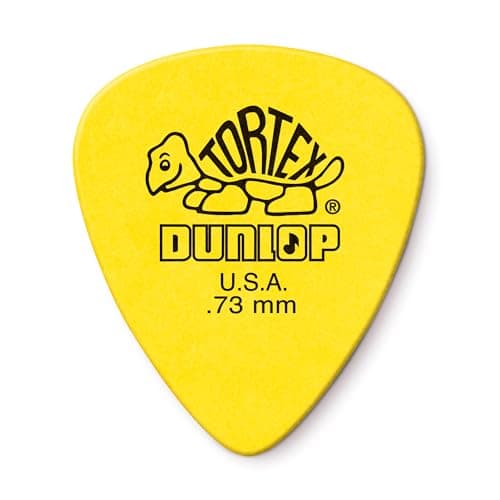
Dunlop Tortex .73 mm — best first electric pick
The overlap gauge. It is firm enough that single notes speak clearly and soft enough that chords still sound like chords, which makes it the right first purchase for someone who does not yet know whether they are going to be a rhythm player or a lead one.
It is also the same pick we rank third on the acoustic page, which is the honest reason it wins here: if you own one guitar of each, this is the gauge that does not need swapping.
Against it: if you already know you play mostly lead, you will outgrow it quickly. It wears to a furred edge. And on a heavy-gauge set it can feel slightly too willing to bend.
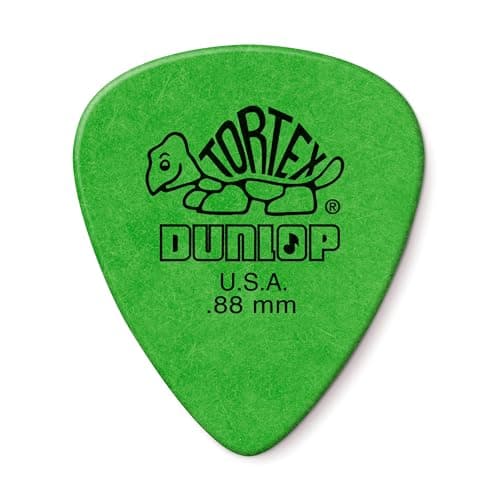
Dunlop Tortex .88 mm — the gauge most players settle on
One step up, and for most electric players the last step they take. The extra 0.15 mm is enough that the pick effectively stops flexing under normal picking force, which is the whole point, while the body shape stays familiar.
Dunlop publishes the part number (418P.88) and color-codes it green, so reordering exactly the right thing is trivial — a small consideration that matters for a consumable you lose constantly.
Against it: too stiff for comfortable acoustic strumming, so if you own both guitars this becomes a second pick rather than a replacement. It is unforgiving of an uneven hand. And like all Tortex it furs rather than staying crisp.
Dunlop Jazz III — best for single notes
1.38 mm of precision-molded nylon in a small body with a sharp tip. On fast single-note lines the difference against a standard shape is real and immediately audible: less plastic crossing the string means a more defined attack.
It is the pick an enormous number of lead players converge on independently, which is worth something even though it is consensus rather than measurement.
Against it, and these are real: the small body is genuinely harder to hold until your grip adapts, it is poor at strumming and does not pretend otherwise, and it comes six to a pack rather than twelve while being just as easy to lose.
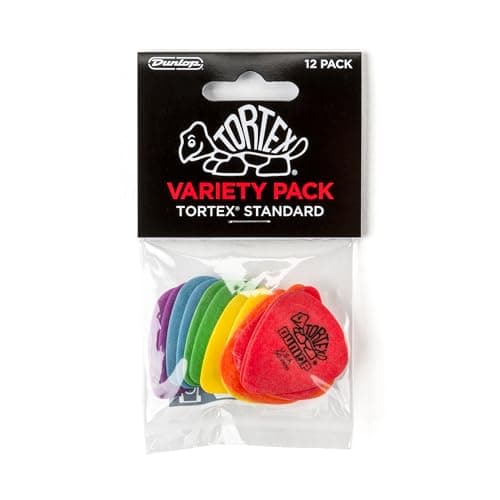
Dunlop Tortex variety pack — best way to find your gauge
Ranked fourth here rather than first, because the electric band is narrower and better known than the acoustic one — most electric players end at .73 or .88, and buying both directly is cheaper than buying ten gauges you will not use.
It is still the right purchase if you genuinely have no idea, and it is the only way to discover that you are one of the people who prefers 1.14 mm. Against it: ten of the twelve picks will sit in a drawer.
Published specifications, side by side
What Dunlop publishes| Pick | Material | Thickness | Shape | Pack |
|---|
| Tortex .73 | Delrin | 0.73 mm | Standard 351 | 12 |
| Tortex .88 | Delrin | 0.88 mm | Standard 351 | 12 |
| Jazz III | Nylon (Stiffo) | 1.38 mm | Small body, sharp tip | 6 |
| Tortex variety pack | Delrin | Six gauges, .50–1.14 mm | Standard 351 | 12 |
Every row here carries a millimeter figure. That is not true of the celluloid picks on the acoustic page, and it is the reason Dunlop dominates a page ranked on published specifications.
How to run the experiment without wasting money
Buy .73 and .88 together. Two twelve-packs cost less than a set of strings and cover the band almost every electric player ends up in. Play each for a week on the same material.
Change one variable at a time. If you switch gauge and material together and prefer the result, you have learned nothing about which change did it.
Then stop. There is an expensive world of boutique picks beyond this and none of it will affect your playing in the first years the way ten minutes of practice will.
Grip, and why picks end up in the pickup cavity
Every electric player loses picks mid-song, and it is almost always one of three fixable things rather than bad luck.
Too much pick sticking out. The most common cause. A long exposed tip gives the string more leverage against your grip on every stroke. Most players hold too much pick for months before somebody tells them; shortening the exposed tip to a few millimeters fixes more slipping than any grip product does.
The wrong surface. Delrin grips without texturing, celluloid is the slickest of the common materials, and plain nylon is smooth — which is exactly why Dunlop sells a textured Max Grip version of the same nylon pick. If you are losing celluloid picks, the material is a legitimate suspect.
Gripping harder as compensation. Squeezing tighter makes the problem worse, not better, because a rigid grip transmits every bit of the string's resistance into your fingers rather than letting the wrist absorb it. The fix is a shorter exposed tip and a looser hand, in that order.
The cheap hardware answer, if none of that works: a pick with a molded grip pattern, or a drop of grip fluid. Both are real products and both are treating a symptom that the first paragraph above usually cures for free.
What a pick will not fix
Notes that buzz. That is fret height, relief or a nut slot, and it is diagnosable with a measuring gauge rather than a plectrum.
Strings that will not bend. That is gauge, not pick. The electric string roundup makes the case for nines over tens for a beginner.
Muddy tone through an amp. That is old strings, amp settings, or the cable — see guitar cables. A pick is the smallest lever in that chain.
What we would actually buy
A twelve-pack of Tortex .73 and a twelve-pack of .88, played for a week each. If you find yourself wanting more definition on single notes after that, a six-pack of Jazz III answers the shape question for about the price of a coffee. That is the whole decision, and it is under the cost of one set of strings in total.
What we did not doWe have not played any of this gear. Every guide in this category says it tested twenty tuners; we would rather say plainly that we tested none. What we did instead is on this page in full: published specifications with their sources, the makers' own manuals read rather than paraphrased, and a note wherever a company publishes nothing at all.