An acoustic guitar is played, most of the time, by dragging something across six strings at once. That is a different job from picking one string at a time, and it wants a different tool — which is why the pick that suits an acoustic is usually thinner than the one that suits an electric.
This page ranks picks for that job. The electric version of the same question, which lands in a different place entirely, is in the best picks for electric guitar.
The criteria, in the order they decide it
1. Flex — the property that evens out a strum
A pick that bends as it crosses the strings does two useful things at once. It spreads the contact over a few more milliseconds, which smooths the attack. And it forgives an uneven right hand, because some of the extra force you put into one stroke goes into bending the pick rather than into the string.
That second effect is the one that matters for a beginner, and it is the reason we rank flex first here and stiffness first on the electric page. Nobody strums evenly in month one. A flexible pick makes the gap between your good strokes and your bad ones smaller while your hand learns.
2. Published thickness, in millimeters
Thickness is the number that controls flex, and it is the only specification in this category that any maker publishes consistently. Dunlop publishes six Tortex Standard gauges — .50, .60, .73, .88, 1.0 and 1.14 mm — and color-codes them so a re-order is unambiguous.
Fender, by contrast, sells the 351 in thin, medium and heavy. Those are adjectives. You cannot line a Fender medium up against a Dunlop .73 numerically, and that gap is the single most irritating thing about buying picks.
.50–.73
The millimeter band most acoustic strumming lands in
Dunlop publishes every Tortex gauge as a number. Fender publishes thin, medium and heavy. Only one of those lets you plan.
3. Material, because the number is only half of it
Two picks printed at the same thickness in different plastics do not feel the same. Nylon flexes further than Delrin at an identical gauge; celluloid sits between them and is slicker in the hand. The mechanism is worked through properly in pick materials compared, and it is why a 0.60 mm nylon and a 0.60 mm Tortex are different purchases rather than the same one twice.
4. Grip, which matters more on an acoustic than anywhere else
Strumming is a bigger motion than picking, at a steeper angle, usually with more force. Picks get thrown across rooms. Delrin has a naturally chalky surface that grips without texturing; celluloid is the slipperiest of the common materials; plain nylon is smooth, which is exactly why Dunlop sells a textured version of the same pick.
The picks
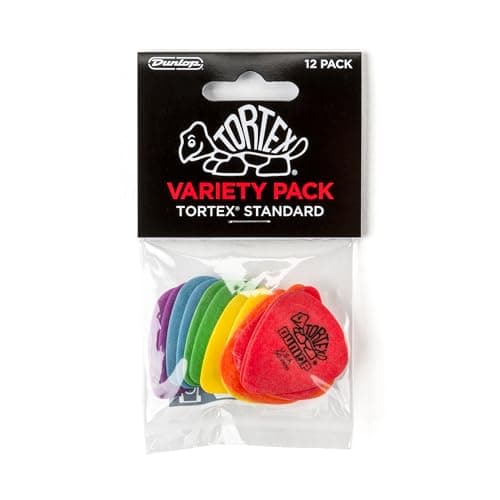
Dunlop Tortex variety pack — best way to find your gauge
Twelve picks, two of each of the six published gauges, color-coded. It wins this page for a reason that is slightly against the grain of a roundup: the right gauge is a physical fact about your hand and grip strength, and no page can determine it for you from the outside.
Play each gauge for two days. Your hand will stop arguing with one of them. That experiment costs about as much as a coffee and settles a question you would otherwise keep re-asking for a year.
Against it: you end up with ten picks you do not want, it does not tell you anything about material, and if you already know your gauge it is the wrong purchase — buy the single gauge instead.
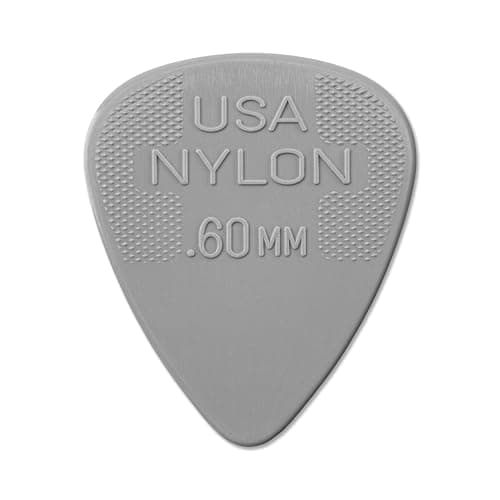
Dunlop Nylon Standard 0.60 mm — most flex for strumming
Nylon at 0.60 mm bends further than Delrin at 0.60 mm, which makes this the most forgiving pick on the page and the one that flatters an unpolished strumming hand the most. On an acoustic the extra give also softens the click of the pick snapping past each string.
Against it: the plain Nylon Standard has a smooth face and will slide in a damp hand — Dunlop makes a Max Grip version of the same pick precisely because that complaint is real. The flex that helps your strumming actively slows down any single-note playing. And nylon wears smooth rather than rough, so it gets slipperier as it ages.
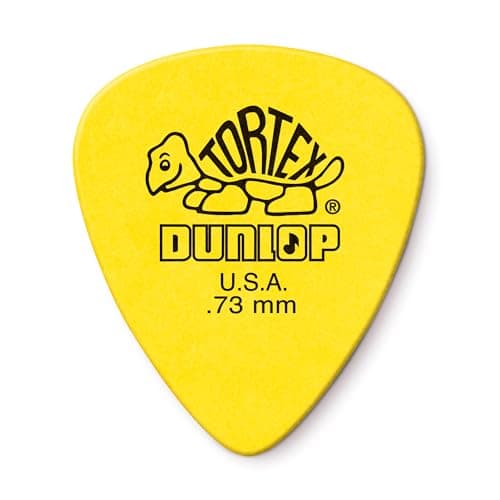
Dunlop Tortex .73 mm — best single-pick answer
If you want one pick and no experiment, this is it, and it is the most recommended gauge in guitar for a reason: enough stiffness that a picked note speaks clearly, enough flex that a strum does not sound like an attack. The yellow color code makes it unmistakable in a drawer.
Against it: at .73 mm it is already firmer than the ideal pure-strumming pick, so if you only ever strum chords you may prefer the .60 or .50. It wears to a furred edge rather than staying sharp. And buying one gauge without trying its neighbors means you have chosen by reputation rather than by hand.
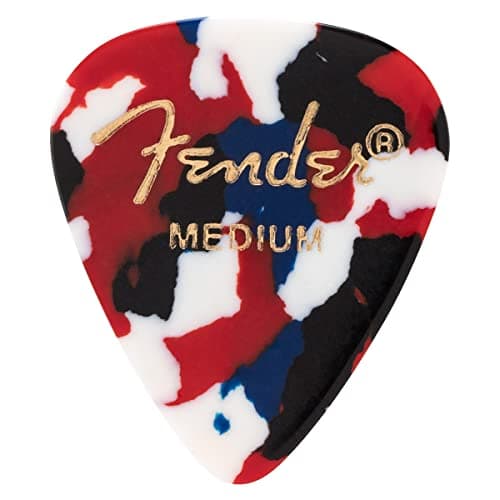
Fender 351 medium celluloid — brightest attack
Celluloid is the oldest pick material still in wide use and it has a brighter, more percussive attack than Delrin at a comparable stiffness. On a dull-sounding acoustic that is a genuine and very cheap improvement.
Against it, and this is the honest problem with it: Fender publishes thin, medium and heavy rather than millimeters, so you cannot compare it to anything else on this page numerically. It is also the slickest surface here, and celluloid wears fastest of the three materials.
Published specifications, side by side
What each maker publishes| Pick | Material | Published thickness | Grip |
|---|
| Tortex variety pack | Delrin | Six gauges, .50–1.14 mm | Matte, grippy |
| Dunlop Nylon Standard | Nylon | 0.60 mm | Smooth — textured version sold separately |
| Dunlop Tortex .73 | Delrin | 0.73 mm | Matte, grippy |
| Fender 351 medium | Celluloid | Thin / medium / heavy, no mm | Gloss, slick |
Read the third column. Three of these four let you plan a purchase with a number; one asks you to trust an adjective.
When to throw a pick away
Picks are consumables and almost nobody treats them as one. A worn pick is a real and gradual degradation in your own playing that you will blame on your hands, because it happens too slowly to notice.
Delrin wears into a rough, slightly furred edge. That edge drags on a wound string and adds a scratchy noise to every downstroke, which is most audible on an acoustic with bronze strings. Run a fingernail along the playing edge: if it catches, the pick is done.
Celluloid wears fastest of the three materials and wears to a point rather than a fur, which quietly turns your medium pick into something sharper and brighter than the one you bought.
Nylon wears smooth, which is the sneakiest of the three, because the pick keeps working and gets progressively more slippery until it starts leaving your hand.
None of them cost enough to justify keeping a worn one. A twelve-pack used properly lasts a beginner most of a year, which works out to roughly nothing per hour played.
What changes if you fingerpick
Then none of this applies and you should not buy a pick at all. Pick and fingers are two techniques, and a player who has decided on fingerstyle needs nails or thumbpicks rather than a plectrum. Strings matter far more in that case — the acoustic string roundup is the more useful page.
What a pick will not fix
A guitar that is hard to press down. That is action, and it is diagnosable in ten minutes — does my guitar need a setup.
Strings that sound dead. A three-month-old set makes any pick sound dull. That is a string-age problem, and it is a much bigger lever on tone than any plectrum.
An uneven strumming hand. A thin pick hides it. Only practice removes it, and both of those things are true at once.
What we would actually buy
The variety pack, first, for the price of a coffee. Then a twelve-pack of whichever gauge won, because you will lose them. If the answer turns out to be at the thin end, try the nylon at the same number and find out whether you prefer material flex to thickness flex — that is a second experiment costing about the same again, and it ends the question for good.
What we did not doWe have not played any of this gear. Every guide in this category says it tested twenty tuners; we would rather say plainly that we tested none. What we did instead is on this page in full: published specifications with their sources, the makers' own manuals read rather than paraphrased, and a note wherever a company publishes nothing at all.