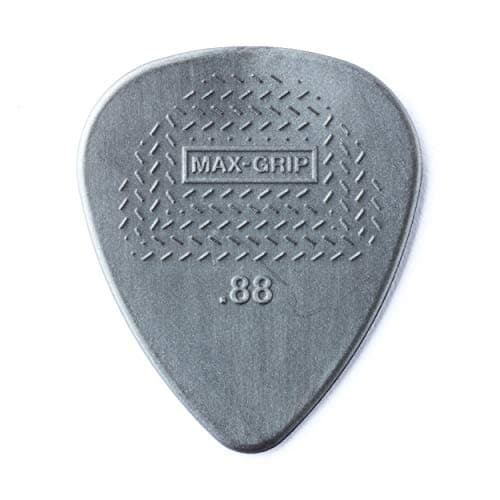
Buy the Dunlop Max-Grip Nylon Standard .88 mm. It is the same pick body as the plain Nylon Standard with a molded grid pressed into both faces, it costs about the same, and the grid is the most aggressive grip anyone here publishes. If you do not want to feel a pattern against your fingertips, the Gator Grip .71 mm reaches the same place with a matte face instead.
Before you buy either: a slipping pick is often a gripping problem rather than a pick problem, and the fix for that is free. It is the first section below.
Try these first, because they cost nothing
A pick rotates for three reasons, and only one of them is the pick.
- You are holding it too tightly. A hard pinch squeezes a flat object out from between two soft surfaces — the harder you grip, the more it wants to squirt out. Holding more lightly, with the pick resting against the side of the index finger rather than clamped on its face, usually stops the rotation on its own.
- Too much of it is sticking out. The further the tip projects, the more leverage every string puts on it. Two or three millimeters of tip is enough for strumming.
- Your hands are damp. This is the one that is genuinely a materials problem, and the one this page is about.
It is also worth knowing what you already own. We measured this across the pick pages on this site: a glossy celluloid pick such as the Fender 351 has a slick surface by design, and Dunlop's plain Nylon Standard has a smooth face — which is precisely why Dunlop sells a Max Grip version of the same pick. If you are slipping on either of those, the problem may simply be that you picked the slippery one.
The criteria, in the order they decide it
1. Which mechanism the grip uses
There are three in the picks you can actually buy, and they are not interchangeable.
- A molded raised pattern. Dunlop's Max-Grip publishes a "carefully engineered coarse grid" giving an "unparalleled non-slip surface". It is the most positive hold here and the one you can feel against the skin.
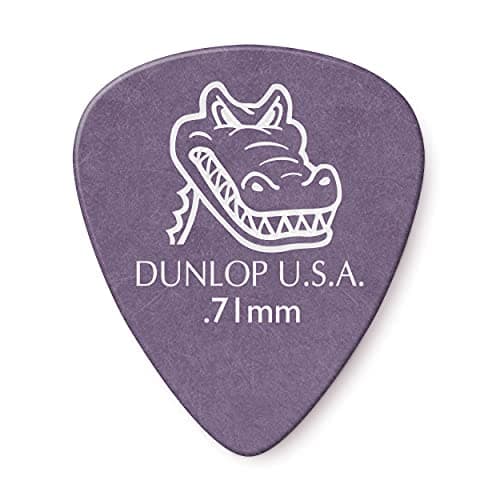
- A matte surface across the whole pick. Gator Grip: "a matte surface allows for a tight, non-slip grip". There is no pattern to feel, so nothing presses into your fingertip, and there is less to hold on to when your hands are properly wet.
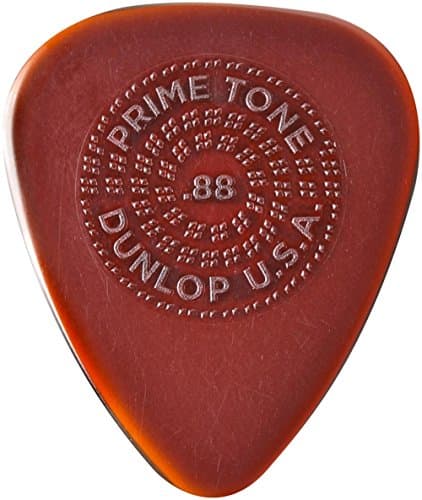
- A low-profile molded grip. Dunlop's Primetone Standard publishes "a low-profile grip for improved control and reduced hand fatigue". It is the compromise: present, but not coarse.
2. What the maker will commit to in writing
This is where the category gets thin. No maker here publishes a single number about grip. There is no coefficient of friction, no surface roughness figure, no moisture claim. Every grip specification in this category is an adjective, and the ranking below is a ranking of mechanisms and wording, not of measurements. We would rather say that than pretend otherwise.
Dunlop also does not publish the material for the Gator Grip, which is unusual — it publishes the material for the Max-Grip (molded nylon) and for the Primetone (Ultex) on the equivalent pages.
3. The gauge you already use
A grip pick is only useful if it exists in the thickness you play. Max-Grip runs .60, .73, .88, 1.0, 1.14 and 1.5 mm — the same ladder as the plain Nylon Standard — so you can switch without changing anything else. Gator Grip is sold in .58 through 2.0 mm. If you do not yet know your gauge, settle that first on the pick thickness guide, because a grippy pick in the wrong thickness is still the wrong pick.
4. What a texture costs you
A coarse grid is a texture on the face of the pick, and three things follow from that. It can be felt by players who rest a fingertip on the pick face. It collects grime. And it wears smooth eventually, because the grip is a surface feature rather than a property of the material. None of that is a reason to avoid it; all of it is a reason to buy a twelve-pack rather than a single.
Published grip claims, side by side| Pick | Mechanism | Maker's published wording | Material published |
|---|
| Max-Grip Nylon Standard (449) | Molded coarse grid, both faces | “Unparalleled non-slip surface” | Yes — molded nylon |
| Gator Grip (417) | Matte surface, whole pick | “A matte surface allows for a tight, non-slip grip” | No |
| Primetone Standard (510) | Low-profile molded grip | “Low-profile grip for improved control and reduced hand fatigue” | Yes — Ultex |
| Tortex Standard (418) | None — matte Delrin surface | No grip claim made | Yes — Delrin |
| Nylon Standard (44) | None — smooth face | No grip claim made | Yes — nylon |
| Any of them | — | No numeric grip figure is published by anyone | — |
Shape is part of grip, and Dunlop sells one surface in three of them
A grip surface is only half of how much pick you have to hold. The other half is how much pick there is, and Dunlop publishes the Gator Grip matte surface across three different outlines with three different part-number families.
The Gator Grip surface, by shape and published gauge| Shape | Part numbers | Published gauges |
|---|
| Standard 351 | 417 | 0.58, 0.71, 0.96, 1.14, 1.5, 2.0 mm |
| Small triangle | 572 | 0.73, 0.88, 1.0 mm |
| Jazz III | 571 | 1.4 mm |
If a standard pick rotates in your fingers, a small triangle gives you three usable points and more area to hold between them, and it does that without changing the surface or the material. It is the least discussed fix in this category and it costs the same as the pick you already use. A Jazz III goes the other way — less to hold, more precision — which is why it is the shape players with a settled grip converge on rather than the shape to reach for when the grip is the problem.
Our own view, labeled as ours: if you have never tried a shape other than the 351, do that before you buy a texture. The picks are the same price and one of the two experiments is more likely to work.
The gauge ladders, so you can switch without changing anything else
The whole argument for buying a grip pick from one of these two lines is that you can keep every other variable identical. Both are published in full.
- Max-Grip Nylon Standard: .60, .73, .88, 1.0, 1.14 and 1.5 mm — the same ladder as the plain Nylon Standard it is based on.
- Gator Grip standard shape: .58, .71, .96, 1.14, 1.5 and 2.0 mm, with .73, .88 and 1.0 mm available in the small triangle.
Find your gauge on the pick thickness guide, then buy the grip version of that number. If your gauge exists in both lines, the choice is purely between a grid you can feel and a matte face you cannot — which is the decision the rest of this page is about.
The picks
Dunlop Max-Grip Nylon Standard .88 mm — best non-slip pick
The reason this wins is that it changes one variable. It is the same nylon body, the same 351 outline and the same gauge ladder as the plain Nylon Standard that half the people reading this already own — with a grid pressed into both faces. Nothing else about your playing has to change, which is not true of jumping to a different material.
Honest downside: you can feel the grid. Players who rest a fingertip against the face of the pick notice it, and a few dislike it enough to go back. At twelve to a pack, finding that out costs less than a coffee.
Dunlop Gator Grip .71 mm — best grip you cannot feel
The whole face is the grip, so there is no pattern pressing into anything. At .71 mm it sits in the strumming range rather than the lead range, which is where most slipping complaints come from in the first place.
Honest downsides: Dunlop publishes no material for it, a matte face grips less than a grid once your hands are actually wet, and matte surfaces polish with use.
Dunlop Primetone Standard with grip .88 mm — best grip with a sharp edge
The upgrade. Ultex instead of nylon, so the edge stays defined far longer, plus a published hand-burnished bevel that genuinely changes how single notes speak. The grip is molded low, which is the gentlest of the three mechanisms here.
Honest downside: three to a pack. Per pick it is several times everything else on this page, and a low-profile grip holds less than a coarse grid.
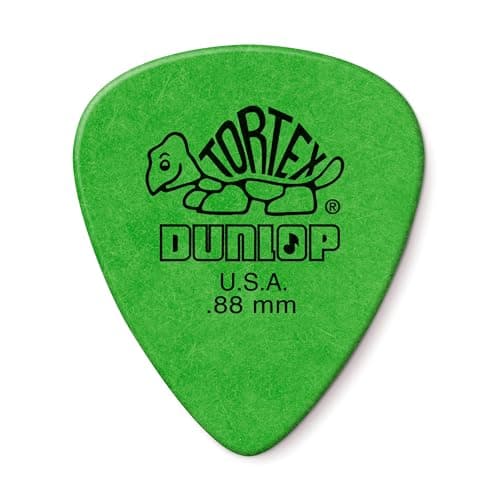
Dunlop Tortex Standard .88 mm — best without any texture at all
Worth knowing before you buy a textured pick at all: Delrin has a dry, matte surface of its own, and Dunlop makes no grip claim for it because it does not need to. For a lot of players a Tortex is already the fix, and it is the most common pick in the world for reasons that include this one.
Honest downside: .88 mm is stiff for acoustic strumming, and Tortex wears to a furred edge rather than staying sharp.
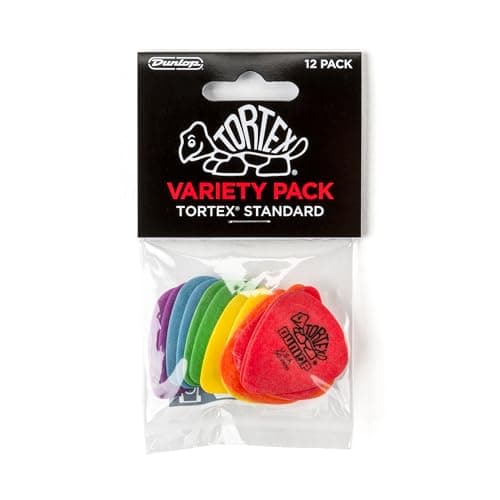
Dunlop Tortex Variety Pack — best for finding your gauge first
If you do not know what thickness you want, buying a grip pick is premature. Twelve picks across the gauge range answers the bigger question for the price of one textured single, and then you buy the grip version of whatever won.
Honest downside: no grip treatment on any of them, and you will end up with eight picks you do not use.
What we did not doWe have not played any of this gear. Every guide in this category says it tested twenty tuners; we would rather say plainly that we tested none. What we did instead is on this page in full: published specifications with their sources, the makers' own manuals read rather than paraphrased, and a note wherever a company publishes nothing at all.
What about picks with holes in them?
Perforated picks exist and the idea is sound — a hole gives the fingertip somewhere to sit rather than relying on friction. We have not featured one here because we could not find a maker publishing anything verifiable about the hole: no diameter, no position, no claim beyond the marketing. When one does, it will go on this page. Until then, the three mechanisms above are what we can stand behind.
What we would actually buy
A twelve-pack of Max-Grip in the gauge you already play. If the grid annoys you, a Gator Grip in the same thickness. Buy the Primetone only if you already know you want Ultex and a bevel; buy nothing at all until you have tried holding the pick more lightly, because that fixes this more often than a texture does.