A flat pick is one object you hold. Thumb and finger picks are three or four objects you wear, each of which has to fit, and the fit is the whole difference between a useful purchase and a drawer full of plastic.
Which makes it awkward that the largest maker in the category publishes no sizing information whatsoever. This page reports what is published, names what is not, and tells you the one measurement you can actually use.
Two different tools, bought for different reasons
A thumb pick straps to your thumb and gives the bass strings a plectrum attack while your fingers play normally. It is what most fingerstyle and country-blues players add first, and it solves a real problem: a thumb alone struggles to match the volume of fingers on the trebles.
Finger picks are metal bands worn on the picking fingers, bent to fit, and they exist for volume. Dunlop describes their sound as "bright and classic", and explicitly lists acoustic guitar alongside banjo, pedal steel and resonator.
You can buy either without the other. Most players who use both start with the thumb pick.
Sizing: the gap in this category
Dunlop sells thumb picks in Small, Medium, Large and Extra Large, and publishes no measurement for any of them — no chart, no millimeters, no description of how one should fit. We checked the product pages, the catalog and the site search; there is nothing.
Alaska Pik is the exception, and it is worth knowing about even if you buy something else. It publishes a printable trace-your-hand chart with fingertip widths — roughly 18 mm for the index and ring fingers, 20 mm for the middle, 27 mm and up for the thumb — plus a glove-size cross reference: a medium glove means a medium pick.
ProPik takes the third approach and says sizing barely matters for finger picks, because they are adjustable: "one size fits all", with most players on medium or large thumb picks adjusted down. That is true of any metal finger pick — they are meant to be bent.
.013 to .025 in
The gauge range Dunlop publishes for its nickel silver finger picks
Six thicknesses, and Dunlop's product description is word-for-word identical on all six. So the gauges are published but what they change is not — treat 'thicker is louder' as folklore rather than a maker claim.
The criteria, in the order they decide it
1. Will it fit, and can you make it fit?
Metal finger picks are bendable, which makes them forgiving: buy one gauge, adjust the wrap. Plastic thumb picks are much less adjustable, which is exactly why the missing size information matters. Buy two sizes if you are between, because you cannot look the answer up.
2. Material, which the makers do tie to tone
This is the one place the category is consistent. Dunlop: plastic gives "warm tonal response and increased control", nickel silver gives a "bright and classic sound". D'Addario, which now makes National picks, publishes the same split — celluloid thumb picks give a "warm, fat tone", nickel finger picks a "smooth, moderately bright tone, with increased volume and clarity", stainless a "bold, bright tone".
Alaska Pik sits outside that: plastic for "natural fingernail sound", and a published warning that its brass version "can be noisy on wound strings".
3. Gauge, where it exists
Only metal picks publish a thickness. Dunlop's nickel silver range runs .013 to .025 in; ProPik publishes .025 in for most of its finger picks and .018 in for stainless. No plastic thumb pick from any maker here publishes a thickness.
4. Handedness, which catches people out
Thumb picks are handed, and the coverage is patchy. Dunlop publishes left-handed thumb picks only in its White plastic line and in nickel silver — there is no left-handed Shell or Ultex. Its Ultex medium is explicitly listed as right-handed. ProPik offers right and left variants across its wrap-around thumb picks. Alaska Pik and National publish no handedness at all, which for Alaska Pik makes sense: the same part serves either hand and either digit.
5. How many you need
One thumb pick, two or three finger picks. Dunlop sells thumb picks in fours and finger picks in fives; the five-pack is listed by retailers as four finger picks plus a thumb pick, though Dunlop itself does not publish the contents. Alaska Pik sells individually.
Published specifications, side by side
What each maker publishes| Pick | Type | Gauge | Sizing info | Maker's tone claim |
|---|
| Dunlop 33P nickel silver | Finger picks | .013–.025 in | Bend to fit | Bright and classic |
| Dunlop Shell 9022 | Thumb pick | Not published | None published | Warm, increased control |
| Dunlop Ultex 9073 | Thumb pick | Not published | None published | Bright, punchy, durable |
| Alaska Pik | Either | Not published | Chart with fingertip widths | Natural fingernail sound |
The picks
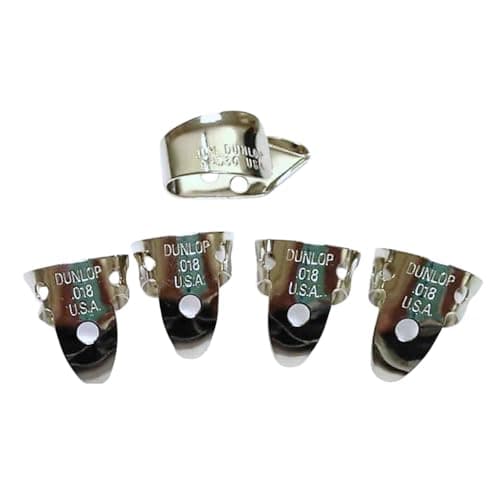
Dunlop nickel silver finger picks, .018 in — best finger picks
The middle of a published gauge ladder, in the metal most players start on, bendable to fit any finger. Dunlop lists acoustic guitar explicitly alongside banjo and resonator, so this is not a banjo-only purchase.
Against it: Dunlop publishes six gauges and no guidance on what choosing between them does. Metal is loud and noisy on wound strings until your touch adapts. And the pack contents come from a retailer, not the maker.
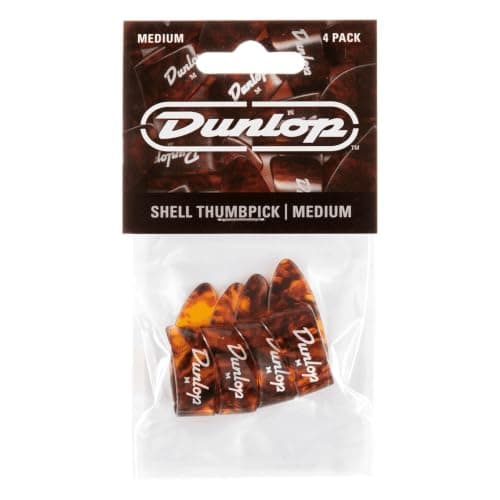
Dunlop Shell thumb pick, medium — best first thumb pick
Cheap, four to a pack, in the material Dunlop credits with warmth and control. Medium is where most adult hands start, and at this price buying medium and large together is a sensible experiment.
Against it: no thickness published, no measurement behind "Medium", and no left-handed option in this finish. Plastic thumb picks also deform with heavy use.
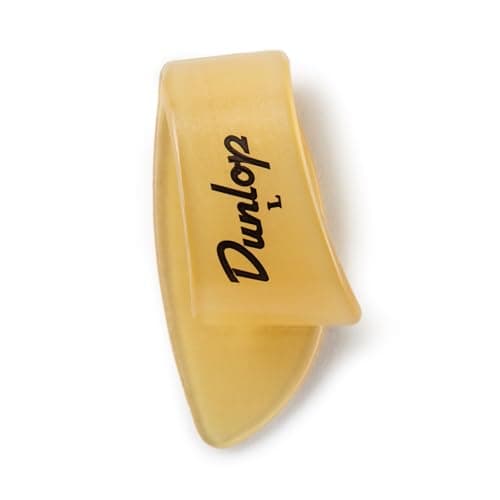
Dunlop Ultex thumb pick, large — best for durability
Dunlop sells Ultex on holding its shape, and describes the sound as bright and punchy rather than warm. If you have already flattened a plastic thumb pick, this is the upgrade path.
Against it: still no published thickness, only two sizes, and the medium is listed as right-handed. It costs more than plain plastic.
Alaska Pik, medium — best for natural nail tone
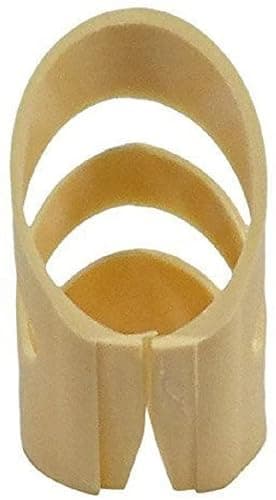
A different idea: the pick sits under the fingernail, so the attack comes off something shaped like your nail rather than a metal blade. It is the only maker here that publishes a sizing chart with measurements, and the only one that publishes instructions for filing the pick to fit.
Against it: you need enough fingernail for it to locate against, no thickness is published, and the brass version carries the maker's own warning about noise on wound strings.
Getting used to them
Expect a week of sounding worse. Picks change where the string is struck and how much give there is. That is a technique adjustment, not a faulty purchase.
Bend metal picks to your finger, not the other way round. They are designed to be adjusted, and a pick that spins on the finger is a pick that is too loose.
Start lighter than you think. Metal picks add volume for free, so the usual first mistake is digging in as hard as you did with flesh.
Keep a flat pick in the case anyway. The pick thickness guide covers the ordinary plectrum decision, and pick materials covers what the same materials do in flat-pick form.
What we would actually buy
Adding volume to fingerstyle on an acoustic: the Dunlop nickel silver finger picks in .018, plus a Shell thumb pick. Trying a thumb pick for the first time: the Shell medium, and buy the large too. Already flattening thumb picks: the Ultex. Wanting your own nail sound back after breaking a nail: the Alaska Pik, sized off the maker's own chart.
What we did not doWe have not played any of this gear. Every guide in this category says it tested twenty tuners; we would rather say plainly that we tested none. What we did instead is on this page in full: published specifications with their sources, the makers' own manuals read rather than paraphrased, and a note wherever a company publishes nothing at all.