First, the question this page assumes you have already answered: whether you need a hard case at all. Gig bag vs hard case works through it, and the short version is that a gig bag is enough if the guitar goes from your bedroom to a lesson in your own hands. A shell is what you need when the guitar goes in a car boot, on public transport, or into an aircraft hold.
If you are here, you are in the second category. So the rest of this page is about the thing nobody checks until the case arrives: whether your guitar goes in it.
Fit is the specification, and most makers publish half of it
A hard case works by holding the instrument still inside a rigid shell. A guitar that can move inside a case is being protected from the outside world and then thrown at the inside of its own container. Fit is not a comfort issue, it is the mechanism.
Electric guitar cases are shape-specific in a way acoustic cases are not. All three cases here are listed for particular body outlines, and two of them explicitly exclude double-cut, semi-hollow, V-style and single-cut shapes. A Les Paul will not sit in a case cut for a Stratocaster, and no amount of padding will make it.
Here is the frustrating part. Of the three, only two publish internal dimensions. The GW-ELECTRIC publishes an external size of 105 by 32 by 9 cm and nothing about the cavity, which tells you where it fits on a shelf and nothing about whether your guitar fits in it. We have marked that as unpublished on its spec card rather than quietly leaving the row out.
1 of 3
Cases here that publish a full internal cavity measurement
The Gator GC-Electric-A publishes body length, width and depth plus total length. The GWE-Extreme publishes internal length, width and height. The GW publishes only the outside of the case.
What separates the shells
Molded ABS against plywood
ABS is an injection-molded plastic shell. It shrugs off the scuffs and corner knocks that mark a covered wooden case, it does not care about rain, and it is dimensionally consistent, which is part of why it is the one with published internal measurements. Its weakness is that a rigid shell transmits more of a hard single impact through to the instrument than a padded wooden case absorbs.
Plywood under artificial leather or Tolex is the traditional construction, and it is what almost every case that has survived forty years is made of. Wood flexes and crushes progressively, which absorbs energy rather than transmitting it. The covering scuffs. Both of those things are true at once.
Neither is the right answer generally. For a case that lives in a car and gets loaded and unloaded weekly, ABS. For a case that will outlive your interest in the guitar, plywood.
Latches, and whether a lock is a lock
All three lock. What that means varies: the GW has a key lock, the GC-Electric-A has lockable latches with an aluminum lock profile, the GWE-Extreme is listed as lockable.
Be honest with yourself about what this is for. A guitar case lock deters an opportunist and stops the case springing open when it is dropped. It does not defeat anybody determined, and it is not a reason to leave a guitar somewhere you would not otherwise leave it.
Weight, which is a real cost
3.81 kg for the GW, 4.08 kg for the ABS case, 5.8 kg for the Extreme — before the guitar goes in. A loaded hard case is a genuinely heavy object to carry any distance, and the reason gig bags exist is that most people, most of the time, are walking rather than flying.
If the guitar mostly travels on foot, a padded gig bag with backpack straps is the honest recommendation and this page is the wrong one.
The picks
Gator GC-Electric-A — best published fit
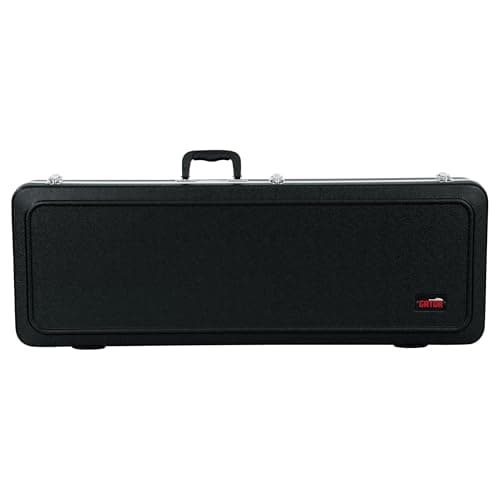
Molded ABS with EPS foam under a black plush lining and a neck support. What earns it the top spot is the specification sheet: Gator publishes body length, body width, body depth and total internal length, which means you can measure your guitar with a tape and know the answer before you order.
That is rarer than it should be in this category and it is worth more than any padding claim, because padding cannot compensate for a case the guitar rattles around inside.
Against it: it is listed for ST and T style bodies only, so it is the wrong case for a large fraction of electric guitars. At 4.08 kg it is heavier than the wooden GW despite feeling smaller. And a rigid molded shell is the construction that transmits the most of a single hard impact.
Gator GW-ELECTRIC — lightest of the three
Plywood core under artificial leather, with a key lock and an accessory box inside, at 3.81 kg. It is the traditional answer and the lightest thing on this page, which matters if you carry it.
Plywood construction is what road cases have always been made of, and the reason is that it fails gracefully. A dropped wooden case dents and keeps working. That is worth something a specification sheet will not show you.
Against it: no published internal dimensions, which on a shape-specific case is a real gap and the reason it is second rather than first. The artificial leather covering scuffs where ABS shrugs. And the same ST and T shape restriction applies.
Gator GWE-Extreme — best for an odd body shape
This one exists because the other two do not fit your guitar. Plywood under black Tolex with a black plush lining, sized and shaped for V-style, Explorer-style and other radical outlines that no standard case will take.
Gator publishes both internal and external dimensions here — 1219 by 432 by 51 mm inside with a 610 mm body length, 1270 by 490 by 97 mm outside — which makes the fit question answerable.
Against it: 5.8 kg, which is 1.7 kg more than the GW, and it is a large awkward object to store. If your guitar is a normal shape you would be paying for space you never use. This is a solution to a specific problem and nothing else.
Published specifications, side by side
What Gator publishes for each | GC-Electric-A | GW-ELECTRIC | GWE-Extreme |
|---|
| Shell | Molded ABS | Plywood, artificial leather | Plywood, black Tolex |
| Interior | EPS foam, plush, neck support | Not published | Black plush |
| Internal dimensions | Published in full | Not published | Published in full |
| External dimensions | 103.5 x 38.7 x 13.3 cm | 105 x 32 x 9 cm | 127 x 49 x 9.7 cm |
| Weight | 4.08 kg | 3.81 kg | 5.8 kg |
| Security | Lockable latches, alloy profile | Key lock | Lockable |
| Body shapes listed | ST, T | ST, T | V, EX and similar |
Before you order: measure your guitar
Three numbers, five minutes, and it removes almost all of the risk from this purchase.
Total length, from the top of the headstock to the bottom of the body along the center line. Body width at the widest point of the lower bout. Body depth, which on a solid-body is the thickness of the slab and on a semi-hollow is much more than you expect.
Compare those against the published internal cavity. If the case does not publish one, either buy from a shop that will take a return or buy one of the two here that does.
What a hard case does not solve
Humidity. A case is the right environment for a two-way humidity pack to work in, and the case alone does not regulate anything. See guitar hygrometers for the measure-first argument and humidifiers for what to do about the reading.
The guitar being knocked over at home. That is the most common damage a first guitar suffers, and a case in a cupboard does not prevent it because the guitar is not in the case. A stand or a wall hanger is the answer to that one.
Airline handling. A hard case improves your odds considerably and does not make a guitar hold-proof. Loosen the strings a little, pack the headstock so it cannot move, and take it as carry-on if the airline will let you.
What we did not doWe have not played any of this gear. Every guide in this category says it tested twenty tuners; we would rather say plainly that we tested none. What we did instead is on this page in full: published specifications with their sources, the makers' own manuals read rather than paraphrased, and a note wherever a company publishes nothing at all.