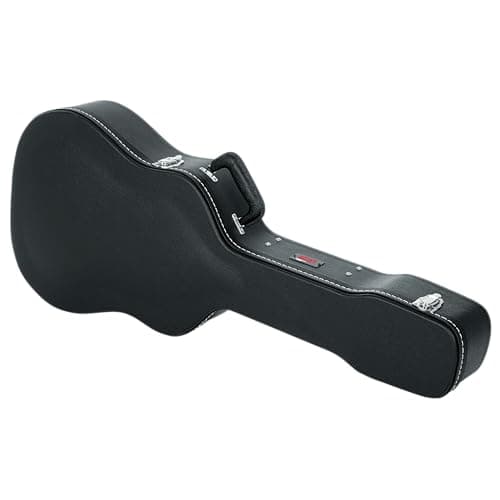
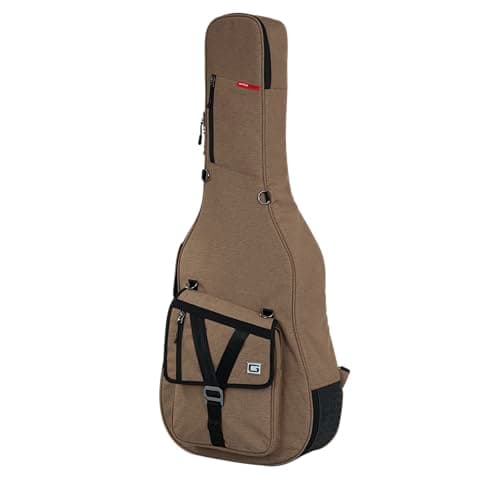
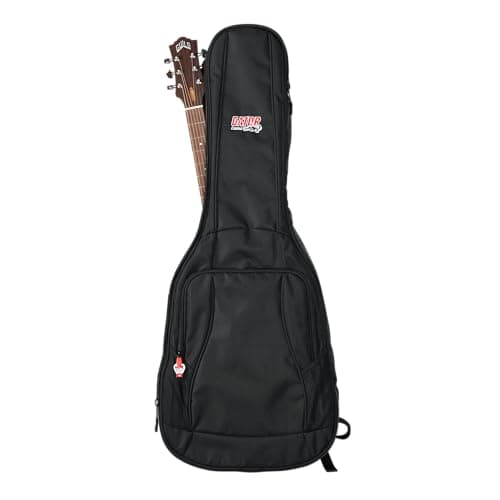
Acoustic guitars are more vulnerable than electrics in one specific way: the top is thin braced wood, and a knock that would scuff a solid body can crack it. That is the whole argument for taking cases seriously on an acoustic.
Check the body shape first
This is where most wasted purchases happen. Acoustic bodies are not one size.
Common acoustic body shapes| Shape | Roughly | Case fit |
|---|
| Dreadnought | The big square-shouldered standard | Dreadnought cases only |
| Concert / OM / auditorium | Narrower waist, smaller lower bout | Will move inside a dreadnought case |
| Parlor | Small-bodied | Needs its own case |
| Jumbo | Larger than a dreadnought | Will not fit a dreadnought case |
| Classical / nylon | Wide, flat-topped, no cutaway | Classical-specific |
A case that is too large is worse than no case for impacts, because the guitar moves inside it and arrives at the shell with momentum. Find your body shape in the maker's specification before you shop. If the guitar is a 3/4 or a travel size, the fraction on a bag label tells you even less — gig bags for 3/4 and 1/2 size guitars ranks those on published interior dimensions instead.
What to look for in an acoustic gig bag
A reinforced base. The bottom edge is what meets the pavement when you set the guitar down, and it is where cheap bags fail. Gator states extra support at the base of the 4G bags; most budget bags do not mention the base at all.
Backpack straps. Both hands free, weight on your back. This is the difference between a bag you use and one you resent.
A neck support or a snug upper bout. The headstock is the most breakable part of a guitar and the most likely to take a knock through a bag.
Pocket volume. A tuner, capo, spare strings, winder and cloth is the standard load, and a single flat sheet-music pocket does not carry it.
What to look for in an acoustic hard case
A close fit to your body shape. Covered above and worth repeating because it is the commonest error.
A seal good enough for humidity control. If you own a solid-wood acoustic and live somewhere with a dry winter, this may be the deciding feature — D'Addario states its two-way packs are best used in a sealed case. See humidifiers.
Latches you can work one-handed. Trivial until you are holding a guitar in the other hand.
A plush lining rather than bare foam. Foam degrades, and degrading foam against a nitrocellulose finish is a known long-term problem.
Body shape
The specification to check before anything else
A dreadnought case does not fit a concert body, and a loose case is worse than no case when something drops.
The nitrocellulose caution
If your acoustic has a nitrocellulose finish — common on higher-end and vintage-style instruments — be careful about what it sits against for months at a time. Some foams, rubbers and vinyls react with nitro over prolonged contact and leave permanent marks.
This applies to case linings, stand arms and cheap straps alike. If you are unsure what a lining is made of, a cloth between the guitar and the lining costs nothing.
What we did not doWe have not played any of this gear. Every guide in this category says it tested twenty tuners; we would rather say plainly that we tested none. What we did instead is on this page in full: published specifications with their sources, the makers' own manuals read rather than paraphrased, and a note wherever a company publishes nothing at all.
What we could not tell you
Gator publishes no padding thickness, no impact rating and no drop-test data for any product in this roundup, and neither does anyone else in the category. We have not dropped these cases and we are not going to imply otherwise. The comparison above is construction detail from the makers' own pages plus the failure modes that recur across the category.