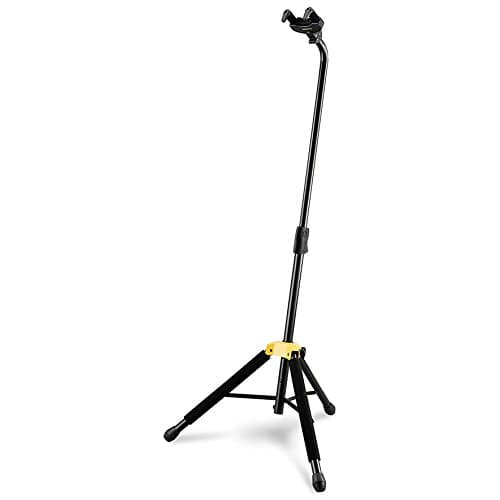
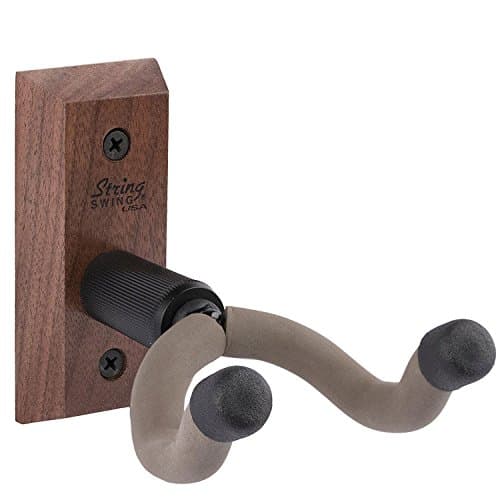
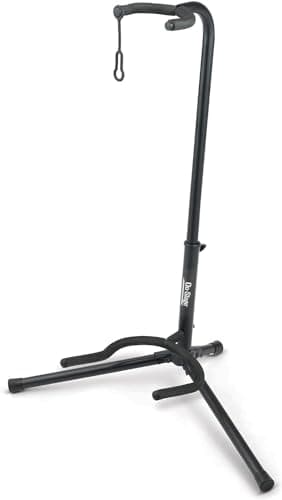
Both solve the same problem: a guitar you can pick up in one movement gets played several times a day, and a guitar in a case in a cupboard gets played on Sundays. That behavioral effect is the real reason to buy either.
They differ on one thing that matters more than the rest: a floor stand can be knocked over and a wall hanger cannot.
The published numbers
What each maker states | Hercules GS414B PLUS | String Swing CC01K | On-Stage XCG4 |
|---|
| Type | Tripod, auto-grip yoke | Wall hanger | Tripod, open yoke |
| Load rating | 15 kg (33 lb) | 15 lb per hanger | Not published |
| Height range | 950–1150 mm (37.4–45.2") | Fixed, wall-mounted | Not published |
| Own weight | 1.8 kg (4 lb) | Not published | Not published |
| Folded size | 710 × 155 × 110 mm | N/A | Not published |
| Neck restraint | Automatic locking arms | Padded pivoting steel yoke | None |
| Warranty | Not published | Lifetime structural | Not published |
Note the pattern. Hercules and String Swing publish real figures; On-Stage publishes none for the XCG4. That is not a claim the cheap stand is unsafe — it is a thirty-year-old design holding guitars in rehearsal rooms everywhere — but it is a real difference in what each company will state.
Where a wall hanger wins
Nothing at floor level. No tripod legs to catch a foot, no base for a vacuum cleaner to hit, nothing for a dog's tail to sweep. If you have small children or pets, this is decisive.
Published load headroom. String Swing publishes 15 lb per hanger. A heavy Les Paul is around 10 lb, so the margin is comfortable.
Space. A guitar on a wall occupies no floor.
It looks good, which is not a technical argument and is genuinely why many people choose one.
Where a floor stand wins
No wall damage. A hanger needs a stud and screws. If you rent, that may end the conversation.
Portability. The Hercules folds to 710 × 155 × 110 mm and weighs 1.8 kg — it goes to a rehearsal. A hanger does not.
No drilling. Out of the box to in use in seconds.
Height adjustment. Hercules publishes a 950–1150 mm range, which matters if you want the guitar at a particular height for grabbing.
15 lb
String Swing's published per-hanger load rating
A heavy Les Paul is around 10 lb. On-Stage publishes no load figure at all for its floor stand.
Does hanging by the headstock damage a guitar?
It worries people and it should not. The neck is under roughly 70–80 kg of string tension along its length at all times. The guitar's own weight hanging from the headstock is a small fraction of that, applied in a direction the neck is already built to handle. Instrument shops hang stock this way as standard.
The genuine caution is chemical rather than structural.
The finish question, which applies to both
Some rubber and foam compounds react with nitrocellulose lacquer over long contact, leaving permanent marks. This applies to wall-hanger yokes and to floor-stand arms equally.
String Swing publishes that the CC01K's steel yoke is wrapped in protective padding; Hercules publishes specially formulated foam on all contact points. Neither states nitro compatibility explicitly.
If your guitar has a nitro finish and you are not certain what the padding is, a cloth between the guitar and the contact points costs nothing and removes the question entirely.
The recommendation
Wall hanger if you own the wall, have a stud, and there is anything in your home that moves — children, pets, doors that swing.
Floor stand with a locking yoke if you rent, need portability, or want the guitar in a spot with no suitable wall. The auto-grip mechanism is worth the difference over an open A-frame, because it restrains the neck.
An open A-frame if the budget is the constraint. It works, it publishes nothing, and it is the easiest thing in the room to knock over.
Full picks in the stands roundup, and if you have settled on hanging it, the wall hanger roundup ranks four mounts on published load rating and on whether each one is stated safe for a nitrocellulose finish.
What we did not doWe have not played any of this gear. Every guide in this category says it tested twenty tuners; we would rather say plainly that we tested none. What we did instead is on this page in full: published specifications with their sources, the makers' own manuals read rather than paraphrased, and a note wherever a company publishes nothing at all.