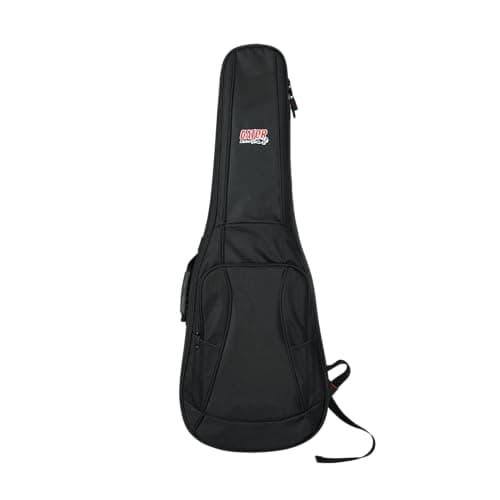
Electric guitars are more robust than acoustics in the body and just as fragile at the headstock. A solid body shrugs off knocks that would crack an acoustic top; a headstock snapped at the nut is one of the most common serious guitar repairs there is.
So on an electric, a bag's job is mostly about the neck end.
The headstock is the weak point
Most electric necks are strongest along their length and weakest right where the headstock angles back from the nut. On angled-headstock designs, that transition is a short-grain area carrying the full leverage of the neck if the guitar falls.
What that means for a bag: padding at the top of the bag matters more than padding at the sides, and a bag whose neck channel lets the headstock rattle around is doing less than it looks like it is doing.
The same reasoning is why a guitar stood upright against a wall is a bad idea, and why a stand or hanger is one of the better early purchases.
Body shape: easier than acoustic, not automatic
Which electrics fit a standard bag| Body | Standard electric bag? |
|---|
| Stratocaster-style double cutaway | Yes |
| Telecaster-style single cutaway | Yes |
| Les Paul-style single cutaway | Yes |
| Semi-hollow 335-style | Usually needs a wider bag |
| Offset (Jazzmaster / Jaguar) | Needs a shape-specific bag |
| V, Explorer and similar | Needs a shape-specific bag |
Gator publishes shape-specific bags for several of these, which is worth knowing before you assume a standard electric bag will do.
What to look for
Padding all round, including the base. Gator states thick interior padding on all sides for the 4G electric bag. The base is the part that meets the ground.
Backpack straps. An electric plus a bag is a real weight over any distance, and two straps beat one.
A pocket that takes a cable. Electric players carry more than acoustic players: cable, tuner, spare strings, sometimes a headphone amp. Coiled cable takes real volume.
Zips. The other consistent failure point in this category, with no published specification anywhere. This comes down to build reputation, and we will say that rather than dress it up.
The headstock
The part of an electric guitar most likely to break
Padding at the neck end of a bag matters more than padding at the sides. So does never leaning the guitar against a wall.
When a bag is not enough
Same rule as everywhere: if the guitar goes in a car boot with other luggage, on public transport at rush hour, or into a hold, it needs a shell. See gig bag vs hard case.
One electric-specific note: a guitar with a floating tremolo is more sensitive to being knocked out of tune in transit, because the bridge floats between string and spring tension. A snug case reduces movement; nothing eliminates it.
For an aircraft hold specifically, the case is only half the job — flying with a guitar covers the packing steps that matter more than which shell you bought.
For a car boot, a van or an aircraft hold, a bag is not enough at any price. Electric guitar hard cases picks up there, and starts with the published internal dimensions rather than the padding claims.
What we did not doWe have not played any of this gear. Every guide in this category says it tested twenty tuners; we would rather say plainly that we tested none. What we did instead is on this page in full: published specifications with their sources, the makers' own manuals read rather than paraphrased, and a note wherever a company publishes nothing at all.