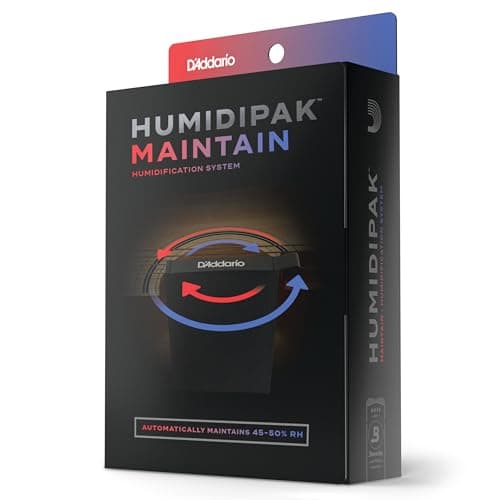
Before anything else: a case-based humidifier only works inside a case that seals. D'Addario states plainly that its Humidipak system is best used in a sealed case. A humidity pack in an open gig bag, or a guitar on a stand in a dry room, is a pack doing nothing.
If your guitar lives out — which is good for practice — the honest answer is room humidity control, not a case product. That is a different purchase and a different budget.
Two mechanisms
Two-way packs
Sealed packets of a saturated salt solution that both release and absorb moisture to hold a target relative humidity. D'Addario publishes a 45–50% RH target and describes the system as automatically adding or depleting moisture to maintain it.
The advantage that matters: it cannot over-humidify. A sponge humidifier only ever adds water, and in a humid summer that is the wrong direction. Two-way control removes the possibility of making things worse.
The cost: the packs are consumable. D'Addario publishes that they should be replaced when they begin to dry out, or every three months at maximum. That is an ongoing cost forever.
Refillable sponge humidifiers
A water reservoir — usually a sponge or a gel in a perforated body — that sits in the soundhole or clips between the strings, and evaporates moisture into the case.
The advantage: no consumables. Refill with water, indefinitely. The Oasis design contracts visibly as the water is used, which turns "is it still working" into something you can see at a glance rather than guess.
The cost: it only adds moisture, it publishes no target humidity, and it depends entirely on you remembering to refill it. A dry sponge protects nothing while looking exactly like a humidifier that is working — which is precisely why the visible indicator matters.
How they compare | Two-way packs | Refillable |
|---|
| Published RH target | 45–50% | None published |
| Direction | Adds and absorbs | Adds only |
| Consumables | Replace every 3 months maximum | None — water only |
| Maintenance | None between replacements | Refill every week or two |
| Can over-humidify | No | Yes, in a humid climate |
| Needs a sealed case | Yes, stated by the maker | Yes, in practice |
| Spill risk near a soundboard | None — sealed packets | Real, if overfilled |
45–50%
The relative humidity D'Addario publishes as its Humidipak target
It is the only published target figure in this roundup. The refillable option publishes none, because it has no target — it simply adds water.
Polish, and the one exclusion that matters
If you would rather buy the polish on its own than a kit, the choice turns on a single published statement: which finishes the maker says it is not for. Polish on a satin or matte surface is permanent. The guitar polish roundup ranks on exactly that.
Buy a hygrometer before you buy a humidifier
A humidifier without a hygrometer is a purchase made on assumption. A small digital hygrometer inside the case tells you what the humidity actually is, which tells you whether you need anything at all, and whether what you bought is working.
Below roughly 35% RH sustained is where solid-wood acoustics start having problems. Above 60% is the other end, where tops swell, action rises and glue joints are stressed. If your case sits between 40% and 55% year-round, you do not need any of this.
Which to buy
Two-way packs if you want it handled: a published target, no refilling, no possibility of over-humidifying, and nothing holding liquid water above a soundboard.
Refillable if the ongoing cost bothers you and you are the sort of person who will actually check it. The visible contraction on the Oasis design makes that check trivial, which is a genuine design advantage over sponge humidifiers that look identical wet and dry.
Neither if you own a laminate acoustic or a solid-body electric in a temperate climate. Do I need a humidifier answers the prior question honestly.
What we did not doWe have not played any of this gear. Every guide in this category says it tested twenty tuners; we would rather say plainly that we tested none. What we did instead is on this page in full: published specifications with their sources, the makers' own manuals read rather than paraphrased, and a note wherever a company publishes nothing at all.