Our humidifier pages both end at the same instruction and it is worth promoting it to a page of its own: do I need a guitar humidifier says measure first, and the humidifier roundup says a pack in an open gig bag does nothing. Both of those are conclusions you can only reach with a number, and a number needs an instrument.
A hygrometer is that instrument. It costs less than a humidifier, it is a one-off purchase rather than a consumable, and for a great many people the reading it produces is "your house is fine, buy nothing". That is the most useful outcome any accessory on this site can produce.
What you are trying to find out
Wood loses and gains moisture with the air around it. A solid-wood acoustic top that dries out shrinks across the grain while the braces underneath do not, and the result is a sunken top, sharp fret ends where the fingerboard has shrunk back from the fret wire, and in the worst case a crack. Too damp and the top swells, the action rises and the tone goes flabby.
D'Addario publishes a 45 to 50 percent relative humidity target for its two-way packs and states the system works best in a sealed case. That is the target range this whole category is organized around. Your job with a hygrometer is to find out where your home actually sits relative to it — not once, but across a heating season.
45–50%
Relative humidity D'Addario publishes as the target for its two-way packs
A hygrometer tells you whether you are inside that band. Nothing else on this site can answer that question for your particular home.
The three things that separate them
1. Whether the maker publishes an accuracy figure
This is the criterion that decides the page, and only one of the three passes it. Oasis publishes plus or minus 3 percent relative humidity across the 20 to 90 percent range, and plus or minus 1 percent on temperature from 0 to 50 degrees Celsius. MusicNomad publishes no accuracy figure for either of its units on the listings we checked, and both spec cards on this page say so rather than carrying a figure we supplied.
Why it matters in practice: the decision you are making is whether 42 percent is close enough to 45. A device with plus or minus 3 percent published error tells you that reading is somewhere between 39 and 45. A device with no published figure tells you nothing about how much to trust it, and the difference between those two states is exactly the thing this site was built to point at.
2. Where it sits
Relative humidity is not uniform through a room, and it is definitely not uniform between a room and the inside of a closed case. A reading from a unit on the shelf tells you about the shelf.
The MusicNomad HONE clips directly to the strings, so it reads the air touching the instrument. The HumiReader sits between the strings in the soundhole or in an adhesive holster inside the case, so one unit covers both storage situations. The Oasis is built to clip inside a case. If your guitar lives on a stand in the room, a room reading is the right reading; if it lives in a case, measure inside the case.
3. Whether it can be recalibrated
Humidity sensors drift. A cheap one that has been in a case for three years is not reading what it read when it was new, and there is no way to tell from the display. The Oasis supports recalibration, which turns a drifting sensor into a fixable problem rather than a replacement. Neither MusicNomad unit lists recalibration.
The picks
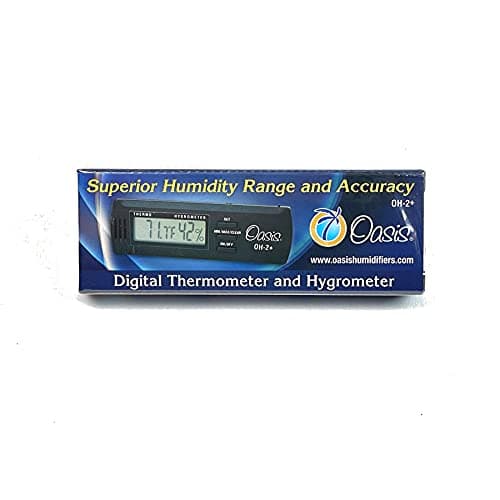
Oasis OH-2+ — the only published accuracy figure
Plus or minus 3 percent relative humidity from 20 to 90 percent, plus or minus 1 percent on temperature from 0 to 50 degrees Celsius, a 10 second update interval, max and min recording, a CR2032 cell and a retaining clip for inside a case. Recalibration is supported.
It wins for the same reason the Korg tuner wins its category: it is the one that committed to a number. Max and min recording matters more than it sounds, because the reading that damages a guitar is the overnight low in a heated house, and that is precisely the reading you are asleep for.
Against it: it is the most expensive of the three, it is built for case mounting rather than for the instrument, and the listing publishes no battery life figure. The original cell is widely reported to last around a year, which is a reasonable expectation and not a published specification, so we have not put it on the spec card.
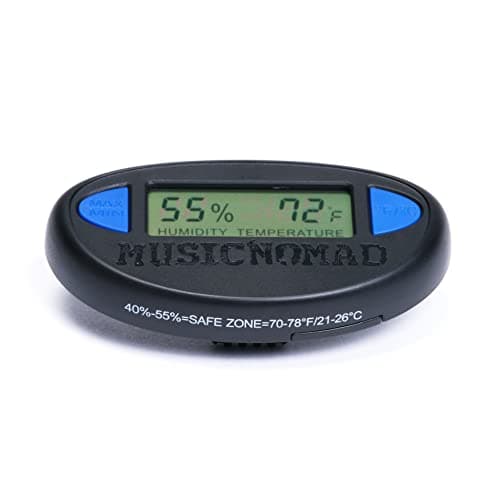
MusicNomad HONE MN312 — best mounted on the guitar
Clips to the strings with an Easy Clip so it reads the air actually touching the instrument, and prints a safe zone for temperature and humidity on the unit itself, which means the reading interprets itself without you having to remember a target. Records max and min. AG13 cell, included.
It is the cheapest of the three and, for a guitar that lives out on a stand, arguably the most sensibly placed.
Against it: no published accuracy figure anywhere we could find, no recalibration, and clipping a device to the strings of your guitar is not to everyone's taste. If you want a number you can put error bars on, this is not it.
MusicNomad HumiReader MN305 — best for case or soundhole
The same readout as the HONE with a different mounting problem solved. It sits between the strings in the soundhole, or in a holster with an adhesive back that sticks inside the case, so one unit covers a guitar that spends some weeks out and some weeks away.
Against it: the same missing accuracy figure as the HONE, soundhole mounting is acoustic-only, and the adhesive holster is a one-way decision inside a case lining. Think about where you want it before you peel the backing off.
Side by side
What each maker publishes | Oasis OH-2+ | MusicNomad HONE | MusicNomad HumiReader |
|---|
| Published RH accuracy | +/-3% over 20–90% | Not published | Not published |
| Published temp accuracy | +/-1%, 0–50 °C | Not published | Not published |
| Mounts | Case clip | Clips to the strings | Soundhole or case holster |
| Max/min recording | Yes | Yes | Yes |
| Recalibration | Yes | Not listed | Not listed |
| Battery | CR2032 | AG13 | AG13 |
| Safe zone printed on unit | Not listed | Yes | Yes |
The top two rows are the page. Two of these three devices ask you to trust a number without telling you how much it might be wrong by.
How to actually use one
Measure for a season, not an afternoon. A single reading in September tells you almost nothing about February, and February is when central heating drives indoor humidity down. Put the unit where the guitar lives and look at it weekly. The max and min figures are doing the real work here.
Measure where the guitar is, not where you are. A reading from the kitchen is not a reading from the case in the spare room.
Then decide. Consistently below 40 percent through winter means a humidifier is a real purchase and the humidifier roundup is the next page. Consistently between 40 and 60 means buy nothing and stop worrying. Consistently above 65 means the opposite problem, and a sealed case with a two-way pack is the answer rather than a humidifier.
Remember what it does not measure. A solid-body electric is far less affected than a solid-wood acoustic, and a laminate acoustic sits between them. The reading is the same; what you should do about it is not. Do I need a guitar humidifier works through which instrument you have.
What this will not do
It will not tell you whether existing damage was caused by humidity. A sunken top or a crack is a technician's diagnosis. It will not fix a sealed case that is not sealed — a pack in an open gig bag still does nothing, whatever the reading says. And it will not save you from a radiator: no amount of measurement helps a guitar stored next to one.
What we did not doWe have not played any of this gear. Every guide in this category says it tested twenty tuners; we would rather say plainly that we tested none. What we did instead is on this page in full: published specifications with their sources, the makers' own manuals read rather than paraphrased, and a note wherever a company publishes nothing at all.