Skip to content
Capo & Cable
Roundup

The best capo for an acoustic guitar

Every capo clamps a bar across the strings. How it applies pressure is the entire difference, and it is why some pull a guitar sharp and others do not.

By Scooter M./Published September 1, 2026

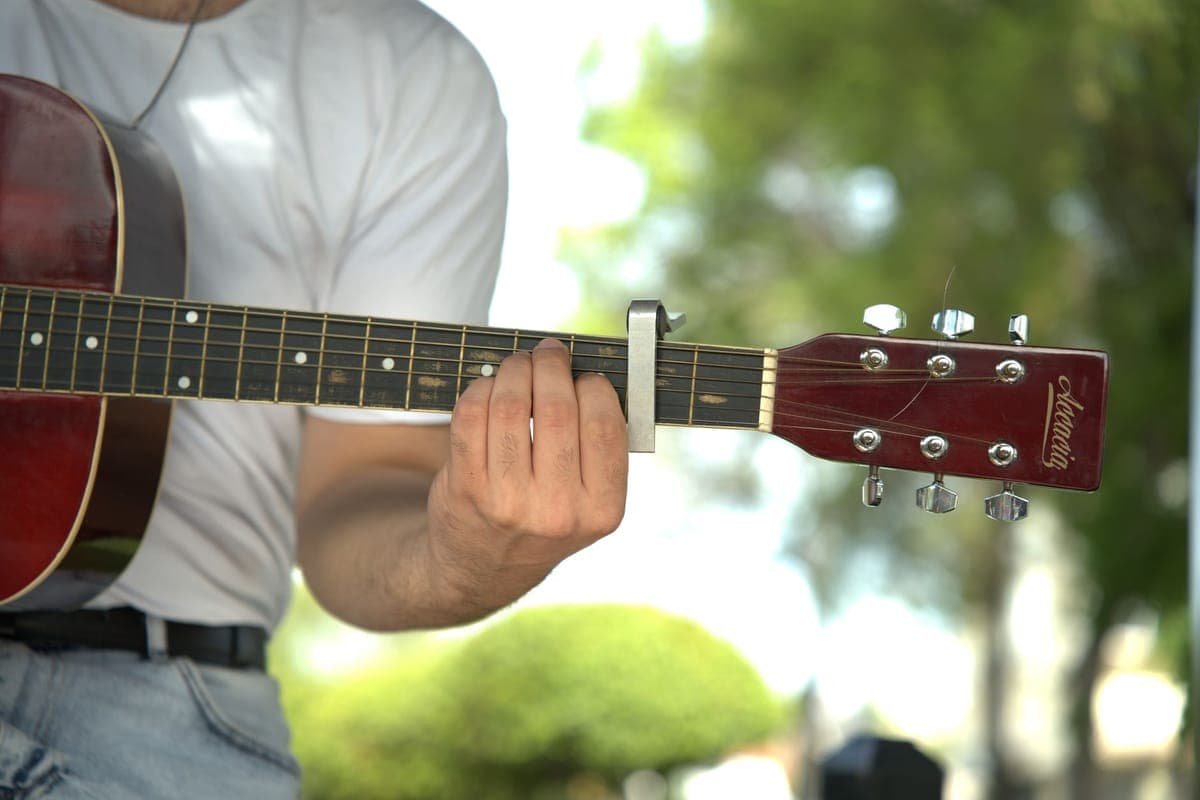
A capo clamped on the fretboard of an acoustic guitar

DisclosureSome links on this page are affiliate links. If you buy through one we may earn a commission at no extra cost to you. It never changes a ranking, and we accept no payment for placement. The full version.

The shortlist

Ranked, with the published numbers

Ranked on the specifications each maker actually publishes, on what they refuse to publish, and on what the thing costs today. Tap any row for the full write-up, including who should skip it.

#ProductBest forScorePrice
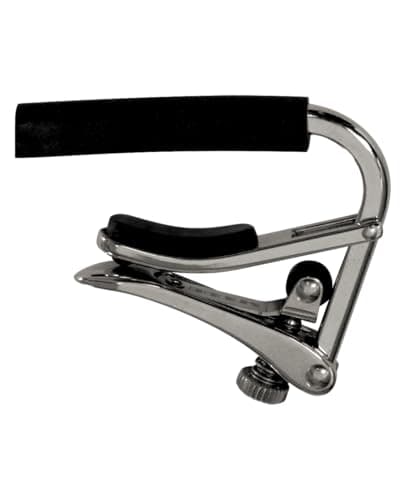
01A capo clamped across the second fret — a stand-in for the Shubb C1 Standard Capo, steel string, not a photograph of this modelShubbShubb C1 Standard Capo, steel stringBest tuning stability9.2Check price on Amazon
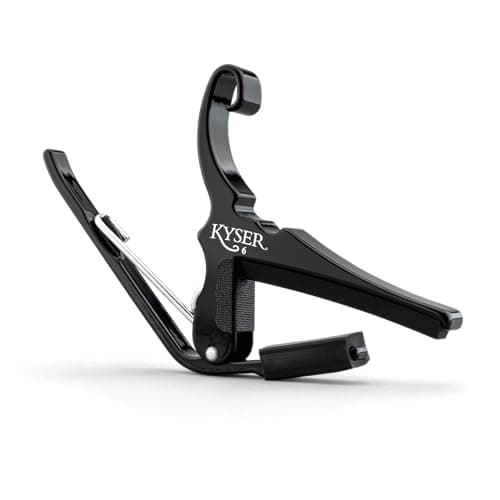
02A capo clamped across the second fret — a stand-in for the Kyser Quick-Change Acoustic Guitar Capo, not a photograph of this modelKyserKyser Quick-Change Acoustic Guitar CapoFastest to move8.7Check price on Amazon
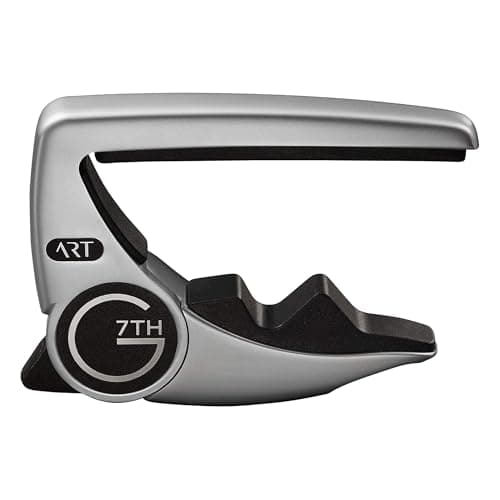
03A capo clamped across the second fret — a stand-in for the G7th Performance 3 capo with ART, steel string, not a photograph of this modelG7thG7th Performance 3 capo with ART, steel stringBest engineering9.1Check price on Amazon
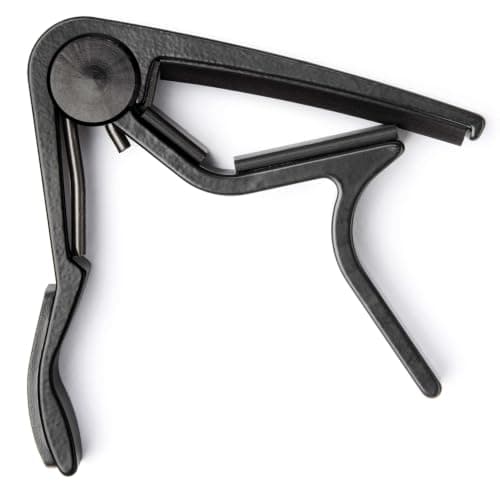
04A capo clamped across the second fret — a stand-in for the Dunlop Trigger Capo, acoustic, not a photograph of this modelDunlopDunlop Trigger Capo, acousticCheapest one-handed8.4Check price on Amazon

Scores are ours and editorial. They are never published as review or rating markup, because we have not played these instruments — here is how we pick.

The complaint you hear about capos is that they put the guitar out of tune. That is real, and it is mechanical rather than a defect: pressing a string down stretches it, and a capo that presses harder than necessary — or that drags the strings sideways as it closes — sharpens them.

Every difference that matters between capos comes back to that.

Three mechanisms

Fixed-tension spring — Kyser, Dunlop Trigger

A strong spring squeezes the neck. Squeeze the handle, slide it on, release. One-handed, instant, and it parks on the headstock between songs.

The spring applies the same force regardless of your neck thickness or string gauge, so on some guitars it applies more than is needed and the strings go sharp. There is no adjustment. That is the design.

Kyser publishes aircraft-grade aluminum construction and that the capos are made in the United States. Neither Kyser nor Dunlop publishes a weight or a clamping force.

Adjustable screw — Shubb

A threaded barrel sets how far the over-center lever closes. You set it once for your guitar; the lever then locks at exactly that pressure every time.

Shubb publishes solid brass construction, a custom-engineered roller in the lever mechanism, and a rubber pad designed to work like a fingertip — the point being that the closing action presses straight down rather than pulling the string off center, which is precisely the mechanism that causes drift in spring capos.

Slower to fit and to move. Much better at leaving your tuning alone.

Radius-following — G7th Performance 3

Squeeze to attach, squeeze to release, with the tension set by your hand. The string pad uses what G7th calls Adaptive Radius Technology: it mechanically adapts to the curvature over your strings and fretboard, aiming for even pressure across all six strings at the minimum tension that works.

G7th publishes non-reactive silicone pads at every touchpoint, replaceable ART pads, and a free lifetime warranty with registration. No weight is published.

Mechanism against outcome
SpringScrewART
Set pressure yourselfNoYes, onceYes, every time
One-handedYesNoYes, with practice
Parks on the headstockYesNoNo
Follows fretboard radiusFixed curveFixed curveAdapts
Published warrantyNot statedNot statedLifetime, registered
Published weightNoNoNo

Curvature: the variable nobody mentions

A fretboard is not flat. It curves across its width, and the radius differs between instruments — a classical guitar is essentially flat, a vintage-style electric strongly curved, a modern acoustic somewhere between.

A capo bar with the wrong curvature presses hardest on the middle strings and least on the outer ones, which produces buzzing at the edges and sharpening in the middle. It is why a classical capo and a steel-string capo are different products, and it is exactly the problem G7th's adaptive pad is built to solve.

Straight down

The direction a capo should press

A capo that drags the strings sideways as it closes is a capo that pulls the guitar sharp. That is the whole tuning argument in one sentence.

Which to buy

If tuning stability matters most: the Shubb. Set the tension once for your guitar and it does not disturb the tuning.

If speed matters most: the Kyser. One hand, instant, parks on the headstock, and if your guitar does not go sharp under it there is no problem to solve.

If you want one capo forever: the G7th, with the caveat that it costs several times the alternatives and a first capo does not need to.

Placement and pressure matter as much as the capo: how to use a capo covers both.

What we did not do

We have not played any of this gear. Every guide in this category says it tested twenty tuners; we would rather say plainly that we tested none. What we did instead is on this page in full: published specifications with their sources, the makers' own manuals read rather than paraphrased, and a note wherever a company publishes nothing at all.
The write-ups

Each one in full, including who should skip it

01Best tuning stability
9.2/10
A capo clamped across the second fret — a stand-in for the Shubb C1 Standard Capo, steel string, not a photograph of this model

Stock photo of the product type, not this model. We publish no product photography we cannot source.

Shubb

Shubb C1 Standard Capo, steel string

Not retuning every time you move the capo

The capo that does not pull the guitar sharp, because the closing action presses straight down rather than dragging the strings sideways. Set the tension once and it stays set.

Good
  • Adjustable tension — you set it for your guitar, once
  • Presses down rather than sideways, so tuning holds
  • Brass body that outlives the guitar
Less good
  • Slower to move between frets than a trigger capo
  • No published weight or dimensions
  • The tension screw needs setting properly or it does nothing
Skip this if

You need to move the capo mid-song. A trigger capo is slower to set but faster to move.

Published specification

BodyMachined solid brass
MechanismOver-center locking lever with roller
PadProprietary rubber, fingertip-resilient
WeightNot published
Live priceCheck price
Check price on Amazon

#ad We hold no verified live price for this one, so we show none. How this site is funded.

Our scoring

Ease for a beginner8.4
Build9.6
Published-spec clarity7.6
Value at this price8.8
02Fastest to move
8.7/10
A capo clamped across the second fret — a stand-in for the Kyser Quick-Change Acoustic Guitar Capo, not a photograph of this model

Stock photo of the product type, not this model. We publish no product photography we cannot source.

Kyser

Kyser Quick-Change Acoustic Guitar Capo

Moving the capo fast, one-handed

One-handed, instant, and it parks on the headstock between songs. The trade is a fixed spring tension you cannot adjust, which pulls some guitars slightly sharp.

Good
  • Genuinely one-handed, genuinely instant
  • Parks on the headstock when not in use
  • Made in the USA and effectively indestructible
Less good
  • Fixed spring tension pulls some guitars sharp
  • The clamp can mark a soft finish over time
  • Bulky on the headstock while parked
Skip this if

Your guitar goes sharp under it. Fixed spring pressure is not adjustable — that is the whole design.

Published specification

BodyAircraft-grade aluminum
MechanismFixed-tension spring, one-handed
Made inUnited States
WeightNot published
Live priceCheck price
Check price on Amazon

#ad We hold no verified live price for this one, so we show none. How this site is funded.

Our scoring

Ease for a beginner9.6
Build9.0
Published-spec clarity6.8
Value at this price9.2
03Best engineering
9.1/10
A capo clamped across the second fret — a stand-in for the G7th Performance 3 capo with ART, steel string, not a photograph of this model

Stock photo of the product type, not this model. We publish no product photography we cannot source.

G7th

G7th Performance 3 capo with ART, steel string

One capo you never think about again

Squeeze to attach, squeeze to release, and the pad mechanically follows the curve of your fretboard. It is the one capo whose maker explains, in engineering terms, why it should stay in tune.

Good
  • The pad follows the fretboard radius mechanically
  • You control the pressure, so you can use the minimum that works
  • Lifetime warranty, and the pads are replaceable
Less good
  • By far the most expensive capo here
  • Does not park on the headstock
  • One-handed use takes practice, by G7th's own description
Skip this if

You are buying your first capo this week. This costs several times a Kyser and the Kyser works.

Published specification

MechanismSqueeze to attach and release, tension controlled by hand
PadAdaptive Radius Technology, replaceable
Contact pointsNon-reactive silicone pads
WarrantyFree lifetime warranty (registration required)
WeightNot published
Live priceCheck price
Check price on Amazon

#ad We hold no verified live price for this one, so we show none. How this site is funded.

Our scoring

Ease for a beginner8.0
Build9.6
Published-spec clarity8.8
Value at this price7.4
04Cheapest one-handed
8.4/10
A capo clamped across the second fret — a stand-in for the Dunlop Trigger Capo, acoustic, not a photograph of this model

Stock photo of the product type, not this model. We publish no product photography we cannot source.

Dunlop

Dunlop Trigger Capo, acoustic

A cheap one-handed capo that is not a Kyser

The other one-handed spring capo, with a slightly softer pad than the Kyser and the same fixed-tension trade-off. Which of the two you prefer is mostly about the shape in your hand.

Good
  • Instant one-handed use
  • Softer neck padding than some spring capos
  • Cheap enough to keep one in every bag
Less good
  • Fixed tension, same sharpening risk as any spring capo
  • Dunlop publishes almost nothing about it
  • Spring weakens over years of use
Skip this if

Same as the Kyser — if your guitar goes sharp under a spring capo, buy the Shubb.

Published specification

MechanismFixed-tension spring, one-handed
PadPadded to protect the neck finish
WeightNot published
Live priceCheck price
Check price on Amazon

#ad We hold no verified live price for this one, so we show none. How this site is funded.

Our scoring

Ease for a beginner9.4
Build8.4
Published-spec clarity5.6
Value at this price9.2
Questions

Frequently asked

Why does my capo make my guitar go sharp?
Because it is pressing harder than necessary, pulling the strings sideways, or sitting too far behind the fret. A fixed-tension spring capo applies the same force to every neck, so on some guitars it applies too much. An adjustable capo lets you set the minimum that works.
Can I use an electric guitar capo on an acoustic?
Usually yes for spring capos, though the bar curvature is matched to a fretboard radius and a mismatch causes buzzing at the edges or sharpening in the middle. Classical guitars need a classical capo because the board is essentially flat.
Is an expensive capo worth it?
If a cheap capo puts your guitar out of tune on every use, yes. If it does not, the expensive one is buying convenience and build quality rather than solving a problem you have.
Where should the capo go on the fret?
Directly behind the fret, not on top of it and not halfway between two. That is where your finger goes, for the same reason: the fret does the work and the capo only needs enough pressure to hold the string against it.
Sources

Where these numbers came from

Every specification on this page came from one of these pages. Where a row reads "not published", it means we checked the page listed and the figure was not there.